Monday, April 11, 2011

It isn’t tuffa to Cappadocia

Selime Caravanserai_DSC4430_1
Selime Caravanserai
There are fairy chimneys, hidden churches, underground cities, caravanserais along the silk route, a few quicscent volcanoes, tuffa valleys galore, a river and enough walks to keep you quite happy.


Fairy Chimney Pano
Fairy Chimneys
Rose Valley
Rose Valley

Pigeon valley_1
One end of Pigeon valley

Hassan_DSC4461
Hassan looms over Pigeon valley. Hassan is one of the three dormant volcanoes that spewed out the ash that makes the characteristic tufa landscape of Cappadocia.


Goreme
Goreme town

Wednesday, April 06, 2011

Deep and inscrutable singular name

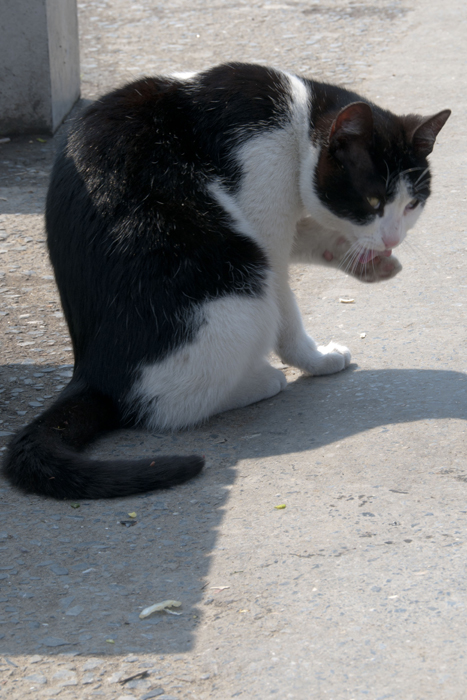
The cats of Old Istanbul are the most practical of all cats. And while you may name them as you please, you will never know their deep inscrutable singular name.

Even the Hagia Sophia's got its own Moggie


Saturday, February 19, 2011

Word beasts 8: Amphibian declines

detail3
Detail 1
I’ve written about this before. But I’ll quote myself to provide context to the images.

“ The Golden toad, a beautiful Costa Rican amphibian, was in trouble according to herpetologist Martha Crump's observations in 1987. We saw the last Golden toad in 1989. In two short years they disappeared.


There were many many reports after that talking about amphibian declines. Large numbers of once common frogs were simply disappearing, entire populations simply wiped out. Rachel Carson's 'Silent Spring' was transposed onto silent streams. Bruce Wilcox noted that between 1996 and 1998 of the 1874 backboned animals added to the Red List of Threatened Species, 1646 (89%) were amphibians! The statistics compiled in AmphibiaWeb also sound quite grim and this is not a resolved crisis. The causes for this decline are perhaps as complex and multiple as they were for the deformities. A large part of the decline is now believed to be explained by an epidemic of fungus. A fungus that is helped along by global warming.”


Stare frog flat3 small
Complete image

The fungus that I spoke of  belonged to a group of fungi called the chytrids, Batrachochytrium dendrobatidis. Its been a cause of great concern to the amphibian community. There have been a few reports of treatments that may control it particularly one with topical Chloramphenicol, a common broad-spectrum antimicrobial, often present in simple topical OTC compounds.
While I think this is good, I wonder whether these are scalable solutions. One can hardly pour barrels of chloramphenicol into streams and ponds. You’re then left with dealing with capturing and treating animals individually which is well impractical when one thinks of the pandemic scale of the current problem. And even if deal with this pathogen, another might emerge. And we have little in place to control it.
We’re doing a lot to this planet that is new and the responsibility for what happens is ours, whether we think so or not, whether we want it or not. They’re watching what we do, they’re holdings us responsible.


detail2
Detail 2

Sunday, January 30, 2011

Plenty and poverty: Word beasts 7

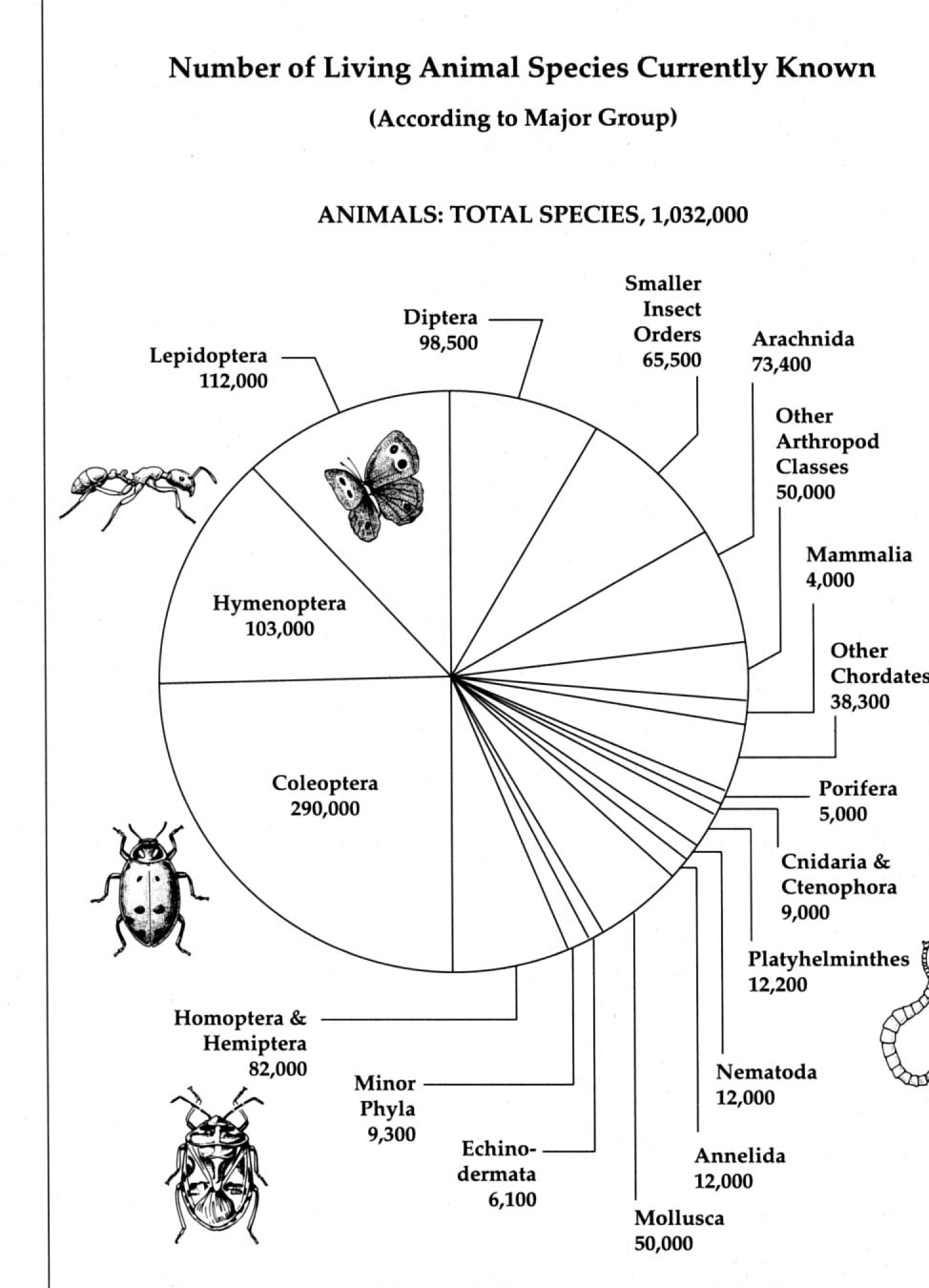
One thing about insects most people will not find surprising and will readily accept is that there are a lot of them. A lot. There’s a lot of species too, here is a good, if old, picture of how many more insects there are than other animals. The trouble is that people also think that there are far too many, and think that none of them are charismatic.
That’s a very incomplete view of insects, hopefully alleviated somewhat by such awesome documentaries as Life in the Undergrowth and champions of insect life as Dr. Mark Moffett, E. O. Wilson, etc. Insects need their champions pretty bad. And strangely enough they need academic champions as well.
The vast diversity of insects is not matched or reflected in the number of people working on them. Less so by the number of people working in insect taxonomy, the science and art of classifying insect species and studying their relationships. There are, off course, many reasons for this. Pure taxonomy in itself doesn’t attract as many researchers anymore; its poorly funded, publishing is difficult and if you are in the ‘developing’ world where most of the insects are, collections are often out of your reach in the elusive and expensive developed world. On top of this insects, simply aren’t attractive enough to people, even to biologists.
They aren’t as warm and cuddly as mammals, or as bright and vibrant as birds. (Unsurprisingly the insects that attract most people, as reflected by amateur naturalists, are the ‘pretty’ ones the butterflies.) And there are a lot of them, which makes life rather difficult. Their taxonomic features are often small and difficult to observe without a microscope, sometime without good dissections skills. It’s all just a bit hard.
These Dragons are meant to reflect just that aspect of insect biodiversity, its vastness and the fact that it is under-studied.
Dragons flat small copy
Thankfully, there is a silver-lining to this story. Thanks to one of my friends and colleagues in India, Indian dragonflies have escaped this ignominious fate. They are well documented and studied and there is even a lovely field guide. The extra special ice-cream on-a-top bonus is that its freely available online as part of the Lifescapes series!

Saturday, January 15, 2011

Word beasts 6: Frogs teaser

There is a finished piece, and an unfinished one. Somehow I thought you’d enjoy this little teaser from the unfinished piece more.
teaser copy

Monday, November 22, 2010

Myth and science: word beasts 5

I stumbled on the Norse idea of a fylgja while I was mucking about on wikipedia to write this story. The idea of a beast that accompanies each of us, a symbol of our fortune, as we make our way through our life appealed to me somehow. I’ve been known to give people animal names. I’ve had a kitten for mine as far back as I can remember.
Eventually I stumbled on Odin’s fylgja, the two ravens, Huginn and Muninn, thought and memory. He sends them every day across Midgard to bring him news of it. And each day he worries that they will not return.


For Hugin I fear lest he come not home,
But for Munin my care is more.

I was amused. Today we know that crows/corvids are indeed quite clever and capable of both thought and memory. They have earned their legendary titles. They can do an awful lot of clever stuff. They can figure out how to complete a task using a series of tools in ways that require them to reason. They cache and store food away, and then recover it, They modify their caching behaviour depending on whether or not another crow watches them showing they can infer about the state of knowledge of another creature, something human children learn only after four years or so.
Huginn and Muninn, thought and memory, then became my next word beast project. The ravens are made from the science that investigates their cognitive abilities, their ability to think thoughts and make memories.
Huginn and Muninn copy small

Monday, November 08, 2010

The law of return: word beasts 4

I had to pick the next beast in my bestiary. I checked up on my obsessions and tried to find the one that hadn’t been satisfied enough. I found one: mantises. I never really managed what I thought was a satisfactory photo of a mantis. I made one that is truly not bad, but even that one wasn’t perfect. And so a mantis it would be.
The words in the wordle were based on research on how they catch their prey. About their ability to judge depth using what is essentially parallax…So I made one and here is the first one.
mantis simple copy small
I’ve shown it to a lot of people and a lot of them love it. Yet I simply wasn’t happy with it. There were parts of it I liked, the arms and the spikes were a simple new innovation I made just for this word beast. The eyes were cleverly made with the same method.
Yet the whole thing didn’t really hang together for me. It didn’t really have the sense of 3D depth which the ecology picture did. There was nothing interesting going on like the interplay in the ecology image, or the courtship with the snakes, or even the simple Escher idea in the ant. That little extra bit of edge was missing. Which it really shouldn’t be in any image that needs to stand on its own rights. Especially with an animal quite as dynamic as a mantis. So I went back and started again.
It is really easier with a photograph, you go back and take the image again, if circumstances cooperate. With making something as complex as this, with a million different small moves that you make to achieve the whole; something which takes ages. It was a bit hard to fight the inertia to start again. But as you might know by now, I return. So I did and it was worth it.
Mantis_fight_posture2 small
For those of you that want to make images with words but haven’t the patience for something this work intensive, there might be hope yet. I stumbled on this website, tagxedo: it will allow you to make 2D word images. I haven’t played with it nearly enough. I’m sure you will! Have fun!
(PS as always, on redbubble should you want it)

Thursday, October 21, 2010

BBC Wildlife photographer of the year 2010


Bence Mate, has been winning for many years now, as a young photographer and as a youngish photographer and now as a full grown complete winner. I've seen nothing but the main winner so far. But I have to say I love it! Its the first time in many years that an invertebrate has been top of the pile! It's awesome!

Have a look here.

Saturday, October 09, 2010

The bestiary discovers my roots: word beasts 3

It was obvious to me after the snakes that there had to be more. A bestiary was on its way. It was a matter of choosing who it would contain and what words they would be made of. I thought about the beasties I like, that I hadn’t already made word beasts of. With my photography, I’d developed obsessions with certain animals, with dragonflies, mushrooms, fireflies, lorises, mongooses, and so on. I decided to pick one of my perhaps much too photographed subjects. Someone had recently said to me that ‘Oecophylla rock!’, and they certainly had been one of my obsessions, so Oecophylla it would be. The red weaver ant and I have other history as well, so it made sense.
So what would my ant be made of? I figured it should be made of words about ants, and I figured the best ones would be the words of the hundreds upon hundreds of scientists who have worked on these ants. As social insects they get some of the best scientific press out there and have been fascinating (and sometimes discomfiting) to everyone from Darwin onwards. There would be no dearth of words on ants. So I collected a whole series of abstracts from scientific papers on ants and plugged them into wordle to make me some word sheets to work with.
It all seemed very poetic when I thought about how we as scientists make a conceptual ant in our minds, in scientific literature; an ant that has existence in our traffic alone, outside the real world of the ant itself. And how my ant was an ant reconstituted from our conceptual ant, the ant of scientific communication. This was the first result based on one of my photographs.

ant_only copy

It was a bit bland, needed something to stand on and a background so I provided one that looked as natural as possible; like vegetation bokeh in the background of a photograph.

ant flat copy

Now, I could have stopped there, but it somehow felt not enough. It was beautiful, to my eyes anyway. Every little piece of that ant is built from the word sheets wordle made. Including the lovely elbowed antennae. The work to make these is long, but it gives you what must be a taxonomist’s pleasure in dwelling over every detail of their anatomy. Yet not enough.
But when I thought of Escher and his ants, and made him a homage, it was finally enough.

ant_mobius white copy

Wednesday, September 15, 2010

The bestiary grows: word beasts 2

Even after I finished the CES brochure, I still itched to make more word beasts. It seemed like they had potential (You can tell me if you think otherwise, I’ll really be happy to hear!). I wondered what I could do with them. I thought of one place I simply had to use them.
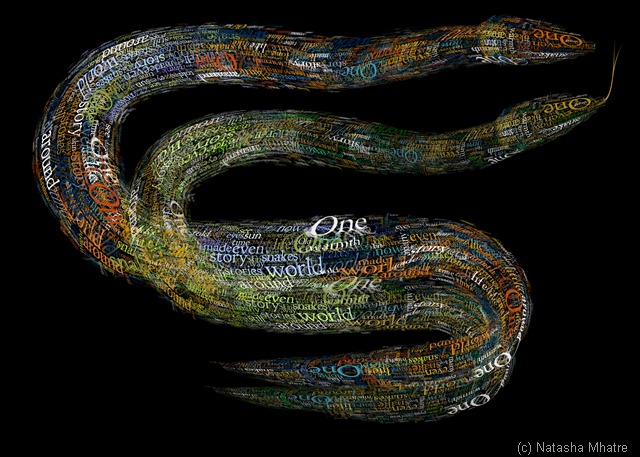
To tell you what that was about, I have to take a bit of an detour. Many years ago, when one of my little cousins was indeed little, in a creative fit I wrote a short story for him. About snakes. He was fascinated by my, shall we say, involvement with them. So I wrote a short story for him and promptly forgot it existed. It never reached him and probably never will since he’s grown up now and isn’t very fond of reading. The odd thing is, I don’t actually remember writing this story and I’m usually quite good at remembering my creative moments. Ask me about almost any of my photographs and I will remember the specific circumstances that surround it. Maybe, its just a sort of curious photographic memory about photographs…
Anyway, several years later, I found this story on my computer and reread it and liked it. It was okay, it didn’t make me want to puke. And I thought, hey, there’s the root of something here. The story was a sci-fi short and about snakes, specifically about the fact that they moult (This one). And I figured, maybe I could write a series, each in a different genre, each highlighting a different aspect of snake biology. As it stands there are four and a half. (I’m struggling with the half because I picked a particularly hard genre to write it in. Its interesting so far, and I love it, at least the process. Despite the fact that I actually hate writing, go figure.) All these and a few more will end up in a book of a sort. I have some ideas on how it all structures together and I’m excited about it.
This book, I figured, will need a cover. And that is where the word beasts came in. Beasts made of the words that make them up. The words of the stories that make snakes come alive (hopefully) in your head, make the snakes in my images. Here are those beasts, courting, hopefully to mate and produce more words and beasts.
Snake
PS: Also would anyone like prints? Know of a good print on demand site, one where I can submit an image and they mail you the prints? Particularly one that works for an Indian audience? I am on RedBubble. If enough people are interested I’ll put a few images up there.
Comment, tell me what you think!

Friday, September 10, 2010

Word beasts

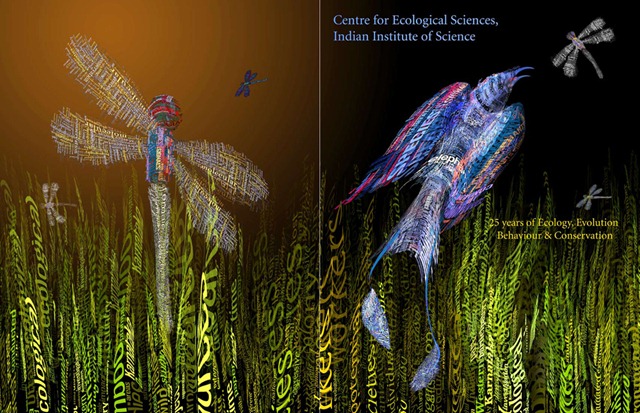
Where did it all begin? A year ago, now. It began with too many words and not enough images. It began when I agreed to make a brochure for CES for its silver jubilee celebrations. I had a lot of text, a lot and very few images. And somehow an appealing document had to be woven from this. There was the cover to be made. What do you put on the cover of a document that is to be made for a whole department? That represents what everyone does, that keeps everyone happy.
The department’s logo a long time ago was designed with a Racket tailed drongo in it. It’s rarely used, but there was an idea someone had suggested. Now I didn’t have an image of this bird. And really I am not going to swipe something of the net. But there were these images, they were hauntingly beautiful. Haunting in the niggling way like sand in your shoes. I wasn’t going to nick them, and I didn’t think we could organise to pay. So I set it aside.
Then I thought I would use the words somehow, the words to make the artwork. That was the first good idea I think. When I was younger, I used to think that somehow looking at other art would influence me, and make my work derivative. I’ve given that up now, I’m of the Wharton school now. So I looked up what others had been doing. A lot of it then was stuff like this. So well, I thought, I sure as hell am not going to do anything that requires me to do paste each word in to a template. So I thought, maybe I could reshape a sheet of words.
That’s where it got interesting. I remembered tag clouds. And I dug around and found Wordle. I took the text from the brochure and plugged it in. Made lots of different shaped, coloured and fonted word clouds. Now what? Well, import them into Photoshop. Start to reshape them. How, well, see what you can use. You don’t want to cut words out, that’s clumsy. What you want is to shape them. And then I started a few simple techniques which gave me the results I wanted. Which will be obvious if you look at these images. This which may be familiar to IIScians and ended up on the poster was among the first products that satisfied me:
PosterCes
And there it was, the start of the word beasts. CES got its brochure and I love what I did for them. Here is what CES got, the front on the right, back on the left, think of it as wrapping around the book. I quite like it. It has everyone’s work right up there in front, it depicts the work in a sort of way as well, the ecology of it all. So I think, that went well finally and the drongo did find its way back, so, no more haunting.
CES_All_pages-cover wrap
But that was not and will not be the last of the word beasts. There are several more in the works, (slow and painstaking work unfortunately). Coming soon…

Friday, September 03, 2010

Lake district

We had good light for one day, so most of the pictures are from that one day. The rest were dry but overcast. Ah well, we concentrated on walking. A lot. C carried my camera a lot, this is getting to be a bad habit.


And the best company

Sunday, August 01, 2010

Lyme Regis


The lab took a day off to visit Lyme Regis and Charmouth in Dorset. Let's just say I will be going back. And its only partly because I miss the sea.

Fossil hunting
Erica gets the fossil of the day award

Ammonite pavement

Wednesday, April 07, 2010

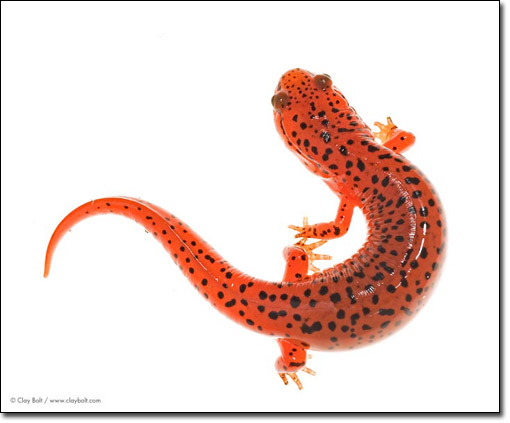
Meet Your Neighbours: Niall Benvie and Clay Bolt's call for a worldwide documentation of species

Here is something interesting for you, especially if you are a local wildlife photographer like I was. I quote directly from Benvie's article on the Nature photographers website:

"Common neighbourhood plants and animals are usually overlooked and undervalued, yet they are most people’s first, sometimes only, point of contact with wild nature. They matter for that reason if no other. They can make us feel better, let us see ourselves in perspective.

We want people to sit up and take notice of these wild neighbours by presenting them as celebrities: photographed in the white field studio, in exquisite detail under beautiful lighting. And we need photographers around the world to partner with us in this effort."


Here's a link to the website: Go there and have a look at and then join in the effort!