Showing posts with label word beasts. Show all posts

Tuesday, August 27, 2013

Polar bears: work in progress

You can probably guess what research this wordle covers...

Sunday, August 11, 2013

Electric fields are everywhere: Dominic Clarke

We have a guest blogger today. My labmate Dominic Clarke: physicist, biologist, musician, general genius at building stuff and resident bee-man! This is a wordle from a paper Dom was lead author on which showed that bees can perceive electric fields generated by their pollinators. More from Dom himself.


Electric field perception in bumblebees:

We know that electric fields are used extensively by sharks and rays and other marine animals as methods of detecting and even incapacitating their prey1. The reason this is prevalent in the ocean is that water has a high relative permittivity (a measure of how easily an electric field can be set up in a material). Water has about 80 times higher permittivity than air so the tiny electric potentials created within animals are able to perturb the background electric field over much greater distances in water than the same potentials can in air.

So it may seem that terrestrial animals would not be well served by the electric sensitivity of a shark or a ray. The much longer-range efficacy of other sensory modes available would seem to overwhelm any benefit conferred by an electrostatic sense. But what if those much shorter distances are important to your survival? Bumblebees around a flower-bed are constantly making decisions about which flowers to choose and which flowers to avoid. They, like us, use memory, instinct and knowledge gained from others in making their decisions. A flower of a particular type may have been very rewarding in the past and so warrants future visits. The reward might have simply been a bumper crop of nectar, but it can also be more subtle. The temperature of a flower can be considered a floral reward since less energy is lost when the bee lands and feeds, so less is required to start flying again2.Even the ease of handling and manipulating a flower is a factor in the decisions a bee makes. Easier flowers to handle can be visited more quickly so more flowers can be visited in a shorter period. In short, the worker bee seeks to maximise the efficiency of her foraging trips, returning home with as much food as possible for the least energy expenditure possible. The stakes are higher than simple energetics too. Each time a bee visits a flower, she risks being eaten by crab spiders and other predators3. All these decisions are made in very close proximity to the flowers, of which there could be thousands of individuals, across hundreds of different species in any given area.

Once all this information is processed and a preference for a particular flower is established, it then has to be remembered. This is where the myriad sensory signals produced by flowers come into play. The colour, shape, texture and smell of a flower all act together to produce a distinctive ‘brand’, so that bees can single out flowers of that species easily. The plants’ motives are very similar to those of product advertisers; they want customers to prefer their product, and just as importantly, to keep coming back to their product, if possible, to the exclusion of their competition. Brand recognition and brand loyalty is vital to the reproductive success of the plant, because a flower’s pollen must land on a conspecific or else, from the plant’s point of view, it is wasted.
Previous research has shown that flowers produce electric fields and that the forces involved may even assist the transfer of pollen between flowers and pollinators4. As sensory biologists, we wanted to know if bees could actually perceive the small electric fields around flowers, and if so, could use them to make foraging decisions. To this end, we gave the bees a choice between artificial flowers that were rewarded with sugar, and identical flowers that weren’t.  The only differences between the two kinds of flowers were the electric fields that they produced. We show that bees are able to reliably distinguish between flowers marked with a small electric field (of similar magnitude to natural flowers) and unmarked flowers. Another group of bees were trained to distinguish not just between the presence and absence of electric fields, but between two fields of similar magnitudes but different geometries, such as might be present on two flowers of different species, showing that the bees could learn some of the distinct features of a given electric field and as well as simply sense its presence or absence.

But what use is this information to bees? What information can a bee get from the electric field that it couldn’t already get from sight or smell? To answer this, we go back to the idea of flowers as advertisers. A television advert typically shows the company’s logo (an easily recognisable combination of colour, text and shape), repeats the name of the product in the voice-over and accompanies all this with a short, catchy piece of music. It’s often the same information given multiple times (the name of the product in the logo, jingle and in the VO) so why wouldn’t one of these methods alone be good enough? Because giving the same information across multiple sensory modes is more effective at getting the viewers’ attention, but more importantly, it is more easily remembered and more readily recalled when it is time for the customer to make a choice about which product to buy (to find out why this is the case, and for a nice primer on Signal Detection Theory, see http://www.cns.nyu.edu/~david/handouts/sdt/sdt.html). The bottom line is that extra information is not redundant, it helps to maximise the efficacy of the advertisement, which is of course in the interest of the advertiser.
Detail from main image
To show that electric fields, when presented as floral cues, actually confer this benefit to the bees, we performed one further experiment. We asked one group of bees to distinguish between flowers of one hue from those of a similar but slightly different hue. This is a purely visual task which the bees can perform fairly easily. We recorded the amount of visits each bee required to be able to find the rewarded flowers with 80% accuracy (if they were choosing at random, they would average 50% accuracy because half of the flowers are rewarded and half aren’t). A second group of bees were trained with exactly the same stimuli but this time, the group of flowers that had the first hue were presented with an electric field of one particular geometry, and the flowers of the second hue, with another. The bees that had both electric field and colour information to work with reached 80% accuracy significantly faster than the bees that were given hue alone. This shows that the electric field, when paired with another stimulus, actually improves the bees’ ability to learn and to remember which flower provided the best reward. This is beneficial to the bees of course, because being better able to identify a rewarding flower and distinguish it from the others means fewer wasted trips to unrewarding flowers. But it also benefits the plants because it helps their product ‘stand out from the crowd’, improving reproductive success.

This may not be the only benefit of having the ability to sense electric fields. Since bees are also electrically charged, when they alight on flowers, they create measurable changes in the floral electric field. If other bees can perceive these changes, they may be able to use the information to avoid recently visited flowers that are empty of nectar, again saving them precious energy reducing the number of risky floral visits they have to make. It is also in the interest of flowers to be honest in their advertising. Just like us, if bees are suckered in by a misleading advertisement, and not given the promised reward, they are less likely to try that product again in the future. It might therefore be in the interest of the flower to show the bees a kind of ‘no vacancies’ sign for the short time it takes them to produce a little more nectar. It is time-consuming and costly for a flower to radically alter its appearance every time a bee lands only to change it back again when it’s ready to accept pollinators. The bees’ electrical footprints may offer a fast and energy-efficient way for flowers to communicate their nectar status with their pollinators and avoid false-advertising.

The weather also plays an enormous role in the day to day activities of bees. The number of workers sent out of a hive to forage is strongly influenced by factors such as temperature, sunlight, humidity and rainfall.  The background electric field in the atmosphere, which on a fine day is typically around +100-150 V/m (yes, that means 150 volts between your head your feet when you stand outside), is highly variable5. Fluctuations are caused by charged clouds moving overhead can change the electric field at ground level by as much as 200%, with the field easily reaching +/- 1000-1500 V/m in storm conditions. This is well within the magnitudes of the fields we used in our experiments. Since clouds tend to precede precipitation and precipitation is something that bees wish to avoid, being able to tell what kind of clouds are overhead might give bees the advanced warning they would require to get inside before the storms break. A five minute warning may not be of much use to a meteorologist, but it may be all the time a bee needs to find shelter.
The discovery of the electric sense in bumblebees highlights the electric field as a potentially fruitful area of study in sensory biology, especially in small invertebrates. Electric fields may turn out to be more important or at least more interesting to sensory biologists than we had thought.
Dominic Clarke.

References:
1.       A.J. Kalmijn - J Exp Biol 1971 
2.       S. Rands & H. Whitney - PLoS ONE 2007
3.       T. Reader et al. - Behavioral Ecology 2006
4.       Y. Vaknin et al. – Plant Sys Evol 2000
5.       A.J. Bennett - Journal of Physics: Conference Series 2008 

Text copyright © Dominic Clarke.

Friday, May 04, 2012

Word beasts: tree crickets break the rules, sort of.


This time its my own work. We just published a paper that I think is important for a couple of reasons. I'll outline the main one here. I've not gone into this detail in any of the popular science articles I've interviewed for, simply because this is a subtle point. (And also because it got lost in trying to explain the work, I'm not practiced at this interviewing thing). But this is my blog, so I can tell you and take the long route, consider this your fair warning! This is not an explanation of the paper, but of why its interesting.

There are very few laws in biology. By laws I mean rules that hold far and wide across a huge phylogenetic range of organisms. Biology is about variation, making oneself distinct, occupying a new niche. So, in the complicated messy world of biology,  it's quite rare and hence, comforting to have a 'law'. Often when such laws exist, they are rooted in physics. For instance, the law that relates thermoregulation capacity to body mass. Since larger animals have a lower surface to volume ratio, they retain heat well and lose it poorly. And vice versa for small animals, loose heat easily and retain it with difficulty. As you can see, this law is very rooted in the physicality of the body. You may even say it is rooted at an even more fundamental level, in geometry itself.

The law that relates to our paper is quite similar. In animals that communicate using sound, the dominant frequency of the sound they produce is correlated to their body size. Neville Fletcher, who has written text-books in the field of acoustics and bioacoustics, calls it a rule that holds from insects to elephants. And he is right; it does, by and large. There are simple physical reasons for this behaviour. They relate mainly to the efficiency of sound production at frequencies appropriate to the organisms size and to the mechanisms of sound production. For instance, insects use resonators as an important element in their sound production mechanism. A large resonator, therefore, leads pretty much deterministically to a lower frequency.

Now, many bioacousticians take this a step further and suggest that size relates to frequency not just across species but also within species. This is not really a large logical step. The reasons why this relationship would hold are the same as for the across species relationship.

The next step that researchers in the field have argued for is somewhat more problematic. They assume (and also test, sometimes) that because this relationship exists, information about size exists and can be percieved in the sounds an animal makes. There is some tentative evidence and a strong belief that size is important to mate choice and choosy females prefer larger males who are somehow 'better' in evolutionary terms. Taking the step, however, it turns out is more complicated; there are a few assumptions that have to hold to make this 'information transfer' and consequent 'choice' possible.

The first assumption is about reciever psychology. There is a presumption that a reciever can make frequency discriminations that are as fine as the spectrum analysis techniques used to study the sounds in the first place. If the change in size associated change in frequency within a species is smaller than the frequency resolution of the listening party, the question of telling the size of a caller is moot.

The second assumption, which we are concerned with, relates to the next level of variation, the within individual variation. The first level of variation is across species, then within species and finally within individual variation. If within individual variation in frequency is higher than within species variation, then information about size is obliterated and no meaningful 'choice' is possible.

 Here's where the crickets come in. The way crickets sing is quite special. Not only do they use resonance to produce song, they also use the resonance to tightly control the song frequency using something called an escapement mechanism*. The idea runs: therefore, within individual variation will always be lower than within species variation and the information must exist in the song. And not just for crickets; this relation is often thought to hold for insects in general since many of them use resonance as a sound production mechanism.

Not so, say the tree crickets, whose frequency changes with ambient temperature. As a direct result of this property, an individual tree cricket's frequency variation is as large as that of the whole species and the train of logic crumbles because an assumption is not met. Remember the law has not been violated, not strictly, the range of frequencies each individual insect will produce will still depend on his size. But since he can call from anywhere within that range, you can't figure out his size from hearing him at any given time. The information that falls out of the 'law' is gone.

We found that these insects, tree crickets, use resonance for song production as well, and have the same singing mechanisms as other crickets. But these mechanisms fail to control song frequency. So we asked, well, how do they do it? What does it take to break this link down and remove 'information' about body size from song frequency? How hard a transition is this? It turns out, its really simple. All you have to do is sing with longer wings. No fancy non-linear mechanics, no stochasticity in the relation between body size and resonator size, no super temperature sensitive materials, nothing special. Just longer wings. Geometry trumps everything.

And that is why its an interesting result. It doesn't take a lot to break down a train of logic which everyone thought derived from a profound biological 'law'. It takes a relatively small change in geometry to undo a laws effect. That is how easy it is to tweak biological systems. And that ease is one of the sources of the huge diversity you see out there.

Paper: Mhatre, Montealegre-Z, Balakrishnan, Robert (2012) Changing resonator geometry to boost sound power decouples size and song frequency in a small insect. PNAS http://dx.doi.org/10.1073/pnas.1200192109 

*  Its the same mechanism that clocks use to keep time. There's a starter image to explain it on this page if you want to know more.

Sunday, March 04, 2012

Word beast bats: Or this one?


Gotta love how I think I can do my editing online!

Saturday, February 25, 2012

Word beasts: an arms race


About 65 million years ago, is the accepted estimate for when bat echolocation first appeared on the scene. This was the beginning of a long and protracted arms race between the bat hunters, and the hunted, the insects. For a bat, the nocturnal insects of choice are the moths. Plentiful, and with large fat bodies which make them quite attractive. It helps that they are also easy to find; their wings are great reflectors of the ultrasonic frequencies that bats use to find them, flagging them up against the clutter in a bats sonic world.

Way back in evolutionary time, the moths responded to their new predators. In the beginning simply, by evading the bat attacks with crazy evasive diving maneuvers. Then, with more sophisticated methods; ears that were tuned with great precision and sensitivity to the bats very high pitched cries. The very echolocation cries that the bats used to find moths now immediately alerted their prospective prey to their presence.The moths could now dive and circle away well in advance of the swooping bat.

In response, the bats called more softly, they started whispering, and changing the pitch signatures of their calls. They tried their very best to make echolocation calls that the moths could not easily detect or discriminate the direction of. The moths kept up their part of the race too, the pressure not to become supper being quite high. They changed the shape of their wings so their main body would not be attacked and just the edges of their wings would be taken. Some even started making sounds of their own! Sounds that either jammed bat sonar or made them sound unappetising, the acoustic equivalent of very red berries. And in return, its seems that some bats have responded by finding prey by the sounds of the prey alone and silencing their echolocation calls. And so, on it goes. 

And on goes the research, starting with the work of Brock Fenton, way back in the late 70's, right up to today with many different groups still working on different aspects of the same behaviour and ecology! Including the work of fellow post-doc Holger Goerlitz, who helped me do this beast. If you want to know still more about this cool co-evolutionary arms race, you could do worse than read this lovely review (if you can get behind the paywall).

Copyright © Natasha Mhatre If you're reading this without attribution to me anywhere other than at my blog Talking Pictures, its probably being plagiarized.

Sunday, February 19, 2012

Word beasts: Bat and moth coevolution teaser

Tuesday, November 15, 2011

Word beasts: a parliament of two

You might remember a moment when in you were choosing what you were going to do with your life in which it all came together or you may not. This may be the mythology of me that I've built myself but one of my markers was reading about the Jeffress' model in Eric Kandel's book, 'Principles of Neuroscience'. I remember thinking, that's cool, if I could do stuff like that I would love it. Somewhere there is the beginning of my love affair with modelling biological systems.

The Jeffress' model is a model of a neural circuit built to detect the direction that a sound is coming from. It's a beautiful and elegant model that has been found to be used by the brains of many different species, including humans. One of the most elegant bodies of work in neuro-ethology showed that this model holds for barn owls and explore many of the nuances of the behaviour.

The work of many people mainly Knudsen and Konishi and Catherine Carr showed that not only is the Jeffress model used to compute the azimuth but it also is used at several frequencies after a sound has been decomposed into different frequency components. This solves the problem of degenerate solutions that you could get from a pure tone sound. Apart from this, in perhaps one of the most 'awww' experiments ever, they showed that the auditory map is tuned to the visual map and this can be tuned and retuned but only when owls are young. It's beautiful work and this piece is in based on it. Imagine trying to sneak up on these owls as they were hunting and imagine that they found you instantly as you rustled through the teasels. They would find you with an accuracy of a single degree!

Edit 1

Tuesday, November 01, 2011

Word beasts: teaser

Care to guess?

Saturday, October 01, 2011

Word beasts: Language baby

language baby small

The study of human language is surprisingly contentious. There are two camps, the words and rules camp and the connectionist camp. (There are perhaps more, but as I understand it, these are the two serious contenders.) The words and rules camp begins with Noam Chomsky's work on language in which he proposes the idea of generative grammar. There are many nuances and subtleties to it, that I don't even begin to understand. But I'll try to explain it as best I understand and remember it.

The rough words and rules idea (sensu Pinker which is an extension of Chomskian theory) is that the a baby's brain is not a blank slate (tabula rasa) when it comes to the syntax of language. What children are programmed to do as the learn language, is to treat what they hear in structured ways. During the acquisition of language stage they both abstract rules from what they hear and learn the meaning of the words. There are two types of memory that get engaged in this: procdeural memory, the procedure of transforming words to be used in a sentence and lexical memory, which learns the semantic meaning of the words.

The other ideas are called connectionist or emergentist or structural. (I'm less familiar with them, so forgive me if I give them a bit of the short shrift.) They suggest that children's brains simply make statistical models of language to allow them to learn it. They don't abstract rules but learn the statistical regularrities in language. These approaches are often accompanied by neural network models which they then train with a lot of text and see what language they are capable of producing. I personally find them a bit unsatisfying, but they keep the debates over language fresh and engaging.

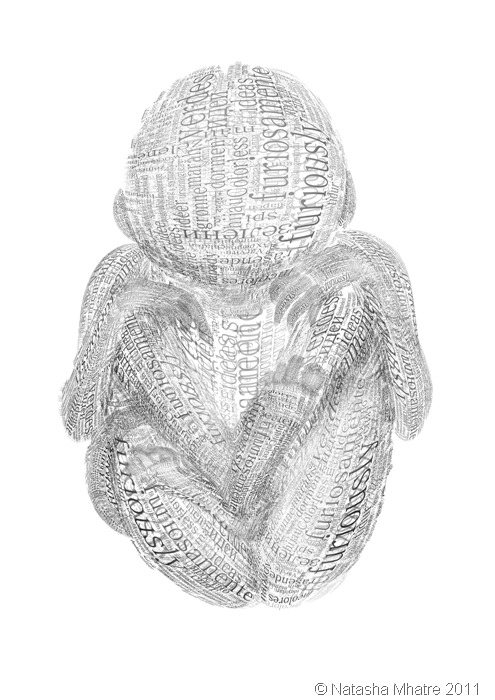
Over the years much arguement and fighting has ensued. In one of his moments, when Chomsky was ridiculing the probabilistic model of language, he coined the phrase, 'Colourless green ideas sleep furiously'. Its a phrase that could come out a statistical or purely structural model, its syntax is perfect and yet it means nothing.

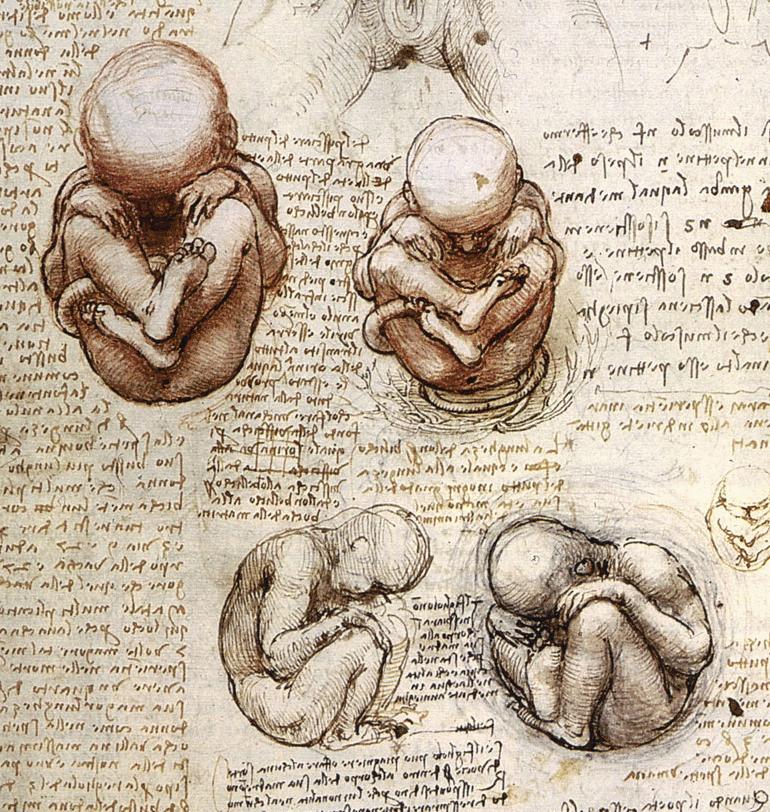
The language baby word beast (and we are beasts even if we would like to seperate ourselves, often on the basis of language itself) is made of that phrase in as many languages are the wordle site can encode. The baby is based on one of my favourite drawings, a fetus seen from a truly unusual angle by a master of many things, not least art and science. The baby is an oblique look at all the arguement that is dormant within our capacity for language.

Hat tip, to Daniel Robert who formed the nucleus of this word beast idea.


Wednesday, June 22, 2011

Word beasts 9: The secrets of a Gecko

I could tell you about the gecko's foot and its remarkable self cleaning adhesive qualities. Or I could let Robert Full, who is a lot better at it, do it. Here is where you go to find out about the remarkable locomotory capabilities evolution has provided animals.

Sunday, May 29, 2011

Word beasts: reworking the amphibians

I wasn't too happy with this one from this post. So I reworked it. I think its better now. I've been asked to stop obsessing over it and to stop now please. So, I will.


PS: If there's beasts and work you would like to see worded, let me know about it. And if I find the work it exciting I'll do one! I tend to like research stories that are sorted rounded off and mature for the word beasts, not ones with just a few papers behind them. Just gives me more material to work with.

OR

Is this better? Vote, please, no 1 or no 2.


And here is what will be the final update: Its done now. Why, you ask? Because it holds together now. Its a tone painting. I've learnt to never start an unplanned image because of this image though. It was a nightmare trying to make it come together and work.


Saturday, February 19, 2011

Word beasts 8: Amphibian declines

detail3
Detail 1
I’ve written about this before. But I’ll quote myself to provide context to the images.

“ The Golden toad, a beautiful Costa Rican amphibian, was in trouble according to herpetologist Martha Crump's observations in 1987. We saw the last Golden toad in 1989. In two short years they disappeared.


There were many many reports after that talking about amphibian declines. Large numbers of once common frogs were simply disappearing, entire populations simply wiped out. Rachel Carson's 'Silent Spring' was transposed onto silent streams. Bruce Wilcox noted that between 1996 and 1998 of the 1874 backboned animals added to the Red List of Threatened Species, 1646 (89%) were amphibians! The statistics compiled in AmphibiaWeb also sound quite grim and this is not a resolved crisis. The causes for this decline are perhaps as complex and multiple as they were for the deformities. A large part of the decline is now believed to be explained by an epidemic of fungus. A fungus that is helped along by global warming.”


Stare frog flat3 small
Complete image

The fungus that I spoke of  belonged to a group of fungi called the chytrids, Batrachochytrium dendrobatidis. Its been a cause of great concern to the amphibian community. There have been a few reports of treatments that may control it particularly one with topical Chloramphenicol, a common broad-spectrum antimicrobial, often present in simple topical OTC compounds.
While I think this is good, I wonder whether these are scalable solutions. One can hardly pour barrels of chloramphenicol into streams and ponds. You’re then left with dealing with capturing and treating animals individually which is well impractical when one thinks of the pandemic scale of the current problem. And even if deal with this pathogen, another might emerge. And we have little in place to control it.
We’re doing a lot to this planet that is new and the responsibility for what happens is ours, whether we think so or not, whether we want it or not. They’re watching what we do, they’re holdings us responsible.


detail2
Detail 2

Sunday, January 30, 2011

Plenty and poverty: Word beasts 7

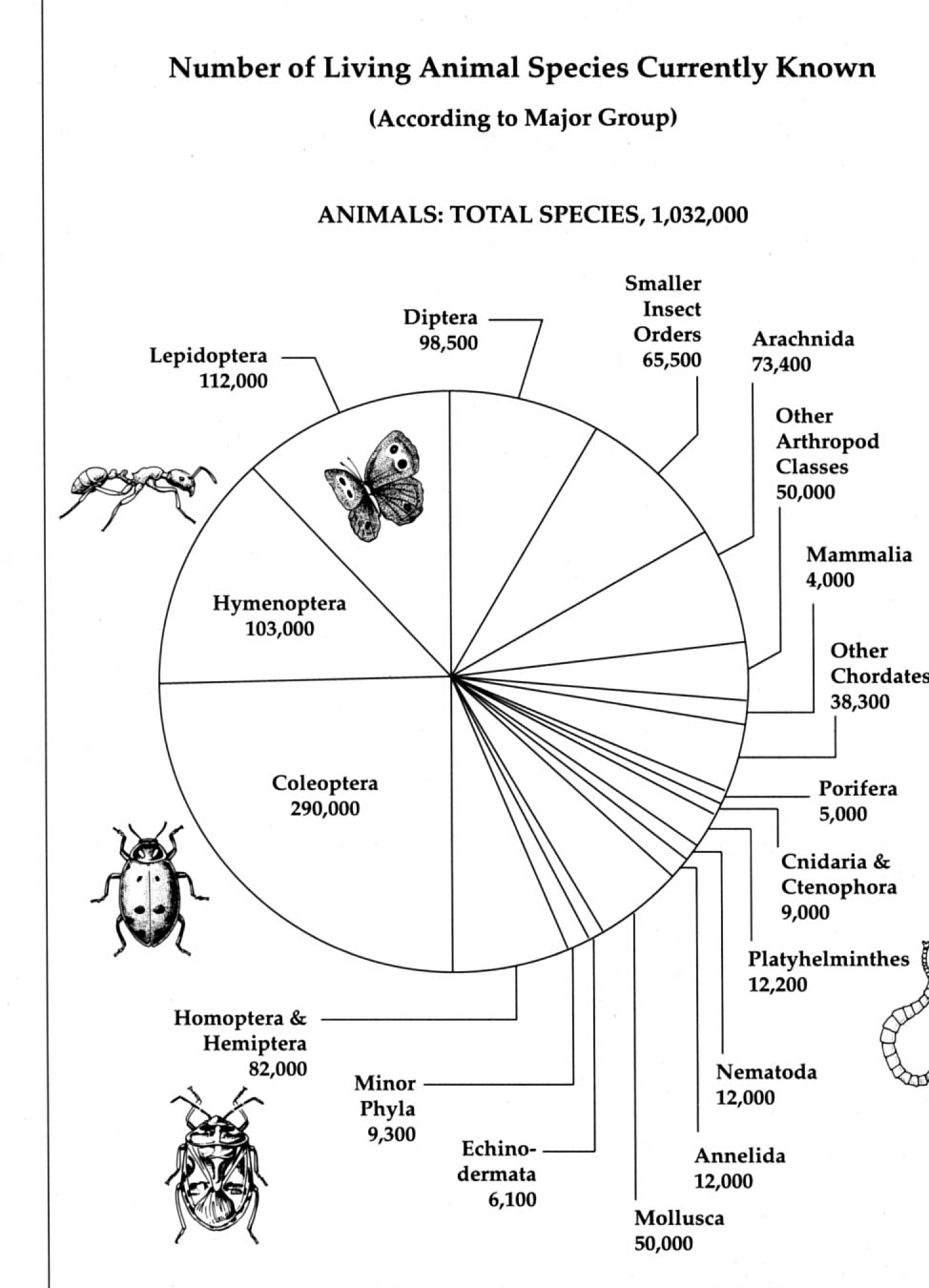
One thing about insects most people will not find surprising and will readily accept is that there are a lot of them. A lot. There’s a lot of species too, here is a good, if old, picture of how many more insects there are than other animals. The trouble is that people also think that there are far too many, and think that none of them are charismatic.
That’s a very incomplete view of insects, hopefully alleviated somewhat by such awesome documentaries as Life in the Undergrowth and champions of insect life as Dr. Mark Moffett, E. O. Wilson, etc. Insects need their champions pretty bad. And strangely enough they need academic champions as well.
The vast diversity of insects is not matched or reflected in the number of people working on them. Less so by the number of people working in insect taxonomy, the science and art of classifying insect species and studying their relationships. There are, off course, many reasons for this. Pure taxonomy in itself doesn’t attract as many researchers anymore; its poorly funded, publishing is difficult and if you are in the ‘developing’ world where most of the insects are, collections are often out of your reach in the elusive and expensive developed world. On top of this insects, simply aren’t attractive enough to people, even to biologists.
They aren’t as warm and cuddly as mammals, or as bright and vibrant as birds. (Unsurprisingly the insects that attract most people, as reflected by amateur naturalists, are the ‘pretty’ ones the butterflies.) And there are a lot of them, which makes life rather difficult. Their taxonomic features are often small and difficult to observe without a microscope, sometime without good dissections skills. It’s all just a bit hard.
These Dragons are meant to reflect just that aspect of insect biodiversity, its vastness and the fact that it is under-studied.
Dragons flat small copy
Thankfully, there is a silver-lining to this story. Thanks to one of my friends and colleagues in India, Indian dragonflies have escaped this ignominious fate. They are well documented and studied and there is even a lovely field guide. The extra special ice-cream on-a-top bonus is that its freely available online as part of the Lifescapes series!

Saturday, January 15, 2011

Word beasts 6: Frogs teaser

There is a finished piece, and an unfinished one. Somehow I thought you’d enjoy this little teaser from the unfinished piece more.
teaser copy

Monday, November 22, 2010

Myth and science: word beasts 5

I stumbled on the Norse idea of a fylgja while I was mucking about on wikipedia to write this story. The idea of a beast that accompanies each of us, a symbol of our fortune, as we make our way through our life appealed to me somehow. I’ve been known to give people animal names. I’ve had a kitten for mine as far back as I can remember.
Eventually I stumbled on Odin’s fylgja, the two ravens, Huginn and Muninn, thought and memory. He sends them every day across Midgard to bring him news of it. And each day he worries that they will not return.


For Hugin I fear lest he come not home,
But for Munin my care is more.
I was amused. Today we know that crows/corvids are indeed quite clever and capable of both thought and memory. They have earned their legendary titles. They can do an awful lot of clever stuff. They can figure out how to complete a task using a series of tools in ways that require them to reason. They cache and store food away, and then recover it, They modify their caching behaviour depending on whether or not another crow watches them showing they can infer about the state of knowledge of another creature, something human children learn only after four years or so.
Huginn and Muninn, thought and memory, then became my next word beast project. The ravens are made from the science that investigates their cognitive abilities, their ability to think thoughts and make memories.
Huginn and Muninn copy small

Monday, November 08, 2010

The law of return: word beasts 4

I had to pick the next beast in my bestiary. I checked up on my obsessions and tried to find the one that hadn’t been satisfied enough. I found one: mantises. I never really managed what I thought was a satisfactory photo of a mantis. I made one that is truly not bad, but even that one wasn’t perfect. And so a mantis it would be.
The words in the wordle were based on research on how they catch their prey. About their ability to judge depth using what is essentially parallax…So I made one and here is the first one.
mantis simple copy small
I’ve shown it to a lot of people and a lot of them love it. Yet I simply wasn’t happy with it. There were parts of it I liked, the arms and the spikes were a simple new innovation I made just for this word beast. The eyes were cleverly made with the same method.
Yet the whole thing didn’t really hang together for me. It didn’t really have the sense of 3D depth which the ecology picture did. There was nothing interesting going on like the interplay in the ecology image, or the courtship with the snakes, or even the simple Escher idea in the ant. That little extra bit of edge was missing. Which it really shouldn’t be in any image that needs to stand on its own rights. Especially with an animal quite as dynamic as a mantis. So I went back and started again.
It is really easier with a photograph, you go back and take the image again, if circumstances cooperate. With making something as complex as this, with a million different small moves that you make to achieve the whole; something which takes ages. It was a bit hard to fight the inertia to start again. But as you might know by now, I return. So I did and it was worth it.
Mantis_fight_posture2 small
For those of you that want to make images with words but haven’t the patience for something this work intensive, there might be hope yet. I stumbled on this website, tagxedo: it will allow you to make 2D word images. I haven’t played with it nearly enough. I’m sure you will! Have fun!
(PS as always, on redbubble should you want it)

Saturday, October 09, 2010

The bestiary discovers my roots: word beasts 3

It was obvious to me after the snakes that there had to be more. A bestiary was on its way. It was a matter of choosing who it would contain and what words they would be made of. I thought about the beasties I like, that I hadn’t already made word beasts of. With my photography, I’d developed obsessions with certain animals, with dragonflies, mushrooms, fireflies, lorises, mongooses, and so on. I decided to pick one of my perhaps much too photographed subjects. Someone had recently said to me that ‘Oecophylla rock!’, and they certainly had been one of my obsessions, so Oecophylla it would be. The red weaver ant and I have other history as well, so it made sense.
So what would my ant be made of? I figured it should be made of words about ants, and I figured the best ones would be the words of the hundreds upon hundreds of scientists who have worked on these ants. As social insects they get some of the best scientific press out there and have been fascinating (and sometimes discomfiting) to everyone from Darwin onwards. There would be no dearth of words on ants. So I collected a whole series of abstracts from scientific papers on ants and plugged them into wordle to make me some word sheets to work with.
It all seemed very poetic when I thought about how we as scientists make a conceptual ant in our minds, in scientific literature; an ant that has existence in our traffic alone, outside the real world of the ant itself. And how my ant was an ant reconstituted from our conceptual ant, the ant of scientific communication. This was the first result based on one of my photographs.

ant_only copy

It was a bit bland, needed something to stand on and a background so I provided one that looked as natural as possible; like vegetation bokeh in the background of a photograph.

ant flat copy

Now, I could have stopped there, but it somehow felt not enough. It was beautiful, to my eyes anyway. Every little piece of that ant is built from the word sheets wordle made. Including the lovely elbowed antennae. The work to make these is long, but it gives you what must be a taxonomist’s pleasure in dwelling over every detail of their anatomy. Yet not enough.
But when I thought of Escher and his ants, and made him a homage, it was finally enough.

ant_mobius white copy

Wednesday, September 15, 2010

The bestiary grows: word beasts 2

Even after I finished the CES brochure, I still itched to make more word beasts. It seemed like they had potential (You can tell me if you think otherwise, I’ll really be happy to hear!). I wondered what I could do with them. I thought of one place I simply had to use them.
To tell you what that was about, I have to take a bit of an detour. Many years ago, when one of my little cousins was indeed little, in a creative fit I wrote a short story for him. About snakes. He was fascinated by my, shall we say, involvement with them. So I wrote a short story for him and promptly forgot it existed. It never reached him and probably never will since he’s grown up now and isn’t very fond of reading. The odd thing is, I don’t actually remember writing this story and I’m usually quite good at remembering my creative moments. Ask me about almost any of my photographs and I will remember the specific circumstances that surround it. Maybe, its just a sort of curious photographic memory about photographs…
Anyway, several years later, I found this story on my computer and reread it and liked it. It was okay, it didn’t make me want to puke. And I thought, hey, there’s the root of something here. The story was a sci-fi short and about snakes, specifically about the fact that they moult (This one). And I figured, maybe I could write a series, each in a different genre, each highlighting a different aspect of snake biology. As it stands there are four and a half. (I’m struggling with the half because I picked a particularly hard genre to write it in. Its interesting so far, and I love it, at least the process. Despite the fact that I actually hate writing, go figure.) All these and a few more will end up in a book of a sort. I have some ideas on how it all structures together and I’m excited about it.
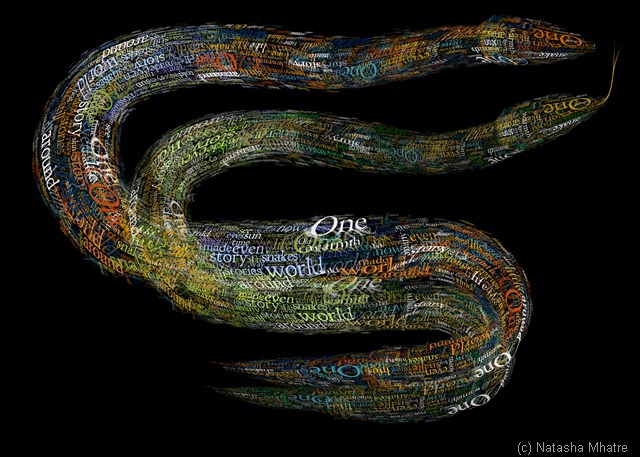
This book, I figured, will need a cover. And that is where the word beasts came in. Beasts made of the words that make them up. The words of the stories that make snakes come alive (hopefully) in your head, make the snakes in my images. Here are those beasts, courting, hopefully to mate and produce more words and beasts.
Snake
PS: Also would anyone like prints? Know of a good print on demand site, one where I can submit an image and they mail you the prints? Particularly one that works for an Indian audience? I am on RedBubble. If enough people are interested I’ll put a few images up there.
Comment, tell me what you think!

Friday, September 10, 2010

Word beasts

Where did it all begin? A year ago, now. It began with too many words and not enough images. It began when I agreed to make a brochure for CES for its silver jubilee celebrations. I had a lot of text, a lot and very few images. And somehow an appealing document had to be woven from this. There was the cover to be made. What do you put on the cover of a document that is to be made for a whole department? That represents what everyone does, that keeps everyone happy.
The department’s logo a long time ago was designed with a Racket tailed drongo in it. It’s rarely used, but there was an idea someone had suggested. Now I didn’t have an image of this bird. And really I am not going to swipe something of the net. But there were these images, they were hauntingly beautiful. Haunting in the niggling way like sand in your shoes. I wasn’t going to nick them, and I didn’t think we could organise to pay. So I set it aside.
Then I thought I would use the words somehow, the words to make the artwork. That was the first good idea I think. When I was younger, I used to think that somehow looking at other art would influence me, and make my work derivative. I’ve given that up now, I’m of the Wharton school now. So I looked up what others had been doing. A lot of it then was stuff like this. So well, I thought, I sure as hell am not going to do anything that requires me to do paste each word in to a template. So I thought, maybe I could reshape a sheet of words.
That’s where it got interesting. I remembered tag clouds. And I dug around and found Wordle. I took the text from the brochure and plugged it in. Made lots of different shaped, coloured and fonted word clouds. Now what? Well, import them into Photoshop. Start to reshape them. How, well, see what you can use. You don’t want to cut words out, that’s clumsy. What you want is to shape them. And then I started a few simple techniques which gave me the results I wanted. Which will be obvious if you look at these images. This which may be familiar to IIScians and ended up on the poster was among the first products that satisfied me:
PosterCes
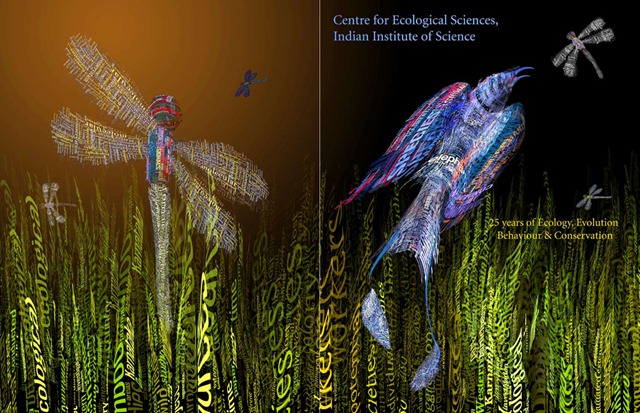
And there it was, the start of the word beasts. CES got its brochure and I love what I did for them. Here is what CES got, the front on the right, back on the left, think of it as wrapping around the book. I quite like it. It has everyone’s work right up there in front, it depicts the work in a sort of way as well, the ecology of it all. So I think, that went well finally and the drongo did find its way back, so, no more haunting.
CES_All_pages-cover wrap
But that was not and will not be the last of the word beasts. There are several more in the works, (slow and painstaking work unfortunately). Coming soon…