Its not yet at WPY quality, which still is the gold standard, but its pretty good. I was told my image was selected from among 32k images; I'm pretty stoked. The quality of the contest entrants appears to be pretty high and getting better and better through the years. Slideshow below!
About 65 million years ago, is the accepted estimate for when bat echolocation first appeared on the scene. This was the beginning of a long and protracted arms race between the bat hunters, and the hunted, the insects. For a bat, the nocturnal insects of choice are the moths. Plentiful, and with large fat bodies which make them quite attractive. It helps that they are also easy to find; their wings are great reflectors of the ultrasonic frequencies that bats use to find them, flagging them up against the clutter in a bats sonic world.
Way back in evolutionary time, the moths responded to their new predators. In the beginning simply, by evading the bat attacks with crazy evasive diving maneuvers. Then, with more sophisticated methods; ears that were tuned with great precision and sensitivity to the bats very high pitched cries. The very echolocation cries that the bats used to find moths now immediately alerted their prospective prey to their presence.The moths could now dive and circle away well in advance of the swooping bat.
In response, the bats called more softly, they started whispering, and changing the pitch signatures of their calls. They tried their very best to make echolocation calls that the moths could not easily detect or discriminate the direction of. The moths kept up their part of the race too, the pressure not to become supper being quite high. They changed the shape of their wings so their main body would not be attacked and just the edges of their wings would be taken. Some even started making sounds of their own! Sounds that either jammed bat sonar or made them sound unappetising, the acoustic equivalent of very red berries. And in return, its seems that some bats have responded by finding prey by the sounds of the prey alone and silencing their echolocation calls. And so, on it goes.
And on goes the research, starting with the work of Brock Fenton, way back in the late 70's, right up to today with many different groups still working on different aspects of the same behaviour and ecology! Including the work of fellow post-doc Holger Goerlitz, who helped me do this beast. If you want to know still more about this cool co-evolutionary arms race, you could do worse than read this lovely review (if you can get behind the paywall).
You might remember a moment when in you were choosing what you were going to do with your life in which it all came together or you may not. This may be the mythology of me that I've built myself but one of my markers was reading about the Jeffress' model in Eric Kandel's book, 'Principles of Neuroscience'. I remember thinking, that's cool, if I could do stuff like that I would love it. Somewhere there is the beginning of my love affair with modelling biological systems.
The Jeffress' model is a model of a neural circuit built to detect the direction that a sound is coming from. It's a beautiful and elegant model that has been found to be used by the brains of many different species, including humans. One of the most elegant bodies of work in neuro-ethology showed that this model holds for barn owls and explore many of the nuances of the behaviour.
The work of many people mainly Knudsen and Konishi and Catherine Carr showed that not only is the Jeffress model used to compute the azimuth but it also is used at several frequencies after a sound has been decomposed into different frequency components. This solves the problem of degenerate solutions that you could get from a pure tone sound. Apart from this, in perhaps one of the most 'awww' experiments ever, they showed that the auditory map is tuned to the visual map and this can be tuned and retuned but only when owls are young. It's beautiful work and this piece is in based on it. Imagine trying to sneak up on these owls as they were hunting and imagine that they found you instantly as you rustled through the teasels. They would find you with an accuracy of a single degree!
The study of human language is surprisingly contentious. There are two camps, the words and rules camp and the connectionist camp. (There are perhaps more, but as I understand it, these are the two serious contenders.) The words and rules camp begins with Noam Chomsky's work on language in which he proposes the idea of generative grammar. There are many nuances and subtleties to it, that I don't even begin to understand. But I'll try to explain it as best I understand and remember it.
The rough words and rules idea (sensu Pinker which is an extension of Chomskian theory) is that the a baby's brain is not a blank slate (tabula rasa) when it comes to the syntax of language. What children are programmed to do as the learn language, is to treat what they hear in structured ways. During the acquisition of language stage they both abstract rules from what they hear and learn the meaning of the words. There are two types of memory that get engaged in this: procdeural memory, the procedure of transforming words to be used in a sentence and lexical memory, which learns the semantic meaning of the words.
The other ideas are called connectionist or emergentist or structural. (I'm less familiar with them, so forgive me if I give them a bit of the short shrift.) They suggest that children's brains simply make statistical models of language to allow them to learn it. They don't abstract rules but learn the statistical regularrities in language. These approaches are often accompanied by neural network models which they then train with a lot of text and see what language they are capable of producing. I personally find them a bit unsatisfying, but they keep the debates over language fresh and engaging.
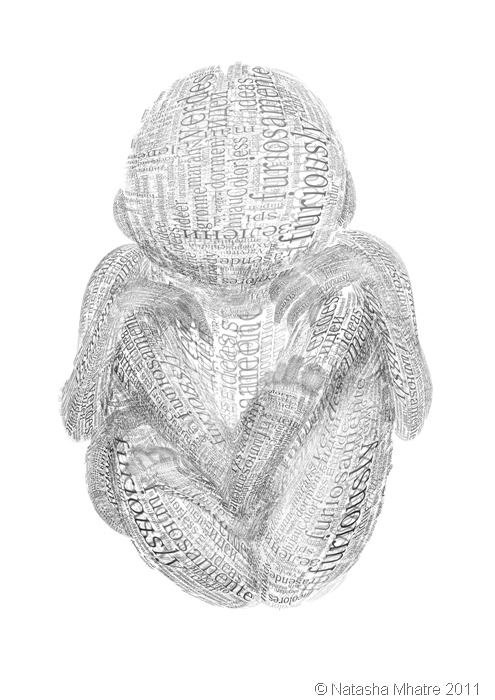
Over the years much arguement and fighting has ensued. In one of his moments, when Chomsky was ridiculing the probabilistic model of language, he coined the phrase, 'Colourless green ideas sleep furiously'. Its a phrase that could come out a statistical or purely structural model, its syntax is perfect and yet it means nothing.
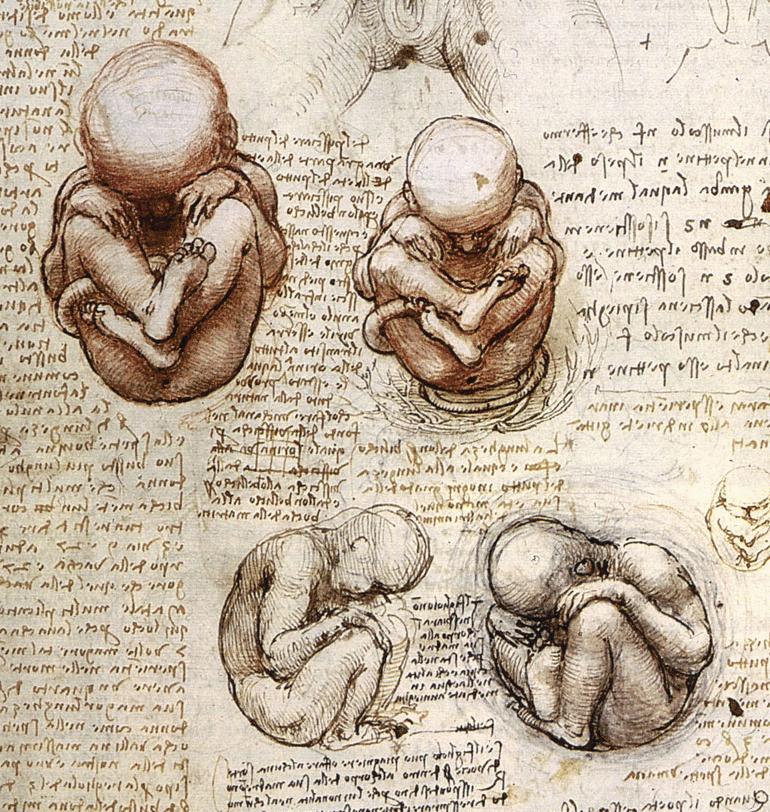
The language baby word beast (and we are beasts even if we would like to seperate ourselves, often on the basis of language itself) is made of that phrase in as many languages are the wordle site can encode. The baby is based on one of my favourite drawings, a fetus seen from a truly unusual angle by a master of many things, not least art and science. The baby is an oblique look at all the arguement that is dormant within our capacity for language.
Hat tip, to Daniel Robert who formed the nucleus of this word beast idea.
I’m away in Sweden on holiday and was in some woods with my camera after a long time. I didn’t expect to find anything particularly exciting. But that’s not what woods are like is it? You make your own excitement in them. The beasties are amazing not in themselves but in the knowledge you possess of them, right? Or something like that. Thank everyone that ever figured anything out, they made the world a bit more wonderful for us all.
Now, plants don’t usually do a thing for me.Well, that’s unfair. I am beginning to appreciate things about them, especially that they are far less passive in controlling their destinies than we believe them to be. Nonetheless, in comparison with insects, or even birds and mammals, I know less about them and am less keen to.
I did, however, a long time ago do a presentation on plants and how they crossed over from being water loving organisms to being land creatures. Plants have done much the same as animals: crawled out of water onto land and then back again (sea grasses are an example of this). I cannot even begin to do justice to the profoundness of this moment in the history of life, plants are the engine of this planet. But although I may not be able to, Loren Eiseley is.
There were beautiful illlustrations in paleobotany text books and papers of ancient and giant and varied ferns that once were the only plants in the forests. The first plants to form a thin fragile green skin over the earths surface were ancient ferns. I saw one of those ancient ferns today as we strolled on a path by a river: a Wood horsetail, Equisetum sylvaticus.
There were thousands of them, fragile and delicate, layering the forest floor with their delicate whorled leaves. Utterly beautiful in the broken light. The Horsetails are a living fossil. They are a member of a once (in the Paleozoic) rich and diverse class of plants, now reduced to handful of species in a single genus.
The only reason I know anything about them was that I took a class a long time ago. (And I had a camera and an internet connection and an internet rich and varied enough to help me track them down, but off course, in my mind, my personal history matters more.) I might have walked among the living dead and not have known it.
I could tell you about the gecko's foot and its remarkable self cleaning adhesive qualities. Or I could let Robert Full, who is a lot better at it, do it. Here is where you go to find out about the remarkable locomotory capabilities evolution has provided animals.
I wasn't too happy with this one from this post. So I reworked it. I think its better now. I've been asked to stop obsessing over it and to stop now please. So, I will.
PS: If there's beasts and work you would like to see worded, let me know about it. And if I find the work it exciting I'll do one! I tend to like research stories that are sorted rounded off and mature for the word beasts, not ones with just a few papers behind them. Just gives me more material to work with.
OR
Is this better? Vote, please, no 1 or no 2.
And here is what will be the final update: Its done now. Why, you ask? Because it holds together now. Its a tone painting. I've learnt to never start an unplanned image because of this image though. It was a nightmare trying to make it come together and work.
There are fairy chimneys, hidden churches, underground cities, caravanserais along the silk route, a few quicscent volcanoes, tuffa valleys galore, a river and enough walks to keep you quite happy.
Fairy Chimneys
Rose Valley
One end of Pigeon valley
Hassan looms over Pigeon valley. Hassan is one of the three dormant volcanoes that spewed out the ash that makes the characteristic tufa landscape of Cappadocia.
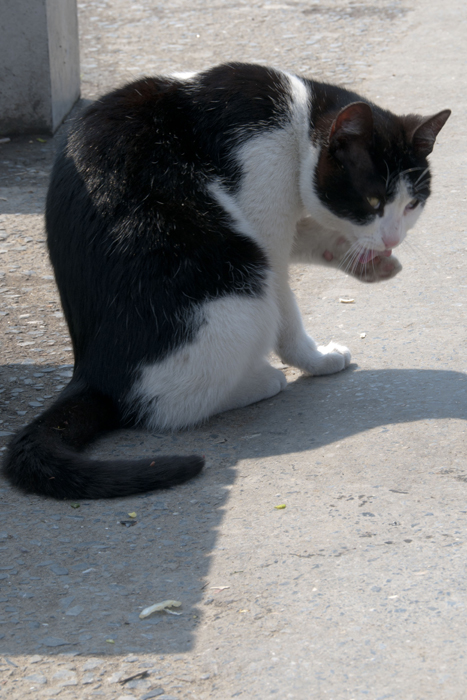
The cats of Old Istanbul are the most practical of all cats. And while you may name them as you please, you will never know their deep inscrutable singular name.
I’ve written about this before. But I’ll quote myself to provide context to the images.
“ The Golden toad, a beautiful Costa Rican amphibian, was in trouble according to herpetologist Martha Crump's observations in 1987. We saw the last Golden toad in 1989. In two short years they disappeared.
There were many many reports after that talking about amphibian declines. Large numbers of once common frogs were simply disappearing, entire populations simply wiped out. Rachel Carson's 'Silent Spring' was transposed onto silent streams. Bruce Wilcox noted that between 1996 and 1998 of the 1874 backboned animals added to the Red List of Threatened Species, 1646 (89%) were amphibians! The statistics compiled in AmphibiaWeb also sound quite grim and this is not a resolved crisis. The causes for this decline are perhaps as complex and multiple as they were for the deformities. A large part of the decline is now believed to be explained by an epidemic of fungus. A fungus that is helped along by global warming.”
Complete image
The fungus that I spoke of belonged to a group of fungi called the chytrids, Batrachochytrium dendrobatidis. Its been a cause of great concern to the amphibian community. There have been a few reports of treatments that may control it particularly one with topical Chloramphenicol, a common broad-spectrum antimicrobial, often present in simple topical OTC compounds.
While I think this is good, I wonder whether these are scalable solutions. One can hardly pour barrels of chloramphenicol into streams and ponds. You’re then left with dealing with capturing and treating animals individually which is well impractical when one thinks of the pandemic scale of the current problem. And even if deal with this pathogen, another might emerge. And we have little in place to control it.
We’re doing a lot to this planet that is new and the responsibility for what happens is ours, whether we think so or not, whether we want it or not. They’re watching what we do, they’re holdings us responsible.