This is where some of my art/sciart goes. Look on the right for a link to my research website.
Saturday, February 25, 2012
Word beasts: an arms race
Monday, December 17, 2007
Macaques: expressive, intelligent and social? Or the other way around?
PS: I'm at home in Bombay. To call my internet access here bad is to compliment it. Posting will be a bit slow for a while.
Have you ever watched a Bonnet Macaque and felt that it was extremely expressive? It indeed is. Macaques use a huge range of facial gestures to communicate within and between their social groups. Each gesture has a subtle meaning that indicates different degrees of submissive to aggressive behaviour, to simple greeting and play behaviour. Simple things like lip-smacks (submission) and eye-flashes (greeting) lubricate everyday living. Presenting, a display of the bottom, unlike in humans, is almost a gesture of humility, at any rate, submission. And yet, even high ranked males will occasionally present to lower ranked monkeys, perhaps to keep their loyalty, to keep everyone happy. Adult males, females and younger members will groom others (allogrooming) to ingratiate themselves to the groomee. When members of another troop come too close, a strategic yawn will display the majestic canines of the alpha male, providing an oh-so-subtle indicator of discomfort.
Behaviours are also used to indicate heirarchy, each animal's knowledge of its position within that ladder and subtle shifts that occur. A young male will present often to an older, higher ranked male, until one day it begins an alliance with another and reaches upward on the social ladder. Females are born into their positions on this ladder in Bonnet macaque societies, and cannot climb or descend. Almost tailor made for these trapped females, Bonnets have a separate ranking system one that measures social attractiveness. Females may have a low social rank, but be quite comely in other ways. Socially attractive females in certain interactions actually precede higher ranked females.
If you think about it that's a lot to keep in mind. Social heirarchies and networks will jostle for brain-space with food and water maps, spatial maps, cultural memories, and off course all the other hard-wired stuff. The boundaries and details of these social interactions will shift continuously, new players may emerge, old ones disappear. The representations of this complex system in the brain must constantly be rewired. It must remain flexible and capable of learning through an entire macaque life.Anindya Sinha from NIAS, among others, has argued that this may be the route through which we humans, primates as well, have reached our extravagantly complex and conscious brains. He argues in yet another paper, that many complex mental states such as deception, intentionality and attribution may be seen in even 'primitive' primates like the Bonnet. The idea I suppose is that somewhere along the primate lineage the two process ran away with each other, complex and intelligent brains fueled the growth of more elaborate social and communication structures and vice versa.
An elegant idea, and testable! The more social an animal is the more likely it is to be intelligent. Even now, if one thinks about all the animals that are attributed with intelligence whether merely through folklore or through actual research, many are indeed social. Dolphins, apes, elephants, corvids are the first to come to mind, each with complex sometimes unexplored social systems.
Wednesday, December 05, 2007
Bat harems
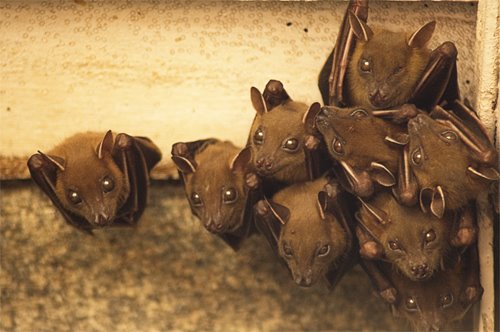
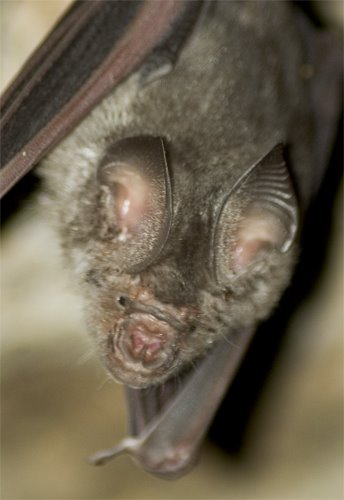
These are short nosed fruit bats (Cynopterus sphinx). I like this picture and a lot of folks do as well. One of the reasons is I guess the nice geometric formation. But the other almost certainly is our human preference for large-eyed infantile creatures. These are nocturnal bats and cant echolocate so they use their eyes to find food and hence must have large eyes. Unlike the eyes of the next guy who is an insectivorus bat, which echolocates and creates a world view using that sense instead. Thats most probably one of the leaf nosed bat species (probably Hipposideros ater), and was shot in Lepakshi, AP. (Not pipistrel like I'd said before).
The other interesting thing about this group is that its a group. Most bats actually live in some kind of group. But this one is special, because its a harem. A male bat creates a resource, in this case its a roost. Actually under more natural conditions these bats build what are called tents. However this group lives in the eaves of the physics dept. And the females basically live in his resource and he gets the first go at reproducing with them. The groups remain stable over quite some time apparently, with some dynamic fusion fission going on. So I guess a female could truly 'evaluate' a male over a period. According to one study, harem keeping males though sire abt 65% of the offspring of harem females, not all interestingly!A bat guy who came to the lab recently speculated that the guy outside the group is the male, he says that the male is probably the bat on the outside cause they dont usually stay within the group and are the first to leave at disturbance. Which are both interesting actually. Cause if you look closely at the image (click for a larger version) you'll notice ticks on some of the animals. All animals in groups face some costs, here females are sole parental care providers so there is no 'division' of the males efforts. But they will almost definitely get parasites from their roost mates. Also a big group is also always more attractive to a predator! (If you look carefully one of the bats has an eye missing, put out by a predator?)
Its interesting that males show behaviours that suggest avoidance of both these costs but the females don't! I wonder if and why the costs are assymetric between the sexes?
Sunday, December 02, 2007
Vultures in the main building
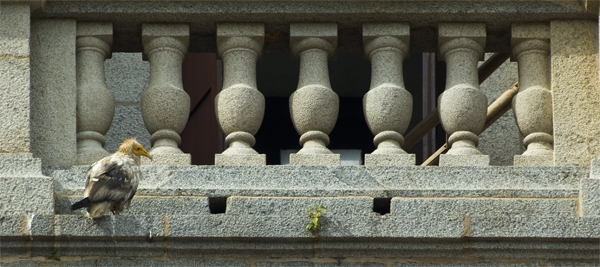
This image to me is iconic IISc. The Faculty building has been the face of IISc for donkeys years, its on every brochure, every handbook, every calender. No one notices the details.Like the two Scavenger vultures that have been on its ledges for the many years (don't ask a lady her age, and a PhD student how long they've been) that I have been here. I'm told they've been there well over thirty years. They're reputed to mate for life and I think larger birds are relatively long lived (but 30 years? maybe they've turned over...) I wonder if Tsundue had a word with them when he was up there?
Anyway, a few years ago Nature news had a feature to which the title was "Faeces brings colour to birds' faces: endangered vulture eats shit to impress females". Now see thats just a brilliant feature to read with your breakfast chai. Its also the sort of thing that adds to the perception that theres not much 'substance' to biology just these silly 'observations', particularly the more classical branches like mine.
But lets put this whole observation in perspective. These birds eat feces in order to accumulate carotenoids which give their heads that characteristic yellow colour. This colour is a signal they can't fake as far as we know, they must eat shit to be yellow, hence its an 'honest signal'. The birds when they eat the shit are obviously taking a risk with endoparasites, enteric infection and so on. And a female could judge from the colour just how much of a risk a particular male took. She could also asses his present condition and tell whether he got away with the risk. Now then, the male bird is in essence signaling to her saying in a sense 'I can do well despite my handicap, hence I must have good genes!'.
Amotz Zahavi sometime ago came up with a brilliant theory called the handicap principle which he says explains many many examples of exuberant sexual display in organisms, which are hard to explain in terms of plain old natural selection. And this behavioral observation seems to fit quite well with his theory. And off course there is an opposing theory, which is Fisher's runaway selection hypothesis.
Here's the paper for the work I referred to. Here's the theoretical work that proved that the handicap principle can work as model. The history of the theory itself is full of some nice internecine evolutionary biology warfare, but I'll leave that to you to find out.
Saturday, February 24, 2007
Monday, December 18, 2006
Sunday, August 27, 2006
Insect ears
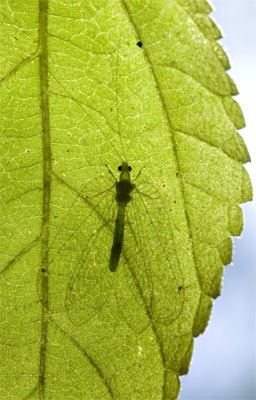
Insects have ears, literally, all over. They've evolved independantly among insects almost a dozen times over. They're on legs, abdomens, and they're on wings! In the neuropterans, ie lacewings, like the one in the picture, the ears are on the wings!
Well, mosquitoes and bees hear with their antennae. Actually, if I have it right, they hear in the near-field, so they detect particle motion not pressure, unlike the other ears I'm talking about. The resolution those systems manage is so great that they apparently can pick up even motion at even angstrom scales! Thats pretty impressive, and possibly almost on the absolute borderline of physical possibility.
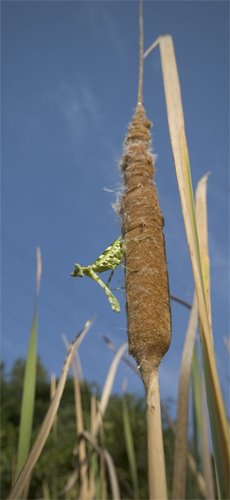
The other weird ear in the insect world belongs to mantises, they have a single ear. Now if you remember your basic physics, sound is scalar and does not have directional cues. So to tell where sound comes from animals have evolved two ears and several physical and computational tricks. But this hinges on having more than a single ear, which the mantises dont have. Why is that?
The thing about ears in insects is that they seem to be easy to build. Ingredient one : you need an air space which insects have everywhere because of their tracheal breathing tubes.Ingredient two and three: receptors and neurons. First you need something to sense the vibrations of the tympanic membrane you strung across this empty space. Then some neurons to carry these signals away to the 'brain'.
And those are everywhere in insects as well. See they (actually all of us) have these receptors called proprioceptors that detect mechanical stimuli. They're meant largely to figure out things like ok, legs bending now, and now the wings out, theres x amount of resistance on leg 2 and so on. To provide feedback to the brain on how well its commands to the motor system are being carried out. Now these have neurons connecting them up to some ganglion and then to a higher 'brain'. So if you can rearrange your proprioceptors to detect tympanal vibrations and your neurons to carry the signals, voila, you have a ear!

Actually why spend all that energy on making a ear though? Predator avoidance comes the pat reply, particularly, BATS!
You know this cool thing I read about this proprioception stuff, in one of the first insect walking robots they made, they didnt think about the interaction between the robot and the surface it was to walk on. And there was no feedback of the kind proprioceptors provide. If memory serves, that robot tore itself apart as it walked!
Tuesday, August 15, 2006
Dying for someone else's cause?
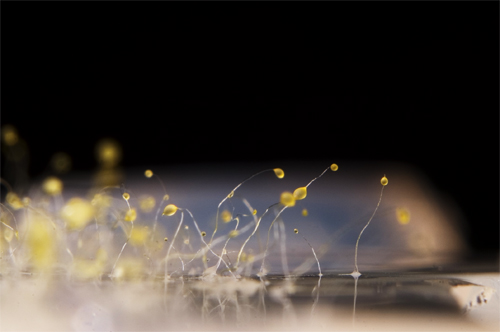
The one thing that every organism is expected to do is try and reproduce. When you see an organism give its life up so someone else might, it begs the question, why? Social animals, particularly the uber-social ones like bees and ants, have been the subject of the much research for this reason.There is yet another organism that drawn attention for this reason. Soil myxamoebae are not too charismatic. The fruiting bodies (that you see in the pictures) that they form in one phase of their life-cycle look much like fungal sporangia. But they're quite different. A single fruiting body is made of many individual soil myxamoebae which have aggregated together. The stalk is made of dead amoebae and the 'fruit' on the top are living ones. The living ones will become spores and be dispersed and so the dead have died for anothers cause. A recent paper suggests that in some slime moulds there might be some interesting kin selection going on. Carl Zimmer the author of At the water's edges blogs here and has written a very nice post about them.
The other interesting angle to Dictyostelium discoidieum is that the individuals here are single celled organisms. And they come together to form multicellular super-organisms! Some believe that they may hold some of the clues to the evolution of multicellularity.
The pictures were taken in this lab which works on them in IISc.
Monday, June 05, 2006
Convergent evolution? Or Whats a blind snake?
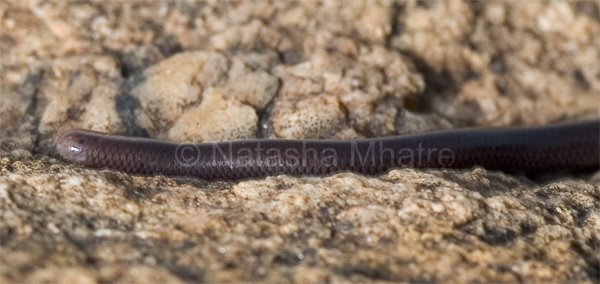
Does that look like an earthworm? Look closely? An earthworm would have a large band about a third of the way down from its head. And you would see horizontal segments. You dont see them here.Well thats cause its a snake! They're called blind snakes. They're burrowing animals, the same size as an earthworm albeit a little darker. If you look closely you'll see the scales. The burrowing lifestyle obviates the need for eyes, so they have very very reduced eyes which are covered with scales. They can probably just make out light and dark. You can see them in the second image.
So if you ever see an earthworm that moving sort of too quickly and too much like a vertebrate, its cause its a snake.
Do you also notice that while the head (which is poking out through the loop of the snakes body) is blunt, the tail is kinda pointy? This snake and I think many other species poke you with the pointy end! And yes they smell! The mouths too small to bite, I believe they use a funny eating mechanism called 'mandibular raking'. Heres some videos made by a guy who works on them.
Tuesday, May 02, 2006
Keystone species and co-evolution

There’s a lot of ways you could be a keystone species, produce a lot of food for instance, or produce food in a season where everything else doesn’t. Maybe all the energy in the system goes through this species at some point, and if you remove it there are two separate entities with no flow between them...producers one end, eaters the other. This is called a wasp waist system; the keystone species would be the one at the waist.
Fig trees are thought of as a keystone species. And sometime you can see why. They produce a LOT of food and often different trees will bloom and fruit at asynchronously, keeping food available to a system. There are usually a huge number of animals that will come to the smells of ripening fig fruits. Some of them will be young boys and girls on their way from school, off course!
We rarely notice figs when they’re not ripe however, which is kind of funny because a lot of other creatures do and they are attracted to them. Figs have another story going, one of co-evolution. The fig is actually a structure called a syconium and its flowers are enclosed inside it. For these flowers to be pollinated, a pollinator must get inside the fig. Here’s where the fig wasps come into the story. A female wasp finds a receptive fig digs into it, she then pollinates some flowers (in some species seemingly intentionally, in others not), after or along with this she lays her eggs in some of the flowers. And then dies. Several wasps may lay in a single fig. Once the next generation of wasps is born, the females mate with the males, the males dig an exit and the females fly off looking for the next fig.
(Dont have a pic of the pollinator yet, coming soon)
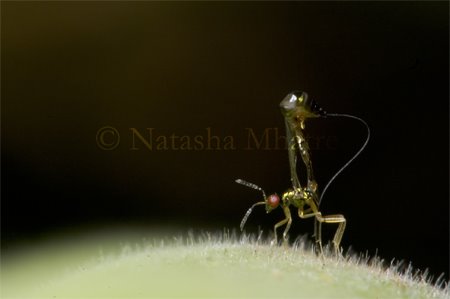
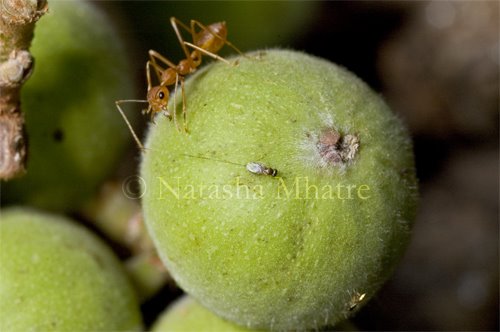
But that isnt it, there are others in the system, other wasps the gallers. These guys are in some ways the cheats of the system. They lay their eggs from the outside inducing galls for their larvae to eat. The larvae of some even eat the larvae of those that came before. Thats a galler laying eggs.Off course the gallers arent all shiny happy people, because right behind that lovely fig ripe for the laying lurks the big bad.........ANT. Red weaver ants, those big bad evil creatures that will shy from attacking nothing, wait for these wasps (pollinators and gallers) to eat them.

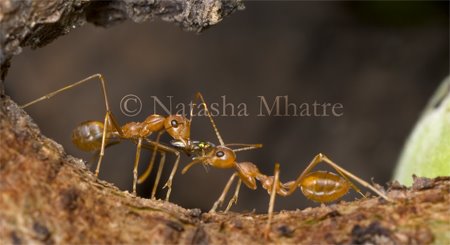
They get them too sometime, these little flitty things. Heres two ants fighting over who gets to keep the wasp.

So thats the fig wasp story, gleaned from the comprehensive presentation of Mahua and Yuvraj at CES, IISc.