Showing posts with label behaviour. Show all posts

Monday, December 28, 2015

Gender bender


Click pictures to embiggen

A lot of natural history comes from patience, from watching for events that only happen rarely, and then are over, in the blink of an eye. There are, of course, some very spectacular natural events that aren't exactly sneaking up on you. More like, they walk up to you and grab your attention by the collar. Collective behaviour, has definitely been one of these: a large number of organisms doing things all at once, and somehow, together. Crowds, swarms, flocks, schools, all sorts of collectives are being studied. Advances in theory, measurement and notions of emergent behaviour have all led up to this.


The emergence of red sided garter snakes (Thamnophis sirtalis parietalis)  in Narcisse, in Manitoba is most certainly a collective event. And the sheer number and coordination is impressive. How do thousands of these animals time their collective exit so exactly? How do they know that now is the time to crawl to the surface for their annual spring orgy? A few thousand snakes out at the same time is definitely the thing that brings so many people out to Narcisse, in the middle of the otherwise featureless flat Manitoba plains. But it isn't necessarily the most interesting thing going on here.


Well, what is going on here?

Before there were the flat lands, there was a first a huge ice sheet and then a huge lake in Manitoba, lake Agassiz. Agassiz was formed from the melt waters of that glacial ice sheet from the last ice-age. The ice-sheet was so large and heavy that Manitoba may still be undergoing isostatic rebound (i.e. the land-mass is still lifting back up after a weight was removed from it!). It is the reason the land is so flat and featureless, the ice sheet scraped everything down to nothing.

So where did all the water go?

Some of it remains in the remnant lakes, lake Manitoba and lake Winnipeg, that are nearly large enough to rival the great lakes. Some of it went underground and carved very deep caves into the bedrock. Some of these caves are so far below under the ground, that they are below the frost line. When winter comes to Manitoba and surface temperatures drop below -30 degrees Celsius, in these deep caves, its still above freezing. So at some point in the geological and evolutionary history of Manitoba, red-sided garter snakes started using these caves to hibernate. In the fall they go underground and they sleep off the winter there. Come spring, when the temperature is a bit more conducive to a happy life for  a cold-blooded animal, they all wake up nearly at once and out they come!


And when you see the numbers, its seems like it is all at once, a few thousand at once. This is already quite the feat: for a few thousand snakes to time their metabolism so they can all emerge within a day or so of each other. But it's not even the best of it, it gets even more interesting. It isn't all at once. Males tend to come out first, when it still isn't quite warm enough outside. And once they are out, they hang around, soaking up what little watery sun they can get; here they wait. They're waiting for the females.


When the females do wake up and make their way out of the cave, a whole bunch of males are waiting for them right at the entrance. The males will then proceed to chase every single female as she comes out of the cave. Several males chase every single female that comes within their ambit. They try their best to align their bodies up against the females, to wrap around her and to mate with her, all the while signalling to her with pheromones and by rub her with their chins. If enough of them try to do this at the same time, it leads to balls of snakes wound tightly around each other, often known as mating balls.

A mating ball
The balls form and dissolve constantly and not always because the deed is done. Mating balls do not always have a female core with a male outer layer.

Sometimes a mating ball is all male.

Some males will pretend to be female in order to attract courtship from other males. The snakes seem to recognize each others sex only through pheromones which they detect on each others skin. Snakes don't have external genitals and male hemipenises are held inside the body and everted from the cloaca only during mating. So all the males need is a chemical disguise. So gender-bending males produce female pheromones and this is enough to fool the other males into courting it and making mating balls around it.

Why on earth though? Well, for the one thing that most cold-blooded animals are short of: warmth. The core of a mating ball is warm and is constantly being warmed up by the bodies that pile up around it. Typically these 'transvestite 'males come out later than the other males, they might be in worse physical condition, and so cold and unable to court other females by themselves. By attracting a mating ball around themselves, they can raise their body temperature a few degrees. For a cold-blooded animal, that's a pretty big deal. When this is done, the gender bending males seem to turn the female pheromone off magically. With the other males no longer pursuing them, they get down to finding some mates of their own. In fact, the current theory is that the female pheromone has just the right degree of volatility: when the male's body temperature rises to where it needs it to be, the pheromone just evaporates off on it's own!


There can be a cost to this trickery, a cost some females pay and some males probably do as well. The mating ball is a pretty frantic affair. These congregations last only a few days, so the urge to get it on is very very strong. And sometimes the mating balls end up suffocating the female they are formed around. With the males there is the added fear of injury from forced copulations. So this strategy isn't without risk, but what a cool adaptation!?

In almost all systems, there's a lot of amazing detail beyond the obviously impressive spectacle and I hope we can keep looking beyond the obvious and finding it.

Have a great Christmas break, guys!

PS: A lot of the research done here was done in the labs of Richard Shine and Robert T Mason in case you want to read some of the primary literature.

Friday, May 04, 2012

Word beasts: tree crickets break the rules, sort of.


This time its my own work. We just published a paper that I think is important for a couple of reasons. I'll outline the main one here. I've not gone into this detail in any of the popular science articles I've interviewed for, simply because this is a subtle point. (And also because it got lost in trying to explain the work, I'm not practiced at this interviewing thing). But this is my blog, so I can tell you and take the long route, consider this your fair warning! This is not an explanation of the paper, but of why its interesting.

There are very few laws in biology. By laws I mean rules that hold far and wide across a huge phylogenetic range of organisms. Biology is about variation, making oneself distinct, occupying a new niche. So, in the complicated messy world of biology,  it's quite rare and hence, comforting to have a 'law'. Often when such laws exist, they are rooted in physics. For instance, the law that relates thermoregulation capacity to body mass. Since larger animals have a lower surface to volume ratio, they retain heat well and lose it poorly. And vice versa for small animals, loose heat easily and retain it with difficulty. As you can see, this law is very rooted in the physicality of the body. You may even say it is rooted at an even more fundamental level, in geometry itself.

The law that relates to our paper is quite similar. In animals that communicate using sound, the dominant frequency of the sound they produce is correlated to their body size. Neville Fletcher, who has written text-books in the field of acoustics and bioacoustics, calls it a rule that holds from insects to elephants. And he is right; it does, by and large. There are simple physical reasons for this behaviour. They relate mainly to the efficiency of sound production at frequencies appropriate to the organisms size and to the mechanisms of sound production. For instance, insects use resonators as an important element in their sound production mechanism. A large resonator, therefore, leads pretty much deterministically to a lower frequency.

Now, many bioacousticians take this a step further and suggest that size relates to frequency not just across species but also within species. This is not really a large logical step. The reasons why this relationship would hold are the same as for the across species relationship.

The next step that researchers in the field have argued for is somewhat more problematic. They assume (and also test, sometimes) that because this relationship exists, information about size exists and can be percieved in the sounds an animal makes. There is some tentative evidence and a strong belief that size is important to mate choice and choosy females prefer larger males who are somehow 'better' in evolutionary terms. Taking the step, however, it turns out is more complicated; there are a few assumptions that have to hold to make this 'information transfer' and consequent 'choice' possible.

The first assumption is about reciever psychology. There is a presumption that a reciever can make frequency discriminations that are as fine as the spectrum analysis techniques used to study the sounds in the first place. If the change in size associated change in frequency within a species is smaller than the frequency resolution of the listening party, the question of telling the size of a caller is moot.

The second assumption, which we are concerned with, relates to the next level of variation, the within individual variation. The first level of variation is across species, then within species and finally within individual variation. If within individual variation in frequency is higher than within species variation, then information about size is obliterated and no meaningful 'choice' is possible.

 Here's where the crickets come in. The way crickets sing is quite special. Not only do they use resonance to produce song, they also use the resonance to tightly control the song frequency using something called an escapement mechanism*. The idea runs: therefore, within individual variation will always be lower than within species variation and the information must exist in the song. And not just for crickets; this relation is often thought to hold for insects in general since many of them use resonance as a sound production mechanism.

Not so, say the tree crickets, whose frequency changes with ambient temperature. As a direct result of this property, an individual tree cricket's frequency variation is as large as that of the whole species and the train of logic crumbles because an assumption is not met. Remember the law has not been violated, not strictly, the range of frequencies each individual insect will produce will still depend on his size. But since he can call from anywhere within that range, you can't figure out his size from hearing him at any given time. The information that falls out of the 'law' is gone.

We found that these insects, tree crickets, use resonance for song production as well, and have the same singing mechanisms as other crickets. But these mechanisms fail to control song frequency. So we asked, well, how do they do it? What does it take to break this link down and remove 'information' about body size from song frequency? How hard a transition is this? It turns out, its really simple. All you have to do is sing with longer wings. No fancy non-linear mechanics, no stochasticity in the relation between body size and resonator size, no super temperature sensitive materials, nothing special. Just longer wings. Geometry trumps everything.

And that is why its an interesting result. It doesn't take a lot to break down a train of logic which everyone thought derived from a profound biological 'law'. It takes a relatively small change in geometry to undo a laws effect. That is how easy it is to tweak biological systems. And that ease is one of the sources of the huge diversity you see out there.

Paper: Mhatre, Montealegre-Z, Balakrishnan, Robert (2012) Changing resonator geometry to boost sound power decouples size and song frequency in a small insect. PNAS http://dx.doi.org/10.1073/pnas.1200192109 

*  Its the same mechanism that clocks use to keep time. There's a starter image to explain it on this page if you want to know more.

Wednesday, January 23, 2008

Flame of the forest

Repost
I'm terribly sorry I haven't really been posting much, there's been a lot to do. With some luck we should be back on schedule shortly.
These trees are blooming all over right now, so I thought it was a good time to resurrect the post.

Flame of the forest

This tree deserves it's name in more ways than one. The flowers look like flames individually. A tree in flower does really look like it's on fire. And every bird within a mile's radius is in love with it. And off course squirrels and insects.

Two days of waiting paid off! Ta dah here they go. The last one, a Spangled drongo, is a western ghats species. If you look at its distribution in the GI and I its painted along the western ghats. Well, it's here and it picked this tree to feast upon.

Flame of the forest
You know sometimes I feel like one of those sad homeless people you see on the streets, clutching at their treasures. Things no one else would find even remotely interesting. I'll be raving about some bird no ones even ever heard of before. Well, fortunately there are a few people who are a bit like that in CES and I'm not considered stark raving, but only moderately mad. Well, the slightly deranged vocabulary that apparently accompanies this enterprise does make up!

Monday, December 17, 2007

Macaques: expressive, intelligent and social? Or the other way around?

Repost
PS: I'm at home in Bombay. To call my internet access here bad is to compliment it. Posting will be a bit slow for a while.


Have you ever watched a Bonnet Macaque and felt that it was extremely expressive? It indeed is. Macaques use a huge range of facial gestures to communicate within and between their social groups. Each gesture has a subtle meaning that indicates different degrees of submissive to aggressive behaviour, to simple greeting and play behaviour. Simple things like lip-smacks (submission) and eye-flashes (greeting) lubricate everyday living. Presenting, a display of the bottom, unlike in humans, is almost a gesture of humility, at any rate, submission. And yet, even high ranked males will occasionally present to lower ranked monkeys, perhaps to keep their loyalty, to keep everyone happy. Adult males, females and younger members will groom others (allogrooming) to ingratiate themselves to the groomee. When members of another troop come too close, a strategic yawn will display the majestic canines of the alpha male, providing an oh-so-subtle indicator of discomfort.

Behaviours are also used to indicate heirarchy, each animal's knowledge of its position within that ladder and subtle shifts that occur. A young male will present often to an older, higher ranked male, until one day it begins an alliance with another and reaches upward on the social ladder. Females are born into their positions on this ladder in Bonnet macaque societies, and cannot climb or descend. Almost tailor made for these trapped females, Bonnets have a separate ranking system one that measures social attractiveness. Females may have a low social rank, but be quite comely in other ways. Socially attractive females in certain interactions actually precede higher ranked females.

If you think about it that's a lot to keep in mind. Social heirarchies and networks will jostle for brain-space with food and water maps, spatial maps, cultural memories, and off course all the other hard-wired stuff. The boundaries and details of these social interactions will shift continuously, new players may emerge, old ones disappear. The representations of this complex system in the brain must constantly be rewired. It must remain flexible and capable of learning through an entire macaque life.

Anindya Sinha from NIAS, among others, has argued that this may be the route through which we humans, primates as well, have reached our extravagantly complex and conscious brains. He argues in yet another paper, that many complex mental states such as deception, intentionality and attribution may be seen in even 'primitive' primates like the Bonnet. The idea I suppose is that somewhere along the primate lineage the two process ran away with each other, complex and intelligent brains fueled the growth of more elaborate social and communication structures and vice versa.

An elegant idea, and testable! The more social an animal is the more likely it is to be intelligent. Even now, if one thinks about all the animals that are attributed with intelligence whether merely through folklore or through actual research, many are indeed social. Dolphins, apes, elephants, corvids are the first to come to mind, each with complex sometimes unexplored social systems.

Wednesday, December 05, 2007

Bat harems

Repost
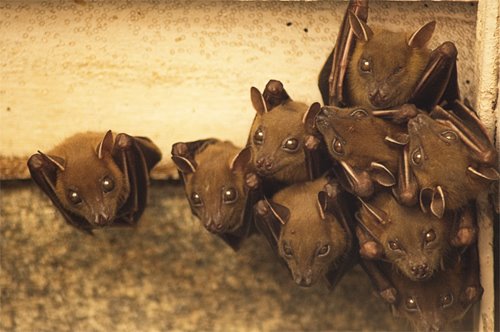
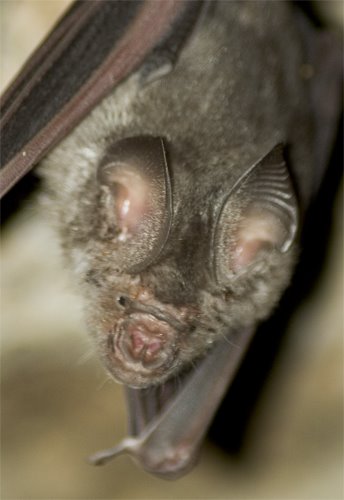
These are short nosed fruit bats (Cynopterus sphinx). I like this picture and a lot of folks do as well. One of the reasons is I guess the nice geometric formation. But the other almost certainly is our human preference for large-eyed infantile creatures. These are nocturnal bats and cant echolocate so they use their eyes to find food and hence must have large eyes. Unlike the eyes of the next guy who is an insectivorus bat, which echolocates and creates a world view using that sense instead. Thats most probably one of the leaf nosed bat species (probably Hipposideros ater), and was shot in Lepakshi, AP. (Not pipistrel like I'd said before).

The other interesting thing about this group is that its a group. Most bats actually live in some kind of group. But this one is special, because its a harem. A male bat creates a resource, in this case its a roost. Actually under more natural conditions these bats build what are called tents. However this group lives in the eaves of the physics dept. And the females basically live in his resource and he gets the first go at reproducing with them. The groups remain stable over quite some time apparently, with some dynamic fusion fission going on. So I guess a female could truly 'evaluate' a male over a period. According to one study, harem keeping males though sire abt 65% of the offspring of harem females, not all interestingly!

A bat guy who came to the lab recently speculated that the guy outside the group is the male, he says that the male is probably the bat on the outside cause they dont usually stay within the group and are the first to leave at disturbance. Which are both interesting actually. Cause if you look closely at the image (click for a larger version) you'll notice ticks on some of the animals. All animals in groups face some costs, here females are sole parental care providers so there is no 'division' of the males efforts. But they will almost definitely get parasites from their roost mates. Also a big group is also always more attractive to a predator! (If you look carefully one of the bats has an eye missing, put out by a predator?)

Its interesting that males show behaviours that suggest avoidance of both these costs but the females don't! I wonder if and why the costs are assymetric between the sexes?

Sunday, December 02, 2007

Vultures in the main building

Repost
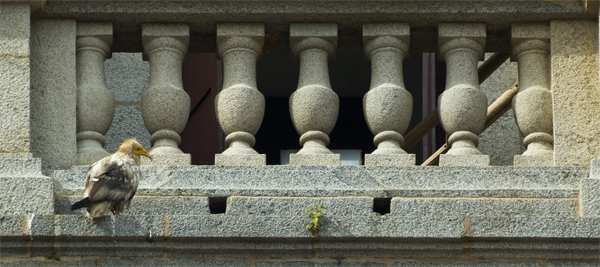
This image to me is iconic IISc. The Faculty building has been the face of IISc for donkeys years, its on every brochure, every handbook, every calender. No one notices the details.

Like the two Scavenger vultures that have been on its ledges for the many years (don't ask a lady her age, and a PhD student how long they've been) that I have been here. I'm told they've been there well over thirty years. They're reputed to mate for life and I think larger birds are relatively long lived (but 30 years? maybe they've turned over...) I wonder if Tsundue had a word with them when he was up there?

Anyway, a few years ago Nature news had a feature to which the title was "Faeces brings colour to birds' faces: endangered vulture eats shit to impress females". Now see thats just a brilliant feature to read with your breakfast chai. Its also the sort of thing that adds to the perception that theres not much 'substance' to biology just these silly 'observations', particularly the more classical branches like mine.

But lets put this whole observation in perspective. These birds eat feces in order to accumulate carotenoids which give their heads that characteristic yellow colour. This colour is a signal they can't fake as far as we know, they must eat shit to be yellow, hence its an 'honest signal'. The birds when they eat the shit are obviously taking a risk with endoparasites, enteric infection and so on. And a female could judge from the colour just how much of a risk a particular male took. She could also asses his present condition and tell whether he got away with the risk. Now then, the male bird is in essence signaling to her saying in a sense 'I can do well despite my handicap, hence I must have good genes!'.

Amotz Zahavi sometime ago came up with a brilliant theory called the handicap principle which he says explains many many examples of exuberant sexual display in organisms, which are hard to explain in terms of plain old natural selection. And this behavioral observation seems to fit quite well with his theory. And off course there is an opposing theory, which is Fisher's runaway selection hypothesis.

Here's the paper for the work I referred to. Here's the theoretical work that proved that the handicap principle can work as model. The history of the theory itself is full of some nice internecine evolutionary biology warfare, but I'll leave that to you to find out.

Monday, September 17, 2007

Fireflies: the making of a shot

The path in Jubilee park by night
When I set out to do a fireflies in the landscape shot, it was quite late in the season. The erratic rain had got the worst of the population. And this meagre shot was all I could come up with. I waited while fireflies flitted around in the frame to let them show up against the dark background. And then later in the quite long exposure, I light-painted the trees in the back hoping that I wasn't washing out any of the firefly trails. I didn't mostly and it was fine, but the method was a little hit or miss. Besides, I did not like the background at all. The tree frame did not look as good as I wanted.

By day: windblown and bent tree in the Mainlawns in the monsoon
So I switched to another place where from a previous daytime shot, I knew I would love the background, and a day and night diptych appealed to me. So I took my tripod, and headed to my favourite windblown tree in the Mainlawns. By now, much of the season was over, and there were darn few fireflies to flit about in my frame. I wanted to make sure if one did oblige, that I would not loose it in the light-painting part of the shot. With the greater number of reflecting surfaces, the grass stalks up in the front of the image, the light would have to be balanced pretty closely. I thought wouldn't it help too much that the colours of the firefly flash and the grass are similar. Cars cruising along the side of the road that turned up around the horizon were not much help either (which was why I hadn't begun on this shot here). I wasn't sure I wanted to risk it, so I took a shot without exposing for the tree, just the dark and a firefly trail in it.

And then I shot for the tree separately, this time like before, waiting till the end of the exposure to light paint (you know, just in case). As it turned out, a firefly (which is actually a beetle) made a small sortie and I got a little trail to the right and another streak in the upper left. Not enough, but some satisfaction. And anyway, I had my backup plan, the earlier trail. All I had to was sandwich the two shots to get what I was after! Fireflies blinking love signals to each other in the lush monsoon enriched Mainlawns!

By night: windblown and bent tree in the Mainlawns in the monsoon


Friday, May 25, 2007

The law of unintended consequences: Lantana camara

Blue Tiger butterfly
A superficial glance at this post might lead you to think it's about butterflies. It is in an oblique fashion, but it's mostly about the plant they are all feeding on, Lantana camara. Lantana off course is an exotic, among ecologists a much reviled one.

The native range of this plant is in Central and South America and the Carribean. Lantana was probably introduced into India as far back as the 19th century. It has probably been introduced on multiple occasions as a ornamental or hedge plant. Since then it has nearly taken over the landscape in India, and is now found just about everywhere. It has the dubious honour of being listed as one among the top hundred worst invasive species in the world.


Common Rose butterfly
But it is not the damage that this weed does to local ecology, displacing native species, outcompeting them for resources that makes Lantana the poster-child for the "Law of unintended consequences". No that would be too simple, and many other contenders vie for that title. Whether it is the ill-fated attempt to get Indians to eat snails which now overrun the countryside eating their way through everything green or the cane toads in Australia. The world is rife with examples of human hubris gone awry.


Striped Tiger butterfly

Lantana carves a niche all its own though. It take things one step further. It not only makes itself ubiquitous it has also made itself indispensable. Well, perhaps that's going a bit far out on the line, but certainly key to many ecosystem processes. The key to this plant's success in novel habitats has been two-fold, it's wide tolerance for habitats and it's fruiting and flowering phenology.
Lantana camara flowers and hence fruits through out the year. This plant is a readily available, ubiquitous and massive source of nectar and fruits. With native plants out-competed and locally extinct, Lantana becomes the key source of nectar for many species of butterflies. It is similarly extremely important to several birds as a source of fruit available throughout the year.


Common Nawab
This double whammy means once established Lantana cannot be easily removed without serious ecosystem disruption. Some unpublished work has apparently suggested that several populations of Western Ghat species now rely on Lantana and a crash will be imminent if there is uncontrolled removal of this weed. This off course makes removal of this weed and subsequent restoration of local ecology difficult. Many parameters will have to be considered when attempting such an exercise.


Twany Coaster

Not that dealing with this invasive has been easy. Large seed loads mean that even burning and massive chopping are simply a set-back, not an eradication. This has been a hard hard weed to deal with incredible rebound capabilities. ATREE in Bangalore has been leading one of the more interesting efforts to deal with this menace.


Hawk moth (shot of the week!)
Lantana furniture! Made by tribals in the Male Madeshwara Hills in Karnataka, the project is an interesting mix of community involvement into conservation practices with payoffs for both. So all of you homesteaders who might want to buy furniture might want to give ATREE a call and check out their Lantana catalogue at their offices. You'd be doing your bit.

Monday, May 21, 2007

Wildlife photo secrets(4): the canopy

Small green barbet
Everyone who popped in and said hi on the previous post, thanks. And here's the next 'how-to' promised.

It's very seductive to think of grandiose names for the unknown. The canopy has been called, in scientific literature, the final frontier. Like the deep oceans and space, who also lay claim on that moniker, it's relatively unexplored and the first few forays into it have yielded a lot that is new. The oldest method of trying to get at animals in the canopy was fogging, immensely destructive and unjustifiable (not to mention useless) if you wanted to photograph living animals.

Pariah or Black kite

Then came the more (ahem!) sophisticated methods, the canopy cranes, bridges, rafts, hides and ropes. But do what we might, the human monkey has lost his ancestral ease among branches. All these tools take us up a bit and down again with little lateral leeway. And most of all they are available to very few people, usually researchers and then for a very little time.

So here's the good part, I've found that for urban/semi-urban wildlife photographers there are canopy cranes aplenty. They are called buildings. Many many rooftops, balconies, windows are actually very close to trees, the canopy within touching distance. These can be absolutely great to watch and photograph what usually goes on above eye level.

Blue rock pigeon

Look out for places where trees are close to a opening and then look out in them for animal activity. Whether it's nesting or nest building birds or birds and other animals that come in to feed when the tree fruits or flowers, or even birds that come in to roost or perch. Keep an eye out for anything you can convert into a photographic opportunity. The great thing about this little window of access is the ability to peer from a ready-made hide (the building) into a usually secret world. And off course, eye-level shots that are so much more attractive than those belly shots from below.

Rose ringed parakeet
But that's so much for the larger birds and mammals, what about the insects? The truth is most of those canopy access techniques I spoke about were actually devised in order to reach the smaller creatures, the arthropods. These cannot be shot merely by looking out over a closeby branch. The long lenses don't get you quite that kind of magnification and you can't really get much closer to the animals.


Long horned beetle
There is however a sort of indirect way that you can get at these animals. The photograph of the long horned beetle was got by this technique. In all of my time of hunting in the undergrowth I've never come across one of these wood-boring beetles. Yet they are all over my bathroom.


Praying mantis

The basic story is this, the lights in our bogs are left on overnight and they attract plenty of insects. (You can increase the efficacy of capture by using insect attracting UV lights). I live a floor off the ground and the canopy is close to our windows, sometimes peering in. The insects that are attracted to the lights here are often from the upper canopy and not the usual ground and undergrowth dwellers. All I do is go look everyday for something interesting. You'd be amazed at what you can get. The moths in the Nat Geo story were entirely from an urban backyard. (That story began in the bogs as well.)

Praying mantis
I keep a few vials and containers handy with me, catch what is interesting and take it to a habitat similar to what it must have come from and then shoot it. The insect goes free, I get some shots. It's pretty much win-win. Off course you're not going to get any big behavior shots this way. But you do get some spectacular animals and portraits are usually tractable with a little knowledge of insect behavior and some gentle coaxing. The insects in this post are all bog-insects!

So go try out your very own canopy access system!

Others in this series: Wildlife secrets parts 1, 2 and 3.

Tuesday, May 08, 2007

Wildlife photo secrets(3): Getting close

Red wattled lapwing through grass
"If your pictures aren't good enough, you're not close enough." -Robert Capa. (Link to another site about Capa)Robert Capa, co-founder of Magnum, whose autobiography Slightly out of focus I recently read spent the best part of WWII getting close to the action. Its a hilarious read; he had to go through a lot to just stay in the war theatre with no passport and no press agency backing. He managed this feat of staying on in the war theater and close to the action with some amount of trepidation, at much risk to himself. He gained access mostly with a smile and with the lubrication on which he claims all armies move, alcohol (a strategy I haven't tried yet!)
Wildlife is both similar and different. Unlike people in wars, intent on their own purposes, wildlife notices your presence and reacts to it, usually by bolting. It's similar in that in some ways and sometimes it can be dangerous; for example with large carnivores, venomous snakes, etc. To get close, knowledge about your subject, its habits and capabilities, is paramount. I'll try and tell you what I have learnt. I'm still not as good as I would like and your own suggestions are very welcome.
Saw-scaled viper

Motion
Most wildlife: birds, insects, snakes, mammals, will react very quickly to motion. What this means is if you make sudden quick jerky
movements, you will be noticed and whatever you are shooting will run away. So learn to move slowly, smoothly. I have found this can require quite a bit of strength and agility, so develop those. And oodles of patience, the hardest muscle to build.

Even if you have been discovered, staying motionless afterwards makes animals forget about you and continue with their life after sometime.
Clothing
Camouflage clothing is artform, no really, look at what the military has been upto with it. It's useful, certainly you can't be wearing bright white or red clothes and expect to go unnoticed. Dress appropriately to the environment you expect to be in. Quiet shoes, comfortable shoes, discreet colours. If you can camo your equipment as well.
Silence
This is actually one of the reasons I dislike shooting with other people. Silence obviously keeps attention away from you, but it does a second thing. If you are quiet you'll hear other things, you'll find subjects to photograph or you'll notice that elephant sneaking up behind you. So leave the Ipod behind ok? Shootings safer and more productive that way.
Don't smell
No really. Particularly with mammals, strong odours, deodorant/perfume is a guaranteed way of not getting any shots. Leave your vanity behind.


Mongoose cub eating temple offerings
Sit still
The classic wildlife mode of shooting off course is to stay in one place and let animals come to you, hide photography. Get a hide, a camo net and stay. Hedge your chances of getting close to something by setting up a hide near a resource an animal needs (water, food, salt lick, mating grounds) or a place an animal inhabits (nest, den, etc). As I said knowledge is everything. Also oodles of patience, and all of the above. Some people also use bait, I haven't yet, although I have sort of used food others have set out.
StalkingThis is a different kind of photography altogether. All but sit still applies, well actually sit still, move, sit still, move, you get the idea? Use the terrain, hide behind things, plants, stones, etc. Stay out of direct line of eyesight of your quarry. Use zig-zag or round about approaches to it. When there isn't anything to hide behind squat on the ground and move bent down.

Keep your camera close to shoulder high while approaching. Its hard to do this undetected when you're close. (Any other ideas here?)

Remember your limits, never get too close, you'll loose your shot or worse get bitten, gored or killed.
When in doubt err on the side of caution.Familiarize
Believe it or not animals do get used to you. Wear the same or very similar clothes. Be unobtrusive and completely non-threatening. Keep returning to the place that your quarry is, it will maybe eventually accept you as part of the landscape. True of birds and mammals, insects and reptile, probably not.

Finally,
f5.6 and don't be there!
Camera traps are cool, and potentially expensive. So using remotes is also an option, stay close enough so you can trigger and guard your gear.

PS: the first 2 images link to my new Flickr gallery, following Strobist ideas on the service. Will see how it pans out.

Monday, April 16, 2007

Sally Glean

Did you wonder after the last post who the squabblers were and what they were squabbling over? I'll take the long route.

Among insectivorous birds, there two sorts of hunting habits. One sort in which the birds sally forth, leave their perches high above the ground and chase insects mid air and catch them in flight. The slender, aerodynamic and beautiful flycatchers fall in this category, as do the bee-eaters. The more quotidian habit is to grub about in the grass and undergrowth to catch what hops about there, to glean. To pick up the leftovers. And off course, the dull, common as dirt Mynas are gleaners. Poor things, boring in their habits and not rare enough to excite attention almost ever. Not even as smart as the crows.

But thats the beauty that is biology, every once in a while the commonplace is not itself. The first April showers came and with them came the dispersing insects, termites and ants, out to set up new life. An abundance usually prompts something equally exciting elsewhere. I was on the roof again, the light finished for the day just catching my breath, when I realized that although I was done, the birds were not. So I pulled out my camera and waited.

My weak non nocturnal eyes would pick up a little flicker in the air somewhere and it would be snapped up in an instant by a sallying myna, starling or crow. They looked like the flat lizards straight out of Planet Earth's Deserts episode. For just a little while, the myna's behaviorally adapted and shifted to being salliers, and became for me a little more special.

The squabblers in the previous post were two crows demonstrating their usual adaptability, joining the mynas at the hunt. They arrived at a flying insect at the same time and nearly snapped each other's faces off.

Saturday, March 31, 2007

Some more of...(or less, depending on how you see it)

Water. I missed World water day on the 22nd. Fortunately Magnum didn't and has not one but two fabulous features on it. The second is particularly...refreshing.

The other is merely a reminder. If you still haven't done this, Go up to your roof today, or to whatever is the highest point you can get to in IISc at 6:00 PM, stay there till the light dies. Take your camera if you're so inclined. This thing won't last much longer. Tell people you think might enjoy it.

Finally click on the second image to see the full size image. I ran a quick crude image analysis on that picture, there are at least 1200 birds in it. That's probably a third to a fourth of the whole flock. Its lovely, really.

Monday, March 12, 2007

The exorcist pose

The wiki on owls says that they are able to turn their heads 135 degrees on both sides, not all the way around. So its a little short of the Hollywood record.

They do not, however, need demonic possession or cool f/x to have a 270 degree field of view.

Friday, March 09, 2007

Posture

What was that my mother told me years ago about posture and looking small as a consequence?