Showing posts with label illustration. Show all posts

Saturday, February 25, 2012

Word beasts: an arms race


About 65 million years ago, is the accepted estimate for when bat echolocation first appeared on the scene. This was the beginning of a long and protracted arms race between the bat hunters, and the hunted, the insects. For a bat, the nocturnal insects of choice are the moths. Plentiful, and with large fat bodies which make them quite attractive. It helps that they are also easy to find; their wings are great reflectors of the ultrasonic frequencies that bats use to find them, flagging them up against the clutter in a bats sonic world.

Way back in evolutionary time, the moths responded to their new predators. In the beginning simply, by evading the bat attacks with crazy evasive diving maneuvers. Then, with more sophisticated methods; ears that were tuned with great precision and sensitivity to the bats very high pitched cries. The very echolocation cries that the bats used to find moths now immediately alerted their prospective prey to their presence.The moths could now dive and circle away well in advance of the swooping bat.

In response, the bats called more softly, they started whispering, and changing the pitch signatures of their calls. They tried their very best to make echolocation calls that the moths could not easily detect or discriminate the direction of. The moths kept up their part of the race too, the pressure not to become supper being quite high. They changed the shape of their wings so their main body would not be attacked and just the edges of their wings would be taken. Some even started making sounds of their own! Sounds that either jammed bat sonar or made them sound unappetising, the acoustic equivalent of very red berries. And in return, its seems that some bats have responded by finding prey by the sounds of the prey alone and silencing their echolocation calls. And so, on it goes. 

And on goes the research, starting with the work of Brock Fenton, way back in the late 70's, right up to today with many different groups still working on different aspects of the same behaviour and ecology! Including the work of fellow post-doc Holger Goerlitz, who helped me do this beast. If you want to know still more about this cool co-evolutionary arms race, you could do worse than read this lovely review (if you can get behind the paywall).

Copyright © Natasha Mhatre If you're reading this without attribution to me anywhere other than at my blog Talking Pictures, its probably being plagiarized.

Sunday, February 19, 2012

Word beasts: Bat and moth coevolution teaser

Tuesday, November 01, 2011

Word beasts: teaser

Care to guess?

Saturday, October 01, 2011

Word beasts: Language baby

language baby small

The study of human language is surprisingly contentious. There are two camps, the words and rules camp and the connectionist camp. (There are perhaps more, but as I understand it, these are the two serious contenders.) The words and rules camp begins with Noam Chomsky's work on language in which he proposes the idea of generative grammar. There are many nuances and subtleties to it, that I don't even begin to understand. But I'll try to explain it as best I understand and remember it.

The rough words and rules idea (sensu Pinker which is an extension of Chomskian theory) is that the a baby's brain is not a blank slate (tabula rasa) when it comes to the syntax of language. What children are programmed to do as the learn language, is to treat what they hear in structured ways. During the acquisition of language stage they both abstract rules from what they hear and learn the meaning of the words. There are two types of memory that get engaged in this: procdeural memory, the procedure of transforming words to be used in a sentence and lexical memory, which learns the semantic meaning of the words.

The other ideas are called connectionist or emergentist or structural. (I'm less familiar with them, so forgive me if I give them a bit of the short shrift.) They suggest that children's brains simply make statistical models of language to allow them to learn it. They don't abstract rules but learn the statistical regularrities in language. These approaches are often accompanied by neural network models which they then train with a lot of text and see what language they are capable of producing. I personally find them a bit unsatisfying, but they keep the debates over language fresh and engaging.

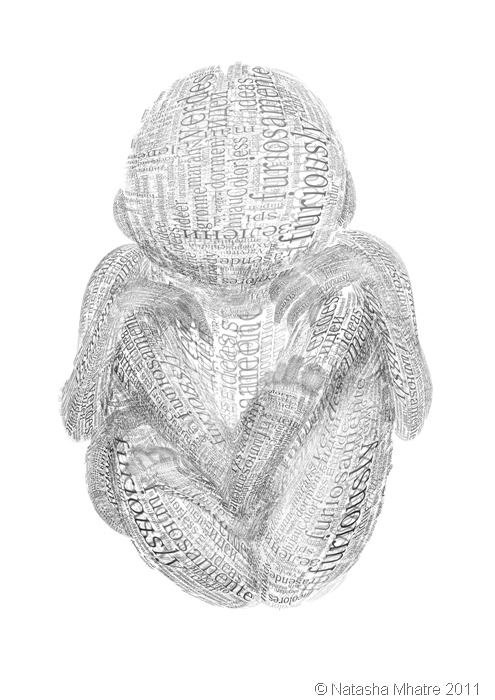
Over the years much arguement and fighting has ensued. In one of his moments, when Chomsky was ridiculing the probabilistic model of language, he coined the phrase, 'Colourless green ideas sleep furiously'. Its a phrase that could come out a statistical or purely structural model, its syntax is perfect and yet it means nothing.

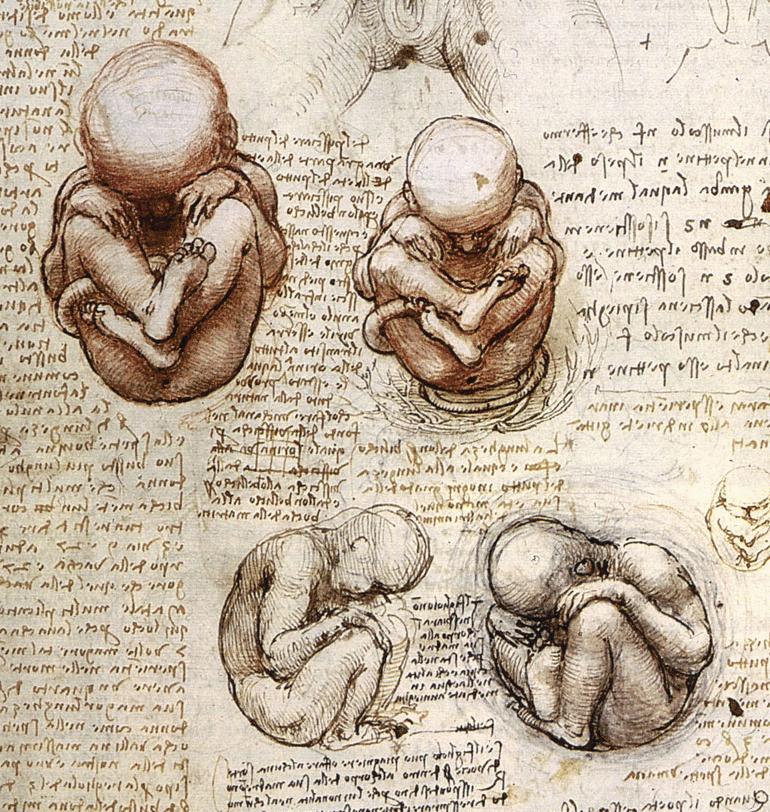
The language baby word beast (and we are beasts even if we would like to seperate ourselves, often on the basis of language itself) is made of that phrase in as many languages are the wordle site can encode. The baby is based on one of my favourite drawings, a fetus seen from a truly unusual angle by a master of many things, not least art and science. The baby is an oblique look at all the arguement that is dormant within our capacity for language.

Hat tip, to Daniel Robert who formed the nucleus of this word beast idea.