This is where some of my art/sciart goes. Look on the right for a link to my research website.
Saturday, February 25, 2012
Word beasts: an arms race
Friday, October 05, 2007
Frogs: whistle blowers
Frogs/toads are famously vocal and are characterized as calling 'ribbid ribbid' or 'croak' or what have you. The truth is frog calls are amazingly varied and come quite melodious. Their calls are species-specific and meant to attract mates. Males call, fight for calling spots, risking predation, in an attempt to mate with a nice large gravid female. A quick google will land you many calls of species all over the world, unfortunately there are not many Indian ones to be found.Common Southeast Asian toads mating. The female's below and big!
I've linked two recordings of two of the frogs I've made on campus along with the pictures of the frogs. I simply didn't know that we had many frogs on campus. Our few ponds are well hidden away and not perennial and my ears are tuned to other sounds. But a few others, including Ashok, are much better at this than I am. We went looking a few nights and I've so far added three more frogs to my list which had only one before. Ashok has heard more and I'm sure they are here. This is reassuring, they are still here.A male Alpine cricket frog and its call
Which brings me to why I called them whistle-blowers. It has nothing to do with their ability to call, I assure you. Frogs have permeable skin, shell-less eggs, and their life-cycle is spent exposed to both land and water. There is something frighteningly vulnerable about these creatures. And this vulnerability makes them good canaries in the coal-mine that is our planet. They are often the first to succumb to pollution, disease, climate-change and invasive species. Monitoring them is a good way of assessing an ecosystem's health. They are indicator species letting us know quickly that something is going wrong.Ornate narrow mouthed toad and it's call
Frogs all over the world began indicating rather frantically somewhere around the late 1980's and early 1990's. Among the first problems that were noticed by some frog watching kids were deformed frogs. By the time we had confirmed that these deformities were more common than could be explained by normal variation, very widespread and affected many species, we were already into the late nineties. Even today well into the 2000's we don't really have a prime candidate for what causes these problems. We have three candidates instead, increased UV radiation, chemical contaminants in the water and parasites. At least two and possibly the third as well are directly related to problems that have been created by humans, are anthropogenic. We are doing things to the earth's ecosystems that it's most sensitive denizens simply cannot take.An Alpine cricket frog plagued by fewer mosquitoes than the photographer.
So just how bad is what we are doing? A deformed frog is eventually an individual. And an individuals story is nowhere nearly as telling as the population's story that began emerging around the same time. The Golden toad, a beautiful Costa Rican amphibian, was in trouble according to herpetologist Martha Crump's observations in 1987. We saw the last Golden toad in 1989. In two short years they disappeared.There were many many reports after that talking about amphibian declines. Large numbers of once common frogs were simply disappearing, entire populations simply wiped out. Rachel Carson's 'Silent Spring' was transposed onto silent streams. Bruce Wilcox noted that between 1996 and 1998 of the 1874 backboned animals added to the Red List of Threatened Species, 1646 (89%) were amphibians! The statistics compiled in AmphibiaWeb also sound quite grim and this is not a resolved crisis. The causes for this decline are perhaps as complex and multiple as they were for the deformities. A large part of the decline is now believed to be explained by an epidemic of fungus. A fungus that is helped along by global warming.
Has anyone heard of the boiling frog experiment? We might be conducting it on a grander scale than we think and the frogs have already died.
The call of the two frogs : Alpine cricket frog & Ornate narrow mouthed toad
Further Links:
Ashutosh on the drugs that could be discovered from frogs
Jeff with much more on frogs.
Update on frogs: A story from BBC suggesting that there might be a cure for the Chyrtrid fungus!
Friday, May 25, 2007
The law of unintended consequences: Lantana camara
A superficial glance at this post might lead you to think it's about butterflies. It is in an oblique fashion, but it's mostly about the plant they are all feeding on, Lantana camara. Lantana off course is an exotic, among ecologists a much reviled one.
The native range of this plant is in Central and South America and the Carribean. Lantana was probably introduced into India as far back as the 19th century. It has probably been introduced on multiple occasions as a ornamental or hedge plant. Since then it has nearly taken over the landscape in India, and is now found just about everywhere. It has the dubious honour of being listed as one among the top hundred worst invasive species in the world.
![]() |
| Common Rose butterfly |
![]() |
Striped Tiger butterfly |
Lantana carves a niche all its own though. It take things one step further. It not only makes itself ubiquitous it has also made itself indispensable. Well, perhaps that's going a bit far out on the line, but certainly key to many ecosystem processes. The key to this plant's success in novel habitats has been two-fold, it's wide tolerance for habitats and it's fruiting and flowering phenology.
Lantana camara flowers and hence fruits through out the year. This plant is a readily available, ubiquitous and massive source of nectar and fruits. With native plants out-competed and locally extinct, Lantana becomes the key source of nectar for many species of butterflies. It is similarly extremely important to several birds as a source of fruit available throughout the year.
Common Nawab

This double whammy means once established Lantana cannot be easily removed without serious ecosystem disruption. Some unpublished work has apparently suggested that several populations of Western Ghat species now rely on Lantana and a crash will be imminent if there is uncontrolled removal of this weed. This off course makes removal of this weed and subsequent restoration of local ecology difficult. Many parameters will have to be considered when attempting such an exercise.
Twany Coaster

Not that dealing with this invasive has been easy. Large seed loads mean that even burning and massive chopping are simply a set-back, not an eradication. This has been a hard hard weed to deal with incredible rebound capabilities. ATREE in Bangalore has been leading one of the more interesting efforts to deal with this menace.
Hawk moth (shot of the week!)

Lantana furniture! Made by tribals in the Male Madeshwara Hills in Karnataka, the project is an interesting mix of community involvement into conservation practices with payoffs for both. So all of you homesteaders who might want to buy furniture might want to give ATREE a call and check out their Lantana catalogue at their offices. You'd be doing your bit.
Tuesday, May 02, 2006
Keystone species and co-evolution

There’s a lot of ways you could be a keystone species, produce a lot of food for instance, or produce food in a season where everything else doesn’t. Maybe all the energy in the system goes through this species at some point, and if you remove it there are two separate entities with no flow between them...producers one end, eaters the other. This is called a wasp waist system; the keystone species would be the one at the waist.
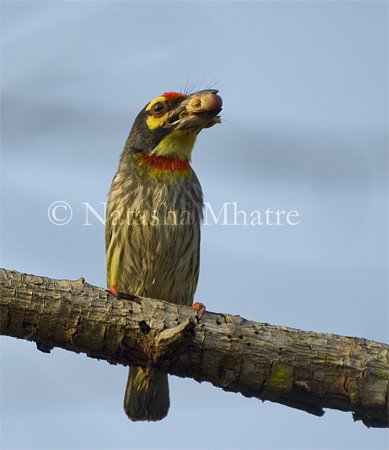
Fig trees are thought of as a keystone species. And sometime you can see why. They produce a LOT of food and often different trees will bloom and fruit at asynchronously, keeping food available to a system. There are usually a huge number of animals that will come to the smells of ripening fig fruits. Some of them will be young boys and girls on their way from school, off course!
We rarely notice figs when they’re not ripe however, which is kind of funny because a lot of other creatures do and they are attracted to them. Figs have another story going, one of co-evolution. The fig is actually a structure called a syconium and its flowers are enclosed inside it. For these flowers to be pollinated, a pollinator must get inside the fig. Here’s where the fig wasps come into the story. A female wasp finds a receptive fig digs into it, she then pollinates some flowers (in some species seemingly intentionally, in others not), after or along with this she lays her eggs in some of the flowers. And then dies. Several wasps may lay in a single fig. Once the next generation of wasps is born, the females mate with the males, the males dig an exit and the females fly off looking for the next fig.
(Dont have a pic of the pollinator yet, coming soon)
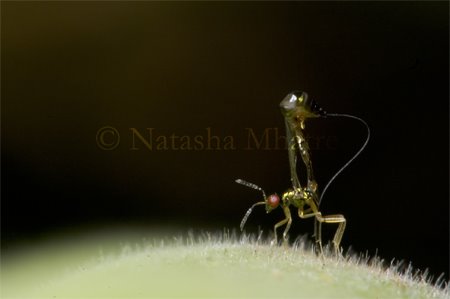
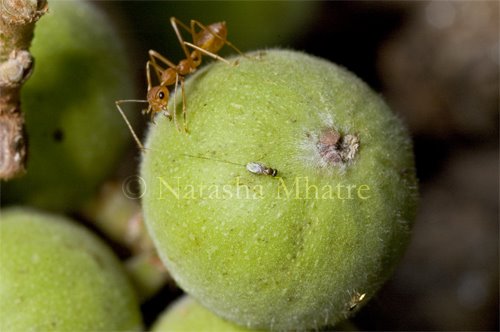
But that isnt it, there are others in the system, other wasps the gallers. These guys are in some ways the cheats of the system. They lay their eggs from the outside inducing galls for their larvae to eat. The larvae of some even eat the larvae of those that came before. Thats a galler laying eggs.Off course the gallers arent all shiny happy people, because right behind that lovely fig ripe for the laying lurks the big bad.........ANT. Red weaver ants, those big bad evil creatures that will shy from attacking nothing, wait for these wasps (pollinators and gallers) to eat them.

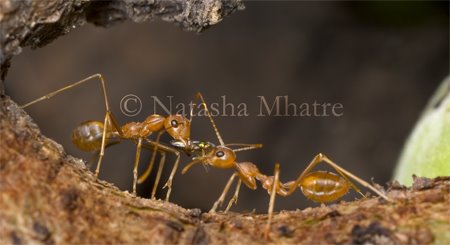
They get them too sometime, these little flitty things. Heres two ants fighting over who gets to keep the wasp.

So thats the fig wasp story, gleaned from the comprehensive presentation of Mahua and Yuvraj at CES, IISc.