Tuesday, November 15, 2011

Word beasts: a parliament of two

You might remember a moment when in you were choosing what you were going to do with your life in which it all came together or you may not. This may be the mythology of me that I've built myself but one of my markers was reading about the Jeffress' model in Eric Kandel's book, 'Principles of Neuroscience'. I remember thinking, that's cool, if I could do stuff like that I would love it. Somewhere there is the beginning of my love affair with modelling biological systems.

The Jeffress' model is a model of a neural circuit built to detect the direction that a sound is coming from. It's a beautiful and elegant model that has been found to be used by the brains of many different species, including humans. One of the most elegant bodies of work in neuro-ethology showed that this model holds for barn owls and explore many of the nuances of the behaviour.

The work of many people mainly Knudsen and Konishi and Catherine Carr showed that not only is the Jeffress model used to compute the azimuth but it also is used at several frequencies after a sound has been decomposed into different frequency components. This solves the problem of degenerate solutions that you could get from a pure tone sound. Apart from this, in perhaps one of the most 'awww' experiments ever, they showed that the auditory map is tuned to the visual map and this can be tuned and retuned but only when owls are young. It's beautiful work and this piece is in based on it. Imagine trying to sneak up on these owls as they were hunting and imagine that they found you instantly as you rustled through the teasels. They would find you with an accuracy of a single degree!

Edit 1

Tuesday, November 08, 2011

As many as tell the tale

The Indian right does it again. They dropped A K Ramanujan's essay in their quest for a perfect world with one sangha line way of looking at it.  So I thought I'd link to it. And revive this tale that's apropos.

Repost


As many as tell the tale

There was always the attention, the eyes that turned towards us throughout the entire journey and the steady stream of questions. We had tired of telling our stories, spending so much of our life like small change on insistent little children who came running up to us, asking, unbridled yet by convention. Our story was now becoming mere words. Every time I told it, reality seemed to erode a bit. It became my construction and not something that had really happened. It was to end soon; it was our last bus ride home.

I sat facing the window; my body sunk into his shoulder, with his arm around me. As I hunkered down for the long dusty ride, I realized that I had wondered whether we would even make it this far, but we had. He had gamely borne the sun, the scrutiny and enjoyed himself nonetheless. As the bus pulled out of the station and into the stone cobbled lanes of an ancient kingdom I said, “Tell me a story.” He nuzzled my hair and asked, “What kind?” “Old stories, tell me really old stories, they seem appropriate somehow. Tell me what the world is made of, tell me how it was made.”

It never took him long to come up with stories. We had lived worlds apart and our stories were different, we could rely on our old familiars being new to the other. “You remember that beautiful tree in the courtyard?” “Umm hmm, the Frangipani tree.” “It made me think of the Yggdrassil.” “What is that?”, I asked. He mocked something I’d said oftentimes before “You haven’t heard of it?” “I have”, I said smiling and then in my worst pedagogic voice, “but you have to tell me all about it. That’s how you tell stories.”

“Alright, my little Besserwisser”, he said indulgently. “So I’ll tell you how the world is made according to the Icelanders. There are these old, old Norse poems from about the 13th century I think, in these old books called the Eddas. Pretty much all of Norse mythology comes from them. They say that at the centre of the universe, standing in nothingness, there is a massive ash tree, which is the tree of the world, the Yggdrassil. It shelters and links all the nine worlds together. It is the source of all living souls in all the worlds. One of its roots is in the upper world of Asgard, where the gods live, another in Jotunheim in the Midgard, the middle worlds and the last in Niflheim in the Helheim, the nether-worlds, the realms of death. Under the Asgard roots, the Gods assemble everyday to decide on the affairs of the world, the Midgard root dips into Mimir’s well of wisdom and in Niflheim the tree is constantly chewed on by a snake called Niddhog, the eater of corpses, who continuously tries to destroy the Yggdrassil. Life and death and learning are all organised around this tree. But when Ragnarok comes, everything will be destroyed. Niddhog will be destroyed and so will the mighty gods and all the middle worlds and their puny inhabitants, only the Yggdrasil will remain. And from the tree, life will begin again.”

I pouted and teased him, “There they go, your stories, killing my snakes, making villains of them! Eating the tree of life! That’s even worse than the biblical story, which only makes them responsible for the fall of mankind. Only the mere and meager tempters of essentially flawed and weak humans. This is grander evil. Poor buggers, no one loves them at all.”

"Oh yes, little one, pick on that tiny bit of the story!" But then, smoothing down my mock ruffled feathers, he said, "To be honest though, there are positive snakes in all mythologies. For instance, the Ouroboros, the snake grabbing its tail is the gnostic symbol of eternal return, renewal, of the very soul of the world. Plato even called the Ouroboros the perfectly constructed animal because it had no need for anything other than itself and had nothing that was superfluous."

"Hmm, ok, so maybe they don't all make them bad. The renewal and return are quite positive and it also makes me think of Sheshnag. So, Sheshnag is the massive snake upon whose coils Vishnu, the preserving god of the Hindu trinity rests. He is Vishnu's constant companion, born with him on the earth in every one of Vishnu's ten incarnations, the dash avatars, which by the way is where the word comes from." Realising I made constant unnecessary diversions, I impatiently added, "Anyway, more to the point, the word 'Shesha' means what remains. And like the Yggdrassil, when the Universe is destroyed, all that will remain will be the serpent. He is the only truly eternal being, which is where his other name Ananta or the eternal comes from. In the Norse myth, the snake eats the eternal and in the Hindu one, it is the eternal and the Ouroboros is a symbol of eternity. Funny that snakes are so often linked to the forever."

Doubt still niggling away at me, I added "But there's loads of different Ouroboros aren't there? I mean mythic snakes that eat their own tails? And also the Christians don't take such a kindly view of the symbol, they don't see it as a eternity symbol, but one of being trapped in a limited material world."

"Well, the Christians always hated what they saw as pagan beliefs, they just found a way of twisting them into something ugly so people wouldn’t use them anymore. They were also just a bit more scared of fertility symbols, I think. But, off course, there are others, I think Quetzlcoatl is sometimes depicted as an Ouroboros; then there's Jorgmungandr, Loki's son, the world serpent who catches his tail while encircling the world. I can even think a non-mythological one and I bet you can't guess it", he said his eyes twinkling.

I squeezed my eyes tight against the distracting confusion of images that was tumbling through the TV screen of my window and tried to dig other images up. I gave up eventually and said "I'm going to kick myself for not trying harder, amn't I? Alright I'll bite, tell me."

“Aren't you clever?” He quipped while his fingers traced the contours of my ears as he half whispered, “Kekule’s benzene rings!” and waited for my protests.

I laughed rather than protest and said slyly, “And that’s a real story, isn’t it, unlike Newton’s apple apocrypha? Kekule talked about it himself.”

“Umm hmm, Yes he did. But I think some people think he might have confabulated. So it might not be a true story after all.”

“Such a pretty way of saying he lied! But yes, there were loads of different stories that floated around; different stories that he told different people. So it's thought he might have made all of them up. I wonder though, if a story is a true story as long as it is good, veracity be damned. Well, it certainly gets repeated more, and doesn’t what is called enough get called into existence?

Anyway, snakes of sciency legends, huh? Well, the staff of Asclepius has a snake wound around it, doesn’t it? That’s sciency, the symbol for medicine; it sometimes gets botched a bit, has two snakes instead of one, sometimes it’s done right too. The Greeks used to try and cure people of different ills by letting snakes crawl all over them in some of their temples. That’s believed to be the origin of the snakes on the caduceus. I wonder what kind of magic that is, cause it wouldn’t be Frazer's idea of sympathetic magic, would it? Seeing how snakes are associated with venom and all that.”

“Like I keep saying, it depends how you see it. In the epic of Gilgamesh, Gilgamesh at the end of his long and arduous travels, gets this plant from the bottom of the ocean. The plant was supposed to grant him eternal life but a snake eats it while he is sleeping and it becomes immortal instead of Gilgamesh. And that’s why snakes moult, as a symbol of being reborn again and again. So maybe it is sympathetic magic after all, the patients want a bit of that eternal life to rub off on them. I guess that's another bit of the forever that sticks to snakes.

And, the caduceus, there's also another story for it. Asclepius is supposed to have learnt the secret of immortality while he lay dying, by seeing one snake heal another using a plant. He used the same plant and revived himself. It might be this snake on Asclepius’ staff. Asclepius, by the way, was killed by Zeus for having acquired the secret knowledge of immortality. Zeus feared that all humans might become immortal if Asclepius told them about the plant and so he killed him. Some more snakes with forbidden knowledge. But not evil in this case, I guess, not temptors."

We must have gone quiet for a while at this point, because I remember looking up from the window and noticing the expectant faces around us. A half-lit, insulated tube, full of human faces, hurtling through a fading day in the Indian summer. I imagined for a moment that they were listening to our stories. But perhaps they were merely waiting for us to do something unusual. Or even were just surprised with our freeness with each other. They watched and I was amused and the bus carried on, on its dusty, windy way.

“With both her hands she labors at the knots.” He broke my reverie, and asked me, “What were you thinking of little one?” I sighed a little at having been woken up. It was starting to turn dark outside, the sky turning that beautiful inky blue, against which the tungsten lamp-lit streets and faces are so vivid and beautiful. “I was thinking of the sin of making everything human and how it is impossible to tell a story that at its core does not deal with our concerns. They are all stories of rebirth so we may live forever, fertility so we may be productive, so on and on.” “Well, that is true, I guess till snakes tell stories of themselves, there will be no truly snake stories. There will only be reflections of humans in snake skin. But there must be something, a story out there somewhere that is at least told in the voice of a snake. There’s just too many stories for there not to be one.”

Even the last light was now gone, I turned around and faced him, leaning against the window now. Happy to watch his face, exhausted as it was, but unhappy at not being attached to his hip as I had been for so many days now. We were drifting apart just then, exhausted by the traveling and the intensity of it all. The connection had to be reformed; that narrative had to be found again somehow.

“Well I suppose there is one, there is at least one story told by a snake. Krishna, one of Vishnu’s human avatars, performed many miracles when he still just a child, things that amazed even his parents who knew of his divinity, demonstrating he was no mere god. One of them was the taming of Kaliya, a terrible snake that lived in a lake near Krishna’s home. Kaliya was the bane of Krishna's people. He made a precious resource completely unusable. He spewed his venom into the water of the lake and made it undrinkable and no one could swim or bathe in the lake for fear of dying by his bite or the bite of his many wives and children.” “Evil, evil snake…” “That’s the general idea. But Krishna was not afraid of Kaliya and went to the lake and splashed around in it and sure enough Kaliya came along and attacked the little boy. Krishna was not going to be initimidated by some mere reptile and he jumped on top of Kaliya’s many hooded head while evading all his attacks and danced and danced on it. He danced on it till the snake was exhausted and completely subdued. And then he danced some more, he danced and danced until the snake vomited blood and was near death, he danced till Kaliya’s wives begged him for their husband’s life. And then he stopped.”

“So where’s the snake’s story?” “Patience, it isn’t done yet. When Krishna decided to spare Kaliya’s life, Kaliya was very grateful and thanked him profusely and offered Krishna his best hospitality. Krishna was pleased and told him he could continue living in the lake with his family if he pleased, as long as he harmed no one and did not pollute the waters. Then he went to Kaliya’s home with him at the bottom of the lake and lived with his family for a while, enjoying their hospitality, sporting with their maidens as he had done with those in his village. Krishna was a massive flirt, eventually married some ridiculously large number of women, some sixteen thousand of them. Anyway, one of Kaliya’s daughters told him the story of how they came to be at the bottom of that lake and how they became snakes.

She said that her father was a rich merchant who had lived on the banks of the Yamuna, a long long time ago. He had been very prosperous and had made a great deal of money. They had everything they could ask for and never needed to work to increase their riches. The whole family had grown accustomed to a life of profligacy and sloth. They would eat and drink and lie about and do not a thing for days on end. Their servants would carry them everywhere, to their baths and beds each day and even feed them like infants.

One day, they were all lying about in their front room after a huge lunch when a rishi, a sage with great powers, came to their door asking for alms. The servants had only just retired to their meal and no one in the family even stirred at his presence. He had to wait a long time to even be asked into the house. And when he came they did not think to ask his forgiveness, in their indolence they would not even offer him food or a drink of water. No one rose to wash his feet as is customary to do. Enraged at their sloth, he cursed them, he said these arms and legs you no longer use will fall off and you will crawl on your bellies everywhere. You will become ugly to the eye. You will be reviled by everyone around you, as you shun your duties to me, so shall everyone shun you. He cursed them that they would poison everything they touched and people will hate and fear them greatly. And before their very eyes, they all lost their arms and legs and became scaly and slippery and had to crawl on their bellies to get anywhere; in short they became the first ever snakes. The servants around them seemed terrified at the very sight of them and threw things at them attempting to kill them.

Swiftly, for once, gliding between the blows from the servants the family asked for the forgiveness of the rishi. After much pleading and groveling the rishi finally relented. He told them that they must go and live in the lake they now lived in. They would be reviled and feared and no one would come near them. But one day in the future the lord of the universe would come to them as a child and would fight the merchant who had become the biggest ugliest and most fearsome snake of all, Kaliya. Kaliya must fight the lord with all his might and he will come near death in this fight and in this fight he will be purified by the touch of the feet of the lord. And then if his wives succeed in begging for his life, they would be able to live peacefully from then on. They would remain snakes as they were now, but at least they would not poison the world and would not be hated by all. The snake girl told Krishna that they waited for many many eons for his arrival and were much relieved by his blessings. There that is the snake's story.”

Exhausted at the effort, I put my head on his shoulder and closed my eyes. As I started to drift away, I realized he was restless. I don’t know what tipped him off, whether it was the skeptical looks that I imagined our fellow passenger’s faces wore or whether it was that I had told him of the primordial snake before. He said to me as he wound his comforting arm around me again, “That’s a nice story, love, very evolutionary, but I think you might have taken a few liberties. Haven’t you? That isn’t a real version of that story.” I smiled through sleepy eyes, as the bus conductor turned off the lights to let us all sleep for the night leg of the journey, I said “There are, my love, as many as tell the tale.”
.................................................

PS. Do tell me if you like the stories. Or if you hate them and especially if you think they are so bad I should stop all together. Or best of all, if you know how I can make them better!
N

Orlando
In another skin

Tuesday, November 01, 2011

Word beasts: teaser

Care to guess?

Saturday, October 01, 2011

Word beasts: Language baby

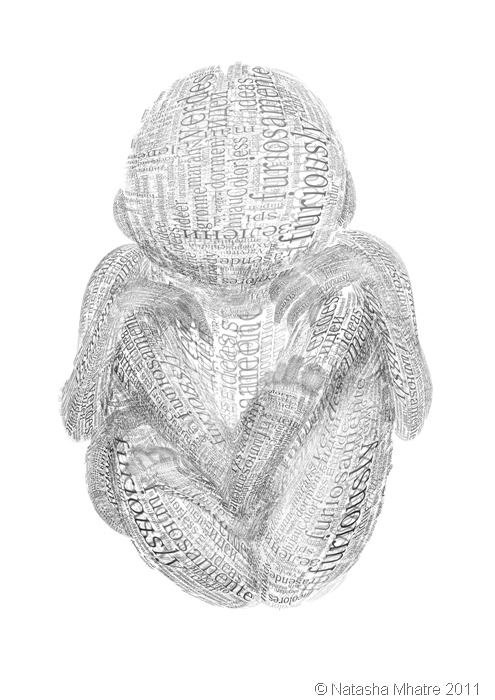
language baby small

The study of human language is surprisingly contentious. There are two camps, the words and rules camp and the connectionist camp. (There are perhaps more, but as I understand it, these are the two serious contenders.) The words and rules camp begins with Noam Chomsky's work on language in which he proposes the idea of generative grammar. There are many nuances and subtleties to it, that I don't even begin to understand. But I'll try to explain it as best I understand and remember it.

The rough words and rules idea (sensu Pinker which is an extension of Chomskian theory) is that the a baby's brain is not a blank slate (tabula rasa) when it comes to the syntax of language. What children are programmed to do as the learn language, is to treat what they hear in structured ways. During the acquisition of language stage they both abstract rules from what they hear and learn the meaning of the words. There are two types of memory that get engaged in this: procdeural memory, the procedure of transforming words to be used in a sentence and lexical memory, which learns the semantic meaning of the words.

The other ideas are called connectionist or emergentist or structural. (I'm less familiar with them, so forgive me if I give them a bit of the short shrift.) They suggest that children's brains simply make statistical models of language to allow them to learn it. They don't abstract rules but learn the statistical regularrities in language. These approaches are often accompanied by neural network models which they then train with a lot of text and see what language they are capable of producing. I personally find them a bit unsatisfying, but they keep the debates over language fresh and engaging.

Over the years much arguement and fighting has ensued. In one of his moments, when Chomsky was ridiculing the probabilistic model of language, he coined the phrase, 'Colourless green ideas sleep furiously'. Its a phrase that could come out a statistical or purely structural model, its syntax is perfect and yet it means nothing.

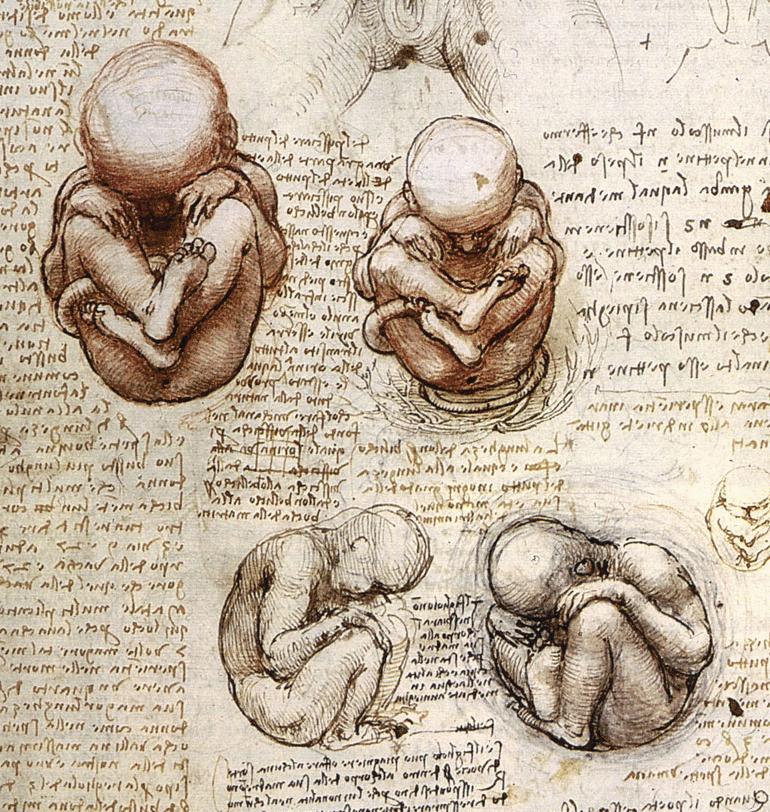
The language baby word beast (and we are beasts even if we would like to seperate ourselves, often on the basis of language itself) is made of that phrase in as many languages are the wordle site can encode. The baby is based on one of my favourite drawings, a fetus seen from a truly unusual angle by a master of many things, not least art and science. The baby is an oblique look at all the arguement that is dormant within our capacity for language.

Hat tip, to Daniel Robert who formed the nucleus of this word beast idea.


Tuesday, August 02, 2011

Horse tails and living fossils

I’m away in Sweden on holiday and was in some woods with my camera after a long time. I didn’t expect to find anything particularly exciting. But that’s not what woods are like is it? You make your own excitement in them. The beasties are amazing not in themselves but in the knowledge you possess of them, right? Or something like that. Thank everyone that ever figured anything out, they made the world a bit more wonderful for us all.
Now, plants don’t usually do a thing for me.Well, that’s unfair. I am beginning to appreciate things about them, especially that they are far less passive in controlling their destinies than we believe them to be. Nonetheless, in comparison with insects, or even birds and mammals, I know less about them and am less keen to.
I did, however, a long time ago do a presentation on plants and how they crossed over from being water loving organisms to being land creatures. Plants have done much the same as animals: crawled out of water onto land and then back again (sea grasses are an example of this). I cannot even begin to do justice to the profoundness of this moment in the history of life, plants are the engine of this planet. But although I may not be able to, Loren Eiseley is.

There were beautiful illlustrations in paleobotany text books and papers of ancient and giant and varied ferns that once were the only plants in the forests. The first plants to form a thin fragile green skin over the earths surface were ancient ferns. I saw one of those ancient ferns today as we strolled on a path by a river: a Wood horsetail, Equisetum sylvaticus.

Equisetum_sylvaticus_DSC4803

There were thousands of them, fragile and delicate, layering the forest floor with their delicate whorled leaves. Utterly beautiful in the broken light. The Horsetails are a living fossil. They are a member of a once (in the Paleozoic) rich and diverse class of plants, now reduced to handful of species in a single genus.
The only reason I know anything about them was that I took a class a long time ago. (And I had a camera and an internet connection and an internet rich and varied enough to help me track them down, but off course, in my mind, my personal history matters more.) I might have walked among the living dead and not have known it.

E_sylvaticus_DSC4805

Wednesday, June 22, 2011

Word beasts 9: The secrets of a Gecko

I could tell you about the gecko's foot and its remarkable self cleaning adhesive qualities. Or I could let Robert Full, who is a lot better at it, do it. Here is where you go to find out about the remarkable locomotory capabilities evolution has provided animals.

Sunday, May 29, 2011

Word beasts: reworking the amphibians

I wasn't too happy with this one from this post. So I reworked it. I think its better now. I've been asked to stop obsessing over it and to stop now please. So, I will.


PS: If there's beasts and work you would like to see worded, let me know about it. And if I find the work it exciting I'll do one! I tend to like research stories that are sorted rounded off and mature for the word beasts, not ones with just a few papers behind them. Just gives me more material to work with.

OR

Is this better? Vote, please, no 1 or no 2.


And here is what will be the final update: Its done now. Why, you ask? Because it holds together now. Its a tone painting. I've learnt to never start an unplanned image because of this image though. It was a nightmare trying to make it come together and work.


Monday, April 11, 2011

It isn’t tuffa to Cappadocia

Selime Caravanserai_DSC4430_1
Selime Caravanserai
There are fairy chimneys, hidden churches, underground cities, caravanserais along the silk route, a few quicscent volcanoes, tuffa valleys galore, a river and enough walks to keep you quite happy.


Fairy Chimney Pano
Fairy Chimneys
Rose Valley
Rose Valley

Pigeon valley_1
One end of Pigeon valley

Hassan_DSC4461
Hassan looms over Pigeon valley. Hassan is one of the three dormant volcanoes that spewed out the ash that makes the characteristic tufa landscape of Cappadocia.


Goreme
Goreme town

Wednesday, April 06, 2011

Deep and inscrutable singular name

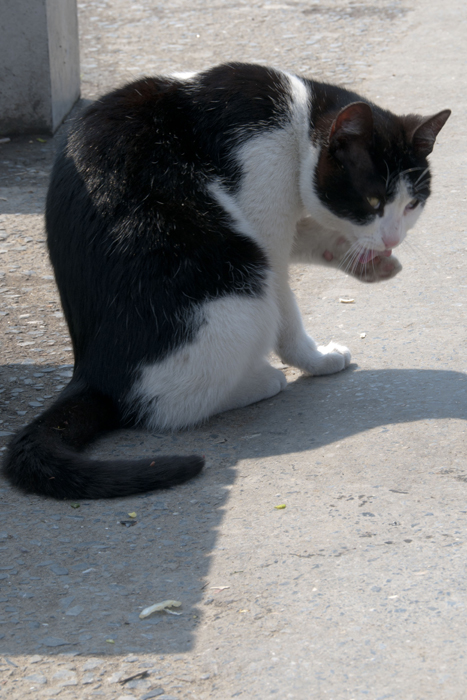
The cats of Old Istanbul are the most practical of all cats. And while you may name them as you please, you will never know their deep inscrutable singular name.

Even the Hagia Sophia's got its own Moggie


Saturday, February 19, 2011

Word beasts 8: Amphibian declines

detail3
Detail 1
I’ve written about this before. But I’ll quote myself to provide context to the images.

“ The Golden toad, a beautiful Costa Rican amphibian, was in trouble according to herpetologist Martha Crump's observations in 1987. We saw the last Golden toad in 1989. In two short years they disappeared.


There were many many reports after that talking about amphibian declines. Large numbers of once common frogs were simply disappearing, entire populations simply wiped out. Rachel Carson's 'Silent Spring' was transposed onto silent streams. Bruce Wilcox noted that between 1996 and 1998 of the 1874 backboned animals added to the Red List of Threatened Species, 1646 (89%) were amphibians! The statistics compiled in AmphibiaWeb also sound quite grim and this is not a resolved crisis. The causes for this decline are perhaps as complex and multiple as they were for the deformities. A large part of the decline is now believed to be explained by an epidemic of fungus. A fungus that is helped along by global warming.”


Stare frog flat3 small
Complete image

The fungus that I spoke of  belonged to a group of fungi called the chytrids, Batrachochytrium dendrobatidis. Its been a cause of great concern to the amphibian community. There have been a few reports of treatments that may control it particularly one with topical Chloramphenicol, a common broad-spectrum antimicrobial, often present in simple topical OTC compounds.
While I think this is good, I wonder whether these are scalable solutions. One can hardly pour barrels of chloramphenicol into streams and ponds. You’re then left with dealing with capturing and treating animals individually which is well impractical when one thinks of the pandemic scale of the current problem. And even if deal with this pathogen, another might emerge. And we have little in place to control it.
We’re doing a lot to this planet that is new and the responsibility for what happens is ours, whether we think so or not, whether we want it or not. They’re watching what we do, they’re holdings us responsible.


detail2
Detail 2

Sunday, January 30, 2011

Plenty and poverty: Word beasts 7

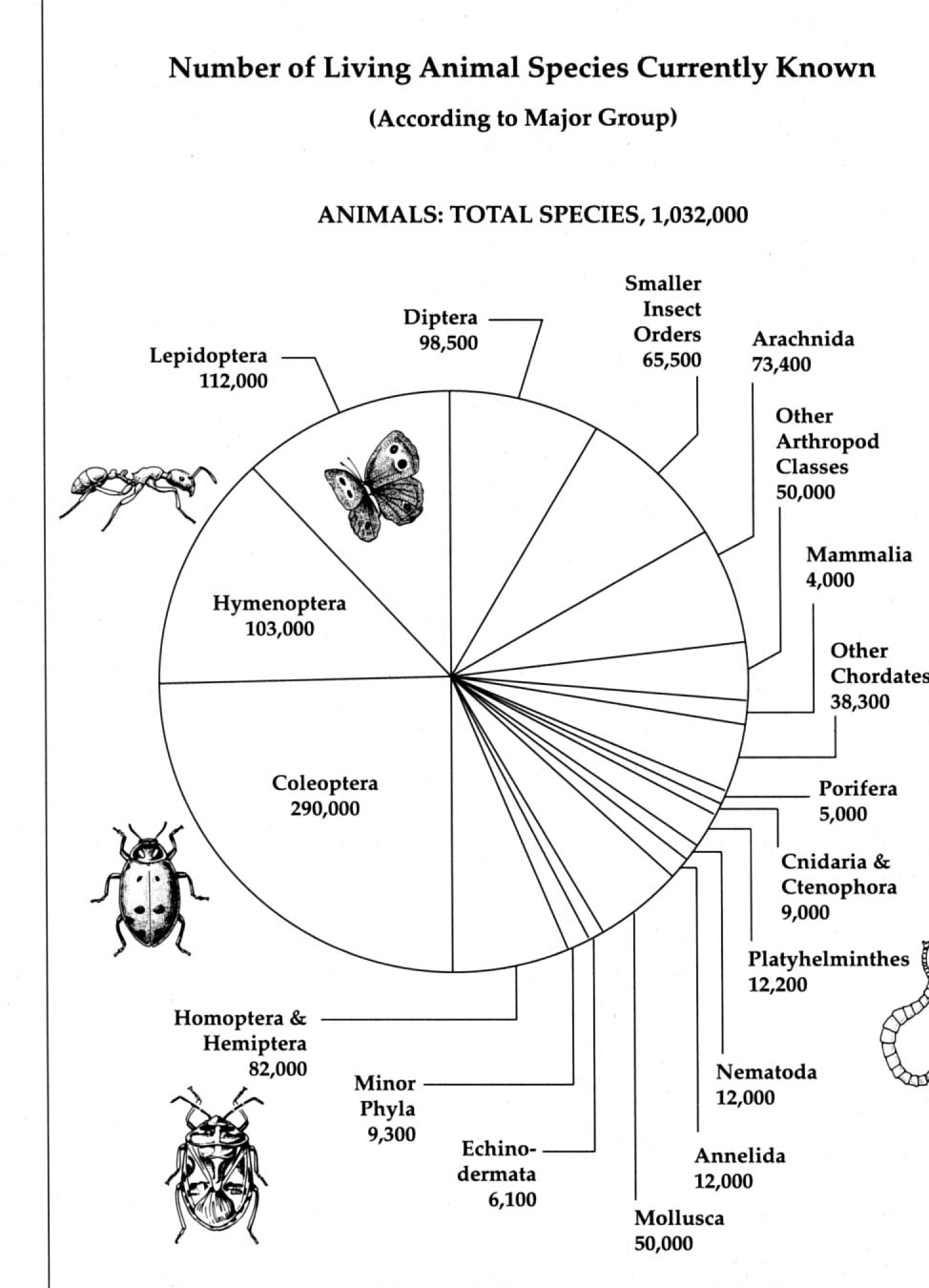
One thing about insects most people will not find surprising and will readily accept is that there are a lot of them. A lot. There’s a lot of species too, here is a good, if old, picture of how many more insects there are than other animals. The trouble is that people also think that there are far too many, and think that none of them are charismatic.
That’s a very incomplete view of insects, hopefully alleviated somewhat by such awesome documentaries as Life in the Undergrowth and champions of insect life as Dr. Mark Moffett, E. O. Wilson, etc. Insects need their champions pretty bad. And strangely enough they need academic champions as well.
The vast diversity of insects is not matched or reflected in the number of people working on them. Less so by the number of people working in insect taxonomy, the science and art of classifying insect species and studying their relationships. There are, off course, many reasons for this. Pure taxonomy in itself doesn’t attract as many researchers anymore; its poorly funded, publishing is difficult and if you are in the ‘developing’ world where most of the insects are, collections are often out of your reach in the elusive and expensive developed world. On top of this insects, simply aren’t attractive enough to people, even to biologists.
They aren’t as warm and cuddly as mammals, or as bright and vibrant as birds. (Unsurprisingly the insects that attract most people, as reflected by amateur naturalists, are the ‘pretty’ ones the butterflies.) And there are a lot of them, which makes life rather difficult. Their taxonomic features are often small and difficult to observe without a microscope, sometime without good dissections skills. It’s all just a bit hard.
These Dragons are meant to reflect just that aspect of insect biodiversity, its vastness and the fact that it is under-studied.
Dragons flat small copy
Thankfully, there is a silver-lining to this story. Thanks to one of my friends and colleagues in India, Indian dragonflies have escaped this ignominious fate. They are well documented and studied and there is even a lovely field guide. The extra special ice-cream on-a-top bonus is that its freely available online as part of the Lifescapes series!

Saturday, January 15, 2011

Word beasts 6: Frogs teaser

There is a finished piece, and an unfinished one. Somehow I thought you’d enjoy this little teaser from the unfinished piece more.
teaser copy

Monday, November 22, 2010

Myth and science: word beasts 5

I stumbled on the Norse idea of a fylgja while I was mucking about on wikipedia to write this story. The idea of a beast that accompanies each of us, a symbol of our fortune, as we make our way through our life appealed to me somehow. I’ve been known to give people animal names. I’ve had a kitten for mine as far back as I can remember.
Eventually I stumbled on Odin’s fylgja, the two ravens, Huginn and Muninn, thought and memory. He sends them every day across Midgard to bring him news of it. And each day he worries that they will not return.


For Hugin I fear lest he come not home,
But for Munin my care is more.

I was amused. Today we know that crows/corvids are indeed quite clever and capable of both thought and memory. They have earned their legendary titles. They can do an awful lot of clever stuff. They can figure out how to complete a task using a series of tools in ways that require them to reason. They cache and store food away, and then recover it, They modify their caching behaviour depending on whether or not another crow watches them showing they can infer about the state of knowledge of another creature, something human children learn only after four years or so.
Huginn and Muninn, thought and memory, then became my next word beast project. The ravens are made from the science that investigates their cognitive abilities, their ability to think thoughts and make memories.
Huginn and Muninn copy small

Monday, November 08, 2010

The law of return: word beasts 4

I had to pick the next beast in my bestiary. I checked up on my obsessions and tried to find the one that hadn’t been satisfied enough. I found one: mantises. I never really managed what I thought was a satisfactory photo of a mantis. I made one that is truly not bad, but even that one wasn’t perfect. And so a mantis it would be.
The words in the wordle were based on research on how they catch their prey. About their ability to judge depth using what is essentially parallax…So I made one and here is the first one.
mantis simple copy small
I’ve shown it to a lot of people and a lot of them love it. Yet I simply wasn’t happy with it. There were parts of it I liked, the arms and the spikes were a simple new innovation I made just for this word beast. The eyes were cleverly made with the same method.
Yet the whole thing didn’t really hang together for me. It didn’t really have the sense of 3D depth which the ecology picture did. There was nothing interesting going on like the interplay in the ecology image, or the courtship with the snakes, or even the simple Escher idea in the ant. That little extra bit of edge was missing. Which it really shouldn’t be in any image that needs to stand on its own rights. Especially with an animal quite as dynamic as a mantis. So I went back and started again.
It is really easier with a photograph, you go back and take the image again, if circumstances cooperate. With making something as complex as this, with a million different small moves that you make to achieve the whole; something which takes ages. It was a bit hard to fight the inertia to start again. But as you might know by now, I return. So I did and it was worth it.
Mantis_fight_posture2 small
For those of you that want to make images with words but haven’t the patience for something this work intensive, there might be hope yet. I stumbled on this website, tagxedo: it will allow you to make 2D word images. I haven’t played with it nearly enough. I’m sure you will! Have fun!
(PS as always, on redbubble should you want it)

Thursday, October 21, 2010

BBC Wildlife photographer of the year 2010


Bence Mate, has been winning for many years now, as a young photographer and as a youngish photographer and now as a full grown complete winner. I've seen nothing but the main winner so far. But I have to say I love it! Its the first time in many years that an invertebrate has been top of the pile! It's awesome!

Have a look here.

Saturday, October 09, 2010

The bestiary discovers my roots: word beasts 3

It was obvious to me after the snakes that there had to be more. A bestiary was on its way. It was a matter of choosing who it would contain and what words they would be made of. I thought about the beasties I like, that I hadn’t already made word beasts of. With my photography, I’d developed obsessions with certain animals, with dragonflies, mushrooms, fireflies, lorises, mongooses, and so on. I decided to pick one of my perhaps much too photographed subjects. Someone had recently said to me that ‘Oecophylla rock!’, and they certainly had been one of my obsessions, so Oecophylla it would be. The red weaver ant and I have other history as well, so it made sense.
So what would my ant be made of? I figured it should be made of words about ants, and I figured the best ones would be the words of the hundreds upon hundreds of scientists who have worked on these ants. As social insects they get some of the best scientific press out there and have been fascinating (and sometimes discomfiting) to everyone from Darwin onwards. There would be no dearth of words on ants. So I collected a whole series of abstracts from scientific papers on ants and plugged them into wordle to make me some word sheets to work with.
It all seemed very poetic when I thought about how we as scientists make a conceptual ant in our minds, in scientific literature; an ant that has existence in our traffic alone, outside the real world of the ant itself. And how my ant was an ant reconstituted from our conceptual ant, the ant of scientific communication. This was the first result based on one of my photographs.

ant_only copy

It was a bit bland, needed something to stand on and a background so I provided one that looked as natural as possible; like vegetation bokeh in the background of a photograph.

ant flat copy

Now, I could have stopped there, but it somehow felt not enough. It was beautiful, to my eyes anyway. Every little piece of that ant is built from the word sheets wordle made. Including the lovely elbowed antennae. The work to make these is long, but it gives you what must be a taxonomist’s pleasure in dwelling over every detail of their anatomy. Yet not enough.
But when I thought of Escher and his ants, and made him a homage, it was finally enough.

ant_mobius white copy

Wednesday, September 15, 2010

The bestiary grows: word beasts 2

Even after I finished the CES brochure, I still itched to make more word beasts. It seemed like they had potential (You can tell me if you think otherwise, I’ll really be happy to hear!). I wondered what I could do with them. I thought of one place I simply had to use them.
To tell you what that was about, I have to take a bit of an detour. Many years ago, when one of my little cousins was indeed little, in a creative fit I wrote a short story for him. About snakes. He was fascinated by my, shall we say, involvement with them. So I wrote a short story for him and promptly forgot it existed. It never reached him and probably never will since he’s grown up now and isn’t very fond of reading. The odd thing is, I don’t actually remember writing this story and I’m usually quite good at remembering my creative moments. Ask me about almost any of my photographs and I will remember the specific circumstances that surround it. Maybe, its just a sort of curious photographic memory about photographs…
Anyway, several years later, I found this story on my computer and reread it and liked it. It was okay, it didn’t make me want to puke. And I thought, hey, there’s the root of something here. The story was a sci-fi short and about snakes, specifically about the fact that they moult (This one). And I figured, maybe I could write a series, each in a different genre, each highlighting a different aspect of snake biology. As it stands there are four and a half. (I’m struggling with the half because I picked a particularly hard genre to write it in. Its interesting so far, and I love it, at least the process. Despite the fact that I actually hate writing, go figure.) All these and a few more will end up in a book of a sort. I have some ideas on how it all structures together and I’m excited about it.
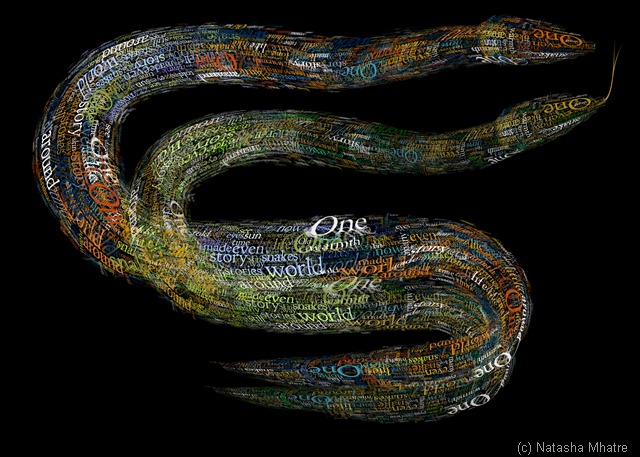
This book, I figured, will need a cover. And that is where the word beasts came in. Beasts made of the words that make them up. The words of the stories that make snakes come alive (hopefully) in your head, make the snakes in my images. Here are those beasts, courting, hopefully to mate and produce more words and beasts.
Snake
PS: Also would anyone like prints? Know of a good print on demand site, one where I can submit an image and they mail you the prints? Particularly one that works for an Indian audience? I am on RedBubble. If enough people are interested I’ll put a few images up there.
Comment, tell me what you think!

Friday, September 10, 2010

Word beasts

Where did it all begin? A year ago, now. It began with too many words and not enough images. It began when I agreed to make a brochure for CES for its silver jubilee celebrations. I had a lot of text, a lot and very few images. And somehow an appealing document had to be woven from this. There was the cover to be made. What do you put on the cover of a document that is to be made for a whole department? That represents what everyone does, that keeps everyone happy.
The department’s logo a long time ago was designed with a Racket tailed drongo in it. It’s rarely used, but there was an idea someone had suggested. Now I didn’t have an image of this bird. And really I am not going to swipe something of the net. But there were these images, they were hauntingly beautiful. Haunting in the niggling way like sand in your shoes. I wasn’t going to nick them, and I didn’t think we could organise to pay. So I set it aside.
Then I thought I would use the words somehow, the words to make the artwork. That was the first good idea I think. When I was younger, I used to think that somehow looking at other art would influence me, and make my work derivative. I’ve given that up now, I’m of the Wharton school now. So I looked up what others had been doing. A lot of it then was stuff like this. So well, I thought, I sure as hell am not going to do anything that requires me to do paste each word in to a template. So I thought, maybe I could reshape a sheet of words.
That’s where it got interesting. I remembered tag clouds. And I dug around and found Wordle. I took the text from the brochure and plugged it in. Made lots of different shaped, coloured and fonted word clouds. Now what? Well, import them into Photoshop. Start to reshape them. How, well, see what you can use. You don’t want to cut words out, that’s clumsy. What you want is to shape them. And then I started a few simple techniques which gave me the results I wanted. Which will be obvious if you look at these images. This which may be familiar to IIScians and ended up on the poster was among the first products that satisfied me:
PosterCes
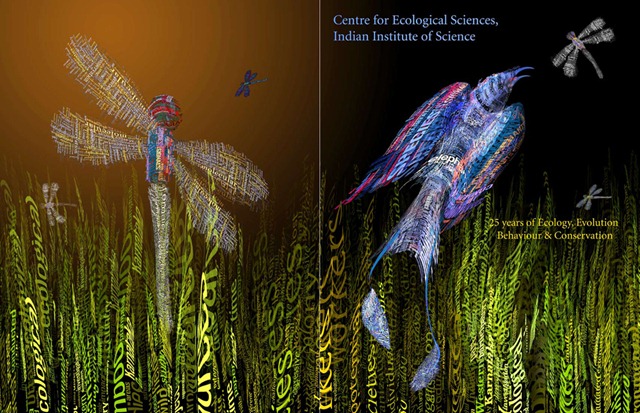
And there it was, the start of the word beasts. CES got its brochure and I love what I did for them. Here is what CES got, the front on the right, back on the left, think of it as wrapping around the book. I quite like it. It has everyone’s work right up there in front, it depicts the work in a sort of way as well, the ecology of it all. So I think, that went well finally and the drongo did find its way back, so, no more haunting.
CES_All_pages-cover wrap
But that was not and will not be the last of the word beasts. There are several more in the works, (slow and painstaking work unfortunately). Coming soon…

Friday, September 03, 2010

Lake district

We had good light for one day, so most of the pictures are from that one day. The rest were dry but overcast. Ah well, we concentrated on walking. A lot. C carried my camera a lot, this is getting to be a bad habit.


And the best company