Showing posts with label snakes. Show all posts

Monday, December 28, 2015

Gender bender


Click pictures to embiggen

A lot of natural history comes from patience, from watching for events that only happen rarely, and then are over, in the blink of an eye. There are, of course, some very spectacular natural events that aren't exactly sneaking up on you. More like, they walk up to you and grab your attention by the collar. Collective behaviour, has definitely been one of these: a large number of organisms doing things all at once, and somehow, together. Crowds, swarms, flocks, schools, all sorts of collectives are being studied. Advances in theory, measurement and notions of emergent behaviour have all led up to this.


The emergence of red sided garter snakes (Thamnophis sirtalis parietalis)  in Narcisse, in Manitoba is most certainly a collective event. And the sheer number and coordination is impressive. How do thousands of these animals time their collective exit so exactly? How do they know that now is the time to crawl to the surface for their annual spring orgy? A few thousand snakes out at the same time is definitely the thing that brings so many people out to Narcisse, in the middle of the otherwise featureless flat Manitoba plains. But it isn't necessarily the most interesting thing going on here.


Well, what is going on here?

Before there were the flat lands, there was a first a huge ice sheet and then a huge lake in Manitoba, lake Agassiz. Agassiz was formed from the melt waters of that glacial ice sheet from the last ice-age. The ice-sheet was so large and heavy that Manitoba may still be undergoing isostatic rebound (i.e. the land-mass is still lifting back up after a weight was removed from it!). It is the reason the land is so flat and featureless, the ice sheet scraped everything down to nothing.

So where did all the water go?

Some of it remains in the remnant lakes, lake Manitoba and lake Winnipeg, that are nearly large enough to rival the great lakes. Some of it went underground and carved very deep caves into the bedrock. Some of these caves are so far below under the ground, that they are below the frost line. When winter comes to Manitoba and surface temperatures drop below -30 degrees Celsius, in these deep caves, its still above freezing. So at some point in the geological and evolutionary history of Manitoba, red-sided garter snakes started using these caves to hibernate. In the fall they go underground and they sleep off the winter there. Come spring, when the temperature is a bit more conducive to a happy life for  a cold-blooded animal, they all wake up nearly at once and out they come!


And when you see the numbers, its seems like it is all at once, a few thousand at once. This is already quite the feat: for a few thousand snakes to time their metabolism so they can all emerge within a day or so of each other. But it's not even the best of it, it gets even more interesting. It isn't all at once. Males tend to come out first, when it still isn't quite warm enough outside. And once they are out, they hang around, soaking up what little watery sun they can get; here they wait. They're waiting for the females.


When the females do wake up and make their way out of the cave, a whole bunch of males are waiting for them right at the entrance. The males will then proceed to chase every single female as she comes out of the cave. Several males chase every single female that comes within their ambit. They try their best to align their bodies up against the females, to wrap around her and to mate with her, all the while signalling to her with pheromones and by rub her with their chins. If enough of them try to do this at the same time, it leads to balls of snakes wound tightly around each other, often known as mating balls.

A mating ball
The balls form and dissolve constantly and not always because the deed is done. Mating balls do not always have a female core with a male outer layer.

Sometimes a mating ball is all male.

Some males will pretend to be female in order to attract courtship from other males. The snakes seem to recognize each others sex only through pheromones which they detect on each others skin. Snakes don't have external genitals and male hemipenises are held inside the body and everted from the cloaca only during mating. So all the males need is a chemical disguise. So gender-bending males produce female pheromones and this is enough to fool the other males into courting it and making mating balls around it.

Why on earth though? Well, for the one thing that most cold-blooded animals are short of: warmth. The core of a mating ball is warm and is constantly being warmed up by the bodies that pile up around it. Typically these 'transvestite 'males come out later than the other males, they might be in worse physical condition, and so cold and unable to court other females by themselves. By attracting a mating ball around themselves, they can raise their body temperature a few degrees. For a cold-blooded animal, that's a pretty big deal. When this is done, the gender bending males seem to turn the female pheromone off magically. With the other males no longer pursuing them, they get down to finding some mates of their own. In fact, the current theory is that the female pheromone has just the right degree of volatility: when the male's body temperature rises to where it needs it to be, the pheromone just evaporates off on it's own!


There can be a cost to this trickery, a cost some females pay and some males probably do as well. The mating ball is a pretty frantic affair. These congregations last only a few days, so the urge to get it on is very very strong. And sometimes the mating balls end up suffocating the female they are formed around. With the males there is the added fear of injury from forced copulations. So this strategy isn't without risk, but what a cool adaptation!?

In almost all systems, there's a lot of amazing detail beyond the obviously impressive spectacle and I hope we can keep looking beyond the obvious and finding it.

Have a great Christmas break, guys!

PS: A lot of the research done here was done in the labs of Richard Shine and Robert T Mason in case you want to read some of the primary literature.

Monday, May 25, 2015

A brief glimpse at my weekend

A self portrait in shadows.

Wednesday, September 15, 2010

The bestiary grows: word beasts 2

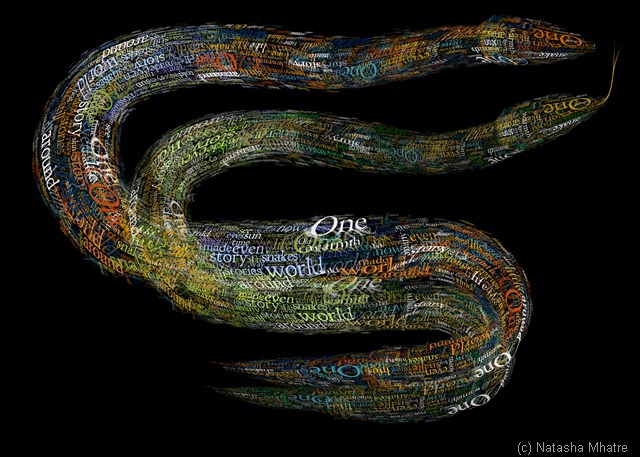
Even after I finished the CES brochure, I still itched to make more word beasts. It seemed like they had potential (You can tell me if you think otherwise, I’ll really be happy to hear!). I wondered what I could do with them. I thought of one place I simply had to use them.
To tell you what that was about, I have to take a bit of an detour. Many years ago, when one of my little cousins was indeed little, in a creative fit I wrote a short story for him. About snakes. He was fascinated by my, shall we say, involvement with them. So I wrote a short story for him and promptly forgot it existed. It never reached him and probably never will since he’s grown up now and isn’t very fond of reading. The odd thing is, I don’t actually remember writing this story and I’m usually quite good at remembering my creative moments. Ask me about almost any of my photographs and I will remember the specific circumstances that surround it. Maybe, its just a sort of curious photographic memory about photographs…
Anyway, several years later, I found this story on my computer and reread it and liked it. It was okay, it didn’t make me want to puke. And I thought, hey, there’s the root of something here. The story was a sci-fi short and about snakes, specifically about the fact that they moult (This one). And I figured, maybe I could write a series, each in a different genre, each highlighting a different aspect of snake biology. As it stands there are four and a half. (I’m struggling with the half because I picked a particularly hard genre to write it in. Its interesting so far, and I love it, at least the process. Despite the fact that I actually hate writing, go figure.) All these and a few more will end up in a book of a sort. I have some ideas on how it all structures together and I’m excited about it.
This book, I figured, will need a cover. And that is where the word beasts came in. Beasts made of the words that make them up. The words of the stories that make snakes come alive (hopefully) in your head, make the snakes in my images. Here are those beasts, courting, hopefully to mate and produce more words and beasts.
Snake
PS: Also would anyone like prints? Know of a good print on demand site, one where I can submit an image and they mail you the prints? Particularly one that works for an Indian audience? I am on RedBubble. If enough people are interested I’ll put a few images up there.
Comment, tell me what you think!

Friday, November 23, 2007

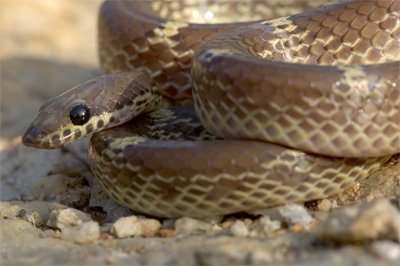
Wolf snake

Just eye-candy for today. And a link for a photography competition website. Andrew, the webmaster, e-mailed me to let me know about it and thought you would be interested too. He seems to be doing a great job, aggregating the important details upfront for your convenience, especially about how image rights are handled in the competition. Watch out for those alright?

And many many thanks to Brian of Epic Edits for featuring my blog and feed in his feedlist.

Thursday, July 13, 2006

Don't try this at home

I get a lot of traffic both here and on my website because of snakes. Its not really surprising I guess, they're fascinating, have captured the imagination of many.

I've had a lot of opportunity to work with them over the last 5 years(!). They're fun, scary and hard to photograph. All animals are camera shy, snakes seem to be particularly so...well ok maybe I just think so...

They're kind of difficult to really vary very much in terms of depiction. Sometimes theres a specific thing you're after and that works.

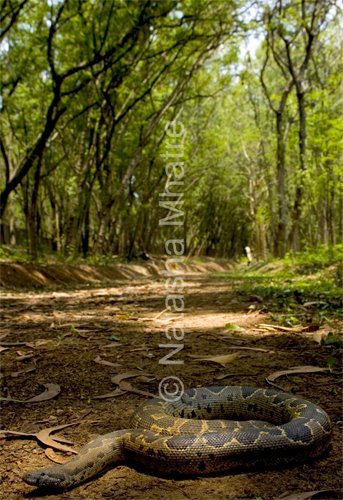
Other times the story has to built by the viewer. (How I wish the Russell's earth boa image had a person walking down that road in it ....how I wish. It would complete the story with less effort from the viewer....
Other times I just like patterns. Not everyone necessarily likes them or even gets the stupid visual puns involved. The Indian Cobra's latin name is Naja naja naja, pronounced with a j ...Na ja as two separate words in Hindi mean "don't go".... Now you get it ?

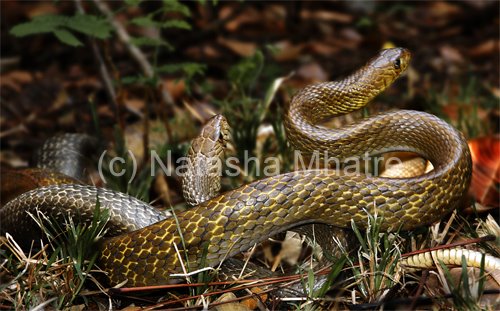
If you're really really lucky though you get to watch some truly amazing behaviour and then to photograph it up close. Like the Rat snakes in combat dance below. Its a long ritualised display for dominance between two male snakes, which occurs in the breeding months, the months at the end of winter approaching summer. This was in the days that I didnt have all the appropriate lenses...I took it with a 28-105, you can go ahead and try and guess how close they were to me....Not that i was afraid they were much too engrossed in themselves to worry about me. And anyway, all I could worry abt was the perfect shot. Don't you just love all that muscle and movement?

Anyway...parting shot... good night.!

Monday, June 05, 2006

Convergent evolution? Or Whats a blind snake?

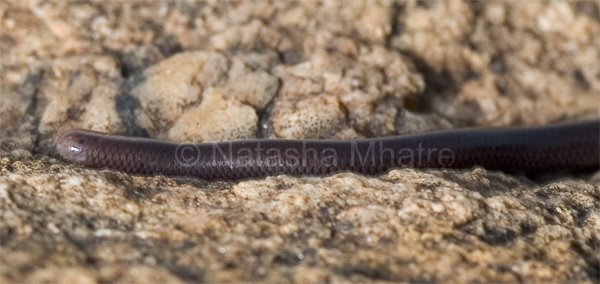
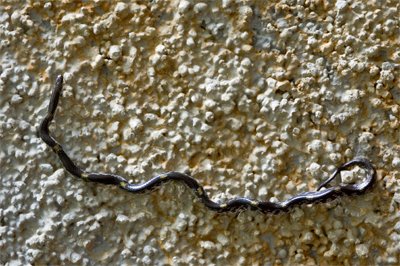
Does that look like an earthworm? Look closely? An earthworm would have a large band about a third of the way down from its head. And you would see horizontal segments. You dont see them here.

Well thats cause its a snake! They're called blind snakes. They're burrowing animals, the same size as an earthworm albeit a little darker. If you look closely you'll see the scales. The burrowing lifestyle obviates the need for eyes, so they have very very reduced eyes which are covered with scales. They can probably just make out light and dark. You can see them in the second image.

So if you ever see an earthworm that moving sort of too quickly and too much like a vertebrate, its cause its a snake.


Do you also notice that while the head (which is poking out through the loop of the snakes body) is blunt, the tail is kinda pointy? This snake and I think many other species poke you with the pointy end! And yes they smell! The mouths too small to bite, I believe they use a funny eating mechanism called 'mandibular raking'. Heres some videos made by a guy who works on them.

Friday, December 30, 2005

Wall climber


Meet my christmas present! Wolf snake (Lycodon aulicus). Often mistaken for the venomous common krait, these are non-poisonous. And great wall climbers. We caught him/her from PD block and took some photographs and let him go....heres another one.