Showing posts with label conservation. Show all posts

Monday, November 12, 2007

IISc green gang: Clean up 2

Some of the folks in this Saturdays clean up
The Green gang revived itself. We sent out a mail last week asking for people who were interested in green issues particularly as regards the IISc campus. We got a few responses, not overwhelmingly large in number but definitely some. Some of the folks who wrote couldn't be there this Saturday, but there's always next time. A big thank you to those who did turn up and participate.

What I'm really hoping for though is to see more students involved in this. A lot of the responses to this little project was from IISc faculty (which is great!), but not as many students as I had hoped (whys that?). Apart from CES students and Satyam, there were no others! (I love my juniors for their candor, by the way, credit where it is due.) I can't believe the rest of the students care so little and take so for granted the place we live in, that we're so complacent. C'mon folks, show a little something, signs of life? Is this why the place is such a mess in the first place?

A discarded chair: was against the wall. Was it being used for unauthorized entry?
We did our first round of cleaning up this Saturday around the GPS and the path in Jubilee. We did do a bit of cleaning along the CPRI wall but really that seemed too much for us to handle by then and by ourselves. That'll need a bigger group and implements. It's smaller than the huge dump I wrote about earlier but bigger than a quick job. And the junk is truly bizarre. There were the inevitable bottles of booze, plastic cups, bottled water bottles and other food type stuff from the CPRI community centre. There were old clothes(!) and a blanket. There was glass tubing of different gauges(?). In the area of the wall near their pump-house, there were car seats, shoes, the usual stuff and ...two chairs. The place is due and ripe for a garbological study.

The two chairs I speak of

There will off course be more coming up soon. Feel free to mail us at the addresses below, to join or even to suggest things that need to be looked into.

Monday, November 05, 2007

Chris Jordan: Conspicuous consumption

The number of plastic bags used in the US in 5 seconds (60x72 ")
How many cellphone models have you had? How many plastic bottles of Coke/Pepsi/etc did you drink and dispose over the last week? How many times did you stop at the coffee kiosk and do you remember where you put your coffee cup? How many print-outs did you take? Were they one-sided? Did you leave the tap running while you brushed your teeth? How many computers have you owned and what happened to the ones you no longer use? Did you go shopping, did you accept plastic bags?


Actual size detail of previous picture
Chris Jordan is an American photographer who's concern is consumption and the scale of it. It seems like a small thing when you see your own waste, but most of us fail to account for the fact that there are hundreds of thousands of people who lead the same lifestyles as us. We fail to account for the size of the problem when do this. Large numbers numb human beings, we cannot process numbers like millions and billions, they are no understandable scale with respect to the ten fingers on our hand. Often to understand them we need the analogy of physical scale. Here is a commonly repeated physical analogy for large time scales:

"Man has been here 32,000 years. That it took a hundred million years to prepare the world for him is proof that that is what it was done for. I suppose it is. I dunno. If the Eiffel tower were now representing the world's age, the skin of paint on the pinnacle-knob at its summit would represent man's share of that age; & anybody would perceive that that skin was what the tower was built for. I reckon they would. I dunno. - Mark Twain"

Chris Jordan's work does exactly this, you see in space what we consume in time and when you consider how much space we occupy, obliterate in how little time hopefully you pause to think. Here is part of his statement, I find it intriguing that he also perceives and worries about the damage to our spirits from this frenzy of consumption:

"The pervasiveness of our consumerism holds a seductive kind of mob mentality. Collectively we are committing a vast and unsustainable act of taking, but we each are anonymous and no one is in charge or accountable for the consequences. I fear that in this process we are doing irreparable harm to our planet and to our individual spirits.- Chris Jordan"


Fifteen minutes of Energizer battery production. Size scaled as if the batteries were depicted at true size.

We, as a country, probably do not yet consume quite as much as the US. But I reckon that in some pockets of Indian society, our consumption levels are as high. With the kind of economic growth that gets much touted in the MSM, some of us are definitely getting there. It is any rate something that many aspire to and that all media now pushes us to aspire to. We need to think about what we're doing. Every time we buy, every time we discard. Can we do without this? Can I use this some more? Do I really need that new shiny thing? Because one day we might be choking on growth.

Recommended viewing: Running the numbers; Intolerable beauty

Monday, October 15, 2007

The clean up

Vidur's bag of garbage
As you might have guessed from Joyshree's comment on the last post, something did happen. Abi sent a mail to many people who live in those quarters. One of them was Arati who decided the best way to begin tackling the mess, was to at least begin ourselves.

A whole bunch of people, faculty, their families and some students turned up there this Sunday at 10:00 and began cleaning up the place. I think I can safely say we made a dent. We hauled a lot of garbage away. The pile in the picture is just about half of it, the other half had already been safely transported to a nearby garbage bin. And the picture is short on a few people as well, some folks left before we took the pictures.

Group photo: not everyone's here (PS. Take a look at the sign)
After the clean-up there was a discussion on what could be done about this specific problem and about waste management in general. A few things got chalked out and various people have taken up responsibilities. I think it's got the ball rolling on many issues and I hope that the group can sustain momentum. In all, it was a really great afternoon.

I can't say enough to thank all the people who got down and dirty! Thanks! Especially Abi and Arati.


Full size images in the Picassa gallery here.

Bloggers Unite - Blog Action Day

Friday, October 05, 2007

Frogs: whistle blowers

Common Southeast Asian toad males fighting over calling space
Frogs/toads are famously vocal and are characterized as calling 'ribbid ribbid' or 'croak' or what have you. The truth is frog calls are amazingly varied and come quite melodious. Their calls are species-specific and meant to attract mates. Males call, fight for calling spots, risking predation, in an attempt to mate with a nice large gravid female. A quick google will land you many calls of species all over the world, unfortunately there are not many Indian ones to be found.


Common Southeast Asian toads mating. The female's below and big!
I've linked two recordings of two of the frogs I've made on campus along with the pictures of the frogs. I simply didn't know that we had many frogs on campus. Our few ponds are well hidden away and not perennial and my ears are tuned to other sounds. But a few others, including Ashok, are much better at this than I am. We went looking a few nights and I've so far added three more frogs to my list which had only one before. Ashok has heard more and I'm sure they are here. This is reassuring, they are still here.


A male Alpine cricket frog and its call
Which brings me to why I called them whistle-blowers. It has nothing to do with their ability to call, I assure you. Frogs have permeable skin, shell-less eggs, and their life-cycle is spent exposed to both land and water. There is something frighteningly vulnerable about these creatures. And this vulnerability makes them good canaries in the coal-mine that is our planet. They are often the first to succumb to pollution, disease, climate-change and invasive species. Monitoring them is a good way of assessing an ecosystem's health. They are indicator species letting us know quickly that something is going wrong.

Ornate narrow mouthed toad and it's call

Frogs all over the world began indicating rather frantically somewhere around the late 1980's and early 1990's. Among the first problems that were noticed by some frog watching kids were deformed frogs. By the time we had confirmed that these deformities were more common than could be explained by normal variation, very widespread and affected many species, we were already into the late nineties. Even today well into the 2000's we don't really have a prime candidate for what causes these problems. We have three candidates instead, increased UV radiation, chemical contaminants in the water and parasites. At least two and possibly the third as well are directly related to problems that have been created by humans, are anthropogenic. We are doing things to the earth's ecosystems that it's most sensitive denizens simply cannot take.

An Alpine cricket frog plagued by fewer mosquitoes than the photographer.
So just how bad is what we are doing? A deformed frog is eventually an individual. And an individuals story is nowhere nearly as telling as the population's story that began emerging around the same time. The Golden toad, a beautiful Costa Rican amphibian, was in trouble according to herpetologist Martha Crump's observations in 1987. We saw the last Golden toad in 1989. In two short years they disappeared.

There were many many reports after that talking about amphibian declines. Large numbers of once common frogs were simply disappearing, entire populations simply wiped out. Rachel Carson's 'Silent Spring' was transposed onto silent streams. Bruce Wilcox noted that between 1996 and 1998 of the 1874 backboned animals added to the Red List of Threatened Species, 1646 (89%) were amphibians! The statistics compiled in AmphibiaWeb also sound quite grim and this is not a resolved crisis. The causes for this decline are perhaps as complex and multiple as they were for the deformities. A large part of the decline is now believed to be explained by an epidemic of fungus. A fungus that is helped along by global warming.

Has anyone heard of the boiling frog experiment? We might be conducting it on a grander scale than we think and the frogs have already died.

The call of the two frogs : Alpine cricket frog & Ornate narrow mouthed toad

Further Links:
Ashutosh on the drugs that could be discovered from frogs
Jeff with much more on frogs.

Update on frogs: A story from BBC suggesting that there might be a cure for the Chyrtrid fungus!

Monday, October 01, 2007

An appeal to IISc faculty in the new quarters

Garbage piles as far as the eye can see (click for larger image)
A little history first. Sometime last year, when the construction of the new faculty quarters had just started, someone, most likely the builders knocked down a piece of the Jubilee park back wall. Whether this was done with authorization or not, I don't know. This piece stayed knocked down. The construction workers began dumping debri and garbage there. With most of them living there full time you can imagine how much garbage that was. Most of it is still there.


Another view from the same place

A depression in the ground in this area of the park gets filled up with water. That year the rains were good and the pond that formed was quite large. It got used by the workers as a convenient shit spot. The place was a land-mine. Shit fortunately eventually degrades and so it doesn't seem to be there right now. I don't know what the arrangements are like for the workers working at the new buildings and I don't know if there's a risk of this recurring, here or elsewhere. I don't know what this place's situation is vis-a-vis the current construction. Not much I think, because now its largely abandoned.

The rough locations of these places on a satellite image from Google earth
The problem here right now is that the old garbage remains and seemingly is added to from the new faculty quarters. I don't know what garbage collection is like in that quarters, but my guess is it's spotty. At any rate, people tend to be lazy and garbage in India is often dumped at the closest available place . If there is a small garbage pile, it will soon be added to and there will be a large pile. Another pile will erupt when one overflows and so on the march of progress.

This was never your classical beautiful place, but it was not littered with plastic, shards of broken bottles, thermacol and a million polythene bags. It was not full of rats, never patrolled by a quite territorial pack of dogs who are understandably possessive of a rich pile of goodies. Its did not have the bones of many dead rats, eaten by someone, snakes most likely. And it most certainly did not teem, absolutely teem, with what to my overwhelmed ears sound like a million mosquitoes.

Aggregating caterpillars
My appeal to you is this, please have the place cleaned up and the wall sealed again. The place is a health hazard, to you, in more ways than one. To point each of them out again would be unsubtle and insulting to your intelligence. It is also a pretty nasty thing to do to a place if you respect and appreciate it. If there is to be any hope of this place getting any cleaner and not becoming a dumpyard, you will have to do something about it. There are few others who can and besides you have the strongest grounds for wanting something done.

The other images are also from the same area, from before, just to convince you that it's worth saving and to show what you might be saving.

Blue capped rock thrush
Directions from faculty apartments: Walk out of your gate, turn left, away from the Janata Bazaar and towards the end of that road. A little further down the mud road, you'll see a breached stone wall. Walk in and you'll be there.

Directions from the main Jubilee entrance: Walk in the gate, take the path directly to your right. The path is straight down and then you have to take a left. Keep an eye on the wire fence to your left, and walk in to the first breach in the fence. A little further in and you'll be there.

PS: Please those of you that read this blog pass this around

And finally: the Paradise flycatcher

Wednesday, August 01, 2007

Oh there are things to talk about

(Disclaimer: There is a genuine effort to keep intact as much as possible of the local ecology on the part of IISc during it's new construction/expansion. Change is inevitable, this post is merely about that inevitable consequence. Call it nostalgia and dismiss it.)

But right now I'm just a bit devoid of, shall I say, inspiration. It's usually very bad photography trying to chase an image of that one bird that has always eluded you by being quicker. You (or actually I in this case) get the perfectly sharp and well filled shot and you know it was silly and not worth it.

The elusive White browed bulbul
What I did not mind though was spending time in the Airfield, I never do. But now is particularly poignant, because come a few months there will be no Airfield. There will be something that is a shade of that beautiful place. It will be used more (by humans), disturbed more and already they are moving trees around (much like this).

Construction in new areas is necessary, I am told, and perhaps, maybe, not really, convinced. We need more land. Things need to go somewhere. It was inevitable, I had something (little) to do with the decisions on where it would happen. And yet it wrenches me a fair bit. I know, I know, IISc, is a research institute not a sanctuary / park(!). The priority is ...doo doo daah daah (cover my ears! run!). Call me a fool, I hate to see land use change especially from wild to otherwise. (Hum 'Big Yellow Taxi' to yourself.)

Moving trees
Anyhow, none of these dire predictions of mine may come to pass. And the Airfield now locked on all four sides by human habitation will still somehow remain the same. (All four sides? Go take a walk around it, you'll see what I mean. Past the faculty quarters over on the other side theres some clearing for something, my guess? A building!). Dogs won't be attracted to garbage, killing every thing in their path & fires won't be carelessly started. The Airfield won't turn into a drinking / goofing off / making out haunt littered with all our 'Fruity' tetra packs and carelessly tossed 'Fresh and honest coffee' paper cups and 'Ruffles Lays' and 'Will's navy cut' packs. And I won't be here to see it.


I really feel like a doom-sayer, like someone who is completely inimical to all progress and even sense. I don't want to be, this is merely my elegy for a well loved friend.


A surprisingly rare Red vented bulbul


I will as compensation for that non-post ask you to read this very good post about layers. No no, not photoshop layers....layers in you image, layers of meaning or even layers of interest...layers to keep your viewers occupied.

Wednesday, June 06, 2007

Niall Benvie on the state of wildlife photography.

"So, it has come to this: more and more people taking more and more similar pictures of the same, celebrity species and locations ... The real problem with wildlife photography is not that there is too much of it but that photographers – amateur and professional – are failing to reflect natural diversity. Far from inhibiting productivity, wildlife photography needs to be expanded greatly, telling the story of species and locations unknown to readers and viewers."

From A crisis in Nature photography: Niall Benvie


Friday, May 25, 2007

The law of unintended consequences: Lantana camara

Blue Tiger butterfly
A superficial glance at this post might lead you to think it's about butterflies. It is in an oblique fashion, but it's mostly about the plant they are all feeding on, Lantana camara. Lantana off course is an exotic, among ecologists a much reviled one.

The native range of this plant is in Central and South America and the Carribean. Lantana was probably introduced into India as far back as the 19th century. It has probably been introduced on multiple occasions as a ornamental or hedge plant. Since then it has nearly taken over the landscape in India, and is now found just about everywhere. It has the dubious honour of being listed as one among the top hundred worst invasive species in the world.


Common Rose butterfly
But it is not the damage that this weed does to local ecology, displacing native species, outcompeting them for resources that makes Lantana the poster-child for the "Law of unintended consequences". No that would be too simple, and many other contenders vie for that title. Whether it is the ill-fated attempt to get Indians to eat snails which now overrun the countryside eating their way through everything green or the cane toads in Australia. The world is rife with examples of human hubris gone awry.


Striped Tiger butterfly

Lantana carves a niche all its own though. It take things one step further. It not only makes itself ubiquitous it has also made itself indispensable. Well, perhaps that's going a bit far out on the line, but certainly key to many ecosystem processes. The key to this plant's success in novel habitats has been two-fold, it's wide tolerance for habitats and it's fruiting and flowering phenology.
Lantana camara flowers and hence fruits through out the year. This plant is a readily available, ubiquitous and massive source of nectar and fruits. With native plants out-competed and locally extinct, Lantana becomes the key source of nectar for many species of butterflies. It is similarly extremely important to several birds as a source of fruit available throughout the year.


Common Nawab
This double whammy means once established Lantana cannot be easily removed without serious ecosystem disruption. Some unpublished work has apparently suggested that several populations of Western Ghat species now rely on Lantana and a crash will be imminent if there is uncontrolled removal of this weed. This off course makes removal of this weed and subsequent restoration of local ecology difficult. Many parameters will have to be considered when attempting such an exercise.


Twany Coaster

Not that dealing with this invasive has been easy. Large seed loads mean that even burning and massive chopping are simply a set-back, not an eradication. This has been a hard hard weed to deal with incredible rebound capabilities. ATREE in Bangalore has been leading one of the more interesting efforts to deal with this menace.


Hawk moth (shot of the week!)
Lantana furniture! Made by tribals in the Male Madeshwara Hills in Karnataka, the project is an interesting mix of community involvement into conservation practices with payoffs for both. So all of you homesteaders who might want to buy furniture might want to give ATREE a call and check out their Lantana catalogue at their offices. You'd be doing your bit.

Thursday, March 15, 2007

"And they came two by two"

One of my utterly all time favourite books is Julian Barnes' 'A history of the the world in 10 and 1/2 chapters'. The book is a series of inter-connected short stories, which stand on their own as well. The first is the 'uncensored' version of the story of Noah's ark told by the one of the few wood worms that have snuck into the ark. The story is complete with the greatest unanswered questions of all time, what happened to the shit? What really happened to the unicorn?, etc. (The image by the way is of termites, similar only functionally.)

The ark has often been thought of as some kind of religious conservation allegory. The en masse saving of animals as creatures of God. E. O. Wilson recently wrote a book called 'The Creation' arguing that religious reasons for conservation are as strong and can be used. As much as the more usually used scientific ones that point to necessity and utility of conservation, through the notion either of interconnectedness or through the notion of sustainable use of a resource bank. It's a need, in my opinion, so urgent, that I don't care what tack one takes as long as more people can be persuaded to care for the planet and its denizens.

John Wilkins disagrees and calls it 'the myth of dominion and stewardship', I think, and points to Tom Hayden's address to a gathering of clergy. The different notions and ideas that are used to promote the idea of conservation and the premises and the consequences of each might be interesting to examine in and of themselves.

And there is a need to promote this idea, it is not self-evident. I was particularly piqued by a statement a friend made during a pub conversation. He suggested that all that the cause of conservation requires is education. I suspect he means indoctrination, cause really, education? Let's see now, the reasons usually suggested for conserving the natural world in a pristine state are stewardship, utility, sustainability, etc. Each of these operate in the longer term, almost always outside the term of a single generation. The changes that occur in the way the world functions as a result of the breakdown of natural ecosystems, the economic shifts take a while to develop. And are indeed exploitable.

Nothing in an education prevents you from optimizing your short-term pay-offs, and saying damn what happens when I am dead. Incidentally, I think an uneducated mind is equally likely to catch this problem. Educating someone merely provides access to information on what might happen if we ignore the idea, it's knowledge. And I'll stop short of saying that realizing the need for conservation requires wisdom. I'll let other wiser, deeper thinkers do that.

PS. Read the original 'Star thrower' essay if you can get your hands on it. The versions that appear on the net are quite shallow and incomplete compared to the orginal.

Tuesday, March 06, 2007

Schadenfreude and water

I'm considering becoming a lawn ornament. That way I can have a regular bath!

Someone wants to make a point and it's being made right now. Crisis has come very close on the heels of the warning. I'm amazed we have a warning system, not so much that it isn't an early warning one.

IISc has next to no water in the hostels, messes and the departments. They asked us to use fewer utensils this morning cause they didn't have any water to wash them with. Soon it will all be finger food. They were shouting at a kid for using drinking water to wash up, there was no water on the tap. We haven't had water in the hostel for two days, none in the lab now for one. Several depts haven't had any for days. IISc is considering (considering!) buying water I am told.

We've had four years of drought in Bangalore in my time here, between roughly 2001 and 2005 there were next to no rains. I lost the local population of my study animals to this drought, ask me I know. In those four years, there were maybe 10-15 days altogether that there was no water in my hostel, never a cut in the lab.

It just amazes me that theres a problem this year after its rained well two years in a row (Admittedly not in B'lore but elsewhere certainly and most of our water come from other catchments, I think, notably Kaveri which is kinda full right now). The problem is apparently at the 'corporation' level. So if they aren't sending us water right now, its either judicious preservation (yeah right!) or political need creation.

Whatever it is, it is fun, everyones already sprouting water bottles, hoarding. People are beginning look irritated, marginally dirtier and suddenly everyones interested in water. A few people are even giving the lawn waterers dirty looks. Maybe eventually someone will think of the very clever idea of hooking those perennially on lawn hoses (which get water from where? a borewell?) into underground sumps that go the rest of the institute and maybe it will tide us over a few days. If all else fails, see you on the lawns.

P.S. The block on blogspot and typepad seems to be here to stay. The guys at SERC never actually got back to me, which I suspect is code for 'Yes, it's blocked, whatcha gonna do about it?' Maybe I laughed too soon at my mates in NCBS and their incompatibility with Yahoo!

Tuesday, February 20, 2007

Water

They are all over campus, and get called by all kinds of names, herons, storks, cranes. Get it right people, they are Cattle egrets! And while they are closely related to those water-birds, they aren't actually that attached to water. Which is how they got to be on our relatively dry campus.

They get their names from the fact that they are seen following grazing cattle all over the countryside, picking up the insects kicked up from the grass. The downward bent head and intense stare, followed by a quick side to side bobbing of the head to judge distance by parallax, and then, wham, strike. A speared insect and a happy bird. But there are no cattle on campus and the birds needed to kick up their own prey.

Until they found a little trick. It probably began with wanting to cool off. They leave a little dish of water out for the birds in front of the library, I've seen them stand in it during the hot part of the day. Then I noticed the thing in the second picture. A bunch of them have learned to follow the gardener who waters the lawns everyday.

Maybe it was a cooling off instinct, and I was intrigued. So I watched them one afternoon, it was a cooler afternoon than many. They did follow the gardener around, not oblivious but not too wary of me. While they did seem to enjoy the water, the principal reason behind this activity seemed to be to pick up the insects the strong jet of water kicked up!

Now an aside and a rant, I watched them a while maybe an hour and half. The hose was running full blast the whole time, it was still running when I left. This lawn gets sprayed everyday. That night there was no water in my hostel, the previous day there was no water all day at my lab!

We got a mail a weekish ago asking us to conserve water and I believe this is a sensible thing to ask, we are very wasteful here. But the excesses are hardly happening in the labs, they are here. Spraying thousands of litres on a lawn in a year in which Bangalore has seen next to no rain!

I don't know how these things function, or actually I know. There is no regulation whatsoever of who does what! The nursery knows not or cares not of water shortages and no one will tell them. Its my pet peeve, this water business. A sump overflowed for three days before the same water dept turned up to fix it, I called thrice! Ah and calling! The folks who take civil/electrical complaints in this place will take complaints only in person! You can't email them or even call them. So you've to leave your lab during working hours and make a trip to their office to report a dripping tap which will maybe kinda get fixed. And working hours is very open you know, they turn up at 10:30, leave for coffee, lunch till two...indian govt office! So guess how many people actually report leaking taps? And then theres the leaking overheads, don't get me started...

So yes, I'll conserve water and for every drop I save, theres a tanker flowing down the drain! Here's a bit from Vikram Seth's 'The Elephant and the Tragopan' possibly based on the agitation against dams in Manipur and Nagaland. " Your pipes cry out for renovation./ Your storage tanks corrode and leak;/ The valves are loose, the washers weak./ I've seen the water gushing out/ From every reservoir and spout./ Repair them it will cost far less/ Than driving us to homelessness."

Like that story this one doesn't have an end, yet.

Thursday, February 01, 2007

Recovering

Winter is the season of decline and decay. The year ends, the days die earlier everyday. Trees shed their leaves, leaving little but bare bones, the grass dries leaving fuel for fires and seed to prick your skin while walking among them. The cold weather drives the cold-blooded creatures underground, the insects and snakes are few and sluggardly, basking, collecting the suns energy before they melt again into the tall grass I must tramp through.

And yet, here, it is the season of recovery. While we wait, for the year must turn around and the days get warmer longer. The flowers remind us of summer and spring although the temperature speaks otherwise.

The migrants that come year after year keep us company in our waiting in their exile from their homes tell a story of their own. IISc has lost many bird species over the years. Due to habitat loss and the changing congealing concrete matrix in which this green space sits. As the favoured spaces disappear so do the birds they attracted, the marshes cost us many a species and the shrinking open space of the airfield and dump some more. Yet some return, some after long hiatuses, their absences deeply felt.

I saw a Hoopoe here last year for the first time in 6 years and it returned again this year to afford me a go at an image. And a Brown shrike which was a first on the campus for me. Both birds were listed as locally extinct. A few regular sightings and we can return them to our lists of those that have returned. With a little luck and a little foresight the returns can be prodigal.

Monday, January 29, 2007

Fire stomping

After a long not very satisfying shoot (the highlight was a Hoopoe sighting) at the airfield, a group of kids ran out of the close-by colony asking to see the snake I was carrying. I wasn't, off course, and told them so. They carried on then with their games, whizzing around the airfield on little bikes. As I got ready to leave, some them started yelling 'fire, fire' and indeed there was one. Someone had carelessly thrown a cigarette. They put out this fire, along with the sole security guard there, using leafy branches, a little piss, water and their little feet. Just as they put one out another smaller one broke out, and threatened to be worse than the first. It was put out post haste.

They told me of a huge fire that had raged here some years ago threatening their houses. Their methods of fire control had proved ineffective and eventually fire engines had been called in. This is the second very large fire thats happened here (that I know of) in the last couple of years. There are always a few small ones, quickly put out by security guards or someone nearby. I helped put out the one in the second picture along with 10-15 guards. Its a scary experience, little ones start from nowhere just under your feet. The smoke is suffocating and your face and eyebrows get singed.

Fire is probably a part of the local ecology and there might be some seeds that need it to germinate. This grassland is a tinderbox in the dry season, waiting for the smallest spark. In the long run, it's going to be a serious hazard. Many of the new buildings that IISc is planning are going to be built around this area. I can just imagine the damage if a serious fire takes root. A glass bottle thrown carelessly concentrating the suns energy on dry fuel, a cigarette carelessly chucked into dry grass. We are so used to doing it in these parts of campus, I can't expect people in IISc will suddenly become careful when they get there. I hope there will be fire management systems in place when they do move. And walls, to keep the fools and their wastes in, and away from the airfield. At least, a designated smoking area (people will smoke, theres no way around it), with those huge ashtrays that used to be seen in old cinemas. And a waste disposal plan that doesn't involve chucking chemical bottles over the wall/fence. And off course plenty of hoses and fire fighting equipment and sprinklers...

Off course, the way IISc deals with trouble usually is to throw the baby out with the bathwater. I expect that the whole area will be bull-dozed and shorn to nothing (after the first fire, never before) and we will have lost a unique little ecological system. Or maybe not, maybe someone will think of it, maybe safeguards will be designed? And people will be able to peer out of their high windows over rolling grasslands and hear sweet sweet sweet.

(9th Feb '07: This post has nothing to do with the fire that occurred at MCBL last night. The two places are quite far apart.)

Monday, September 25, 2006

New species

There's been a lot of buzz about new species of late. The most recent surprise was the ant that was found in IISc. Our campus is home to over 90 ants, whats a new one right? Well no, ants have been worked on for ages, they're probably among the better documented insect species.

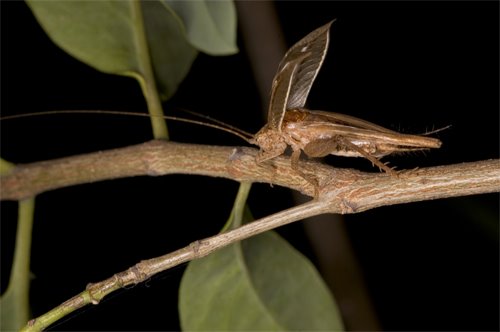
Crickets on the other hand have definitely received less attention. The male you see singing in the photographs belongs to the species Prozvenella bangalorensis. It was also discovered on the IISc campus. You can see another picture here and also hear the call which is actually pretty nice, unlike many other stereotyped repetitive calls.

So how many campuses do you think can live up to that challenge? Two species discovered and described from it? My guess would be not too many, but other folks in India and in the tropics were looking in their backyards, particularly at neglected insects, my suspicion would be quite a few.

Sunday, September 10, 2006

Grasslands

You've probably seen the other picture of the Streaked fantail warbler. But this one tells the story better. Now renamed the Zitting Cisticola, this warbler is small insectivore that forages among high grasses. The name comes from its courtship call which is accompanied by an aerial display. The only place you can see this bird in IISc is the Airfield. I would reccomend going down and having a look see, this is breeding season and you might get to see just how loud a bird merely 3 inches long can be. Try early morning and remember if you get rid of your grasslands you will never hear sweet sweet sweet again.

I love this image for all the sharp colourful verticals its got. The white fluff at the edges, breaking the sharp lines. And of course my miserable selective focus, the bird couldve been sharper and clearer. I guess its a ok animal in habitat pic. Check out the poor guys legs though, you think you can do that?

This superb habitat, the Airfield is possibly one of the least disturbed in IISc. (Except for labour from NIAS fertilising all over the place and the dumping of cut logs from the newly cleared area where faculty quarters were built). And it has a few species that are absolutely exclusive to it, the ZC, the two species of lapwing. And this lark I have trouble identifying.