"... for other waters are ever flowing on to you. " - Heraclitus
To get back to talking about nature/wildlife images that break convention, here's an image by the photograpgers Verena and Georg Popp that I stumbled upon from the NPN's annual picks. There are two versions of the same basic idea, the NPN editors picked the first and then the photographers linked to the 'original'. I prefer the second and its what I have linked to.
Landscape images have by and large had three built in conventions. These are not necessarily always followed, but the winner of NPN's editors pick will attest to their 'mainstreamness'. One is that the image must be of a vista, and the other being that the image must be an f64, sharp from here to infinity and finally nothing must be moving.
All of these conventions have been broken before, in ways that have been considered effective. Michael Kenna whose work I came across through TOP uses the effect of time and motion in his work beautifully. Landscape images also sometimes deal with details within a landscape. Jim Brandenburg has this beautiful image of a not entirely frozen stream with flowing water blurred over time.
Can an image marry more than two elements?
This image does manage to combine three (!) elements of detail, motion and vista in a single frame. Each of these elements are in opposition to each other, its almost like a rock-paper-scissors set. One cannot cohabit the same image with another, yet here they are. And it manages to make these things come together and work in a simpler primal visual way; through the colour, the rush of motion and the click of discovery.
Someone's said before me that all good images have many layers to them, so does this one. The rushing colour holds and draws your attention and gives you no sense of scale, until you notice the little centre of stillness which you might guess is water. Then a few leaf like objects come to your notice. Then you look up into the picture for further clues and slowly the mountains and the pines that reflect in water come to your attention. Its this gradual unfolding of the image that makes it special; as you spend time with it, it rewards you with more and more.
And thats just the visual aspect, I'm sure everyones mind then wanders on to the juxtaposition of a fast moving stream with a seemingly immutable mountain. My mind wandered to Heraclitus, and then through Lyell and his version of a mutable earth, to the fact that the river of time flows over mountains as well, eroding and wearing them into spires. The image is taken in Triglav National Park in Slovenia, a little digging around suggests that the Triglav glacier might have had some hand in carving the mountain we see before us.
Water passing over rock with time and ceaseless motion can achieve a great deal.
Friday, February 09, 2007


Tuesday, February 06, 2007

Friday, February 02, 2007
Migrations
 It all began at the end of an uneventful day. I looked up at the sky as walked up the stairs to my room. And I saw birds. Not entirely unusual in itself, except this flock numbered in the middle tens. They wheeled in the air, changing direction with an almost audible snap, with the coordinated precision I have come to associate with migratory birds. Birds that must rely on each other to fly in harmony over long distances.
Many years ago I stood on a bund in an estuarine marsh and watched a huge flock of birds on the horizon. As the came nearer the sun glinted off their synchronous wings and they looked like a curtain rippling in a slow wind. A dense curtain made of thousands of migratory waders flying over Vedaranyam. Wheeling and moving as one body, they came closer and landed. It was an unforgettable sight.
 One such curtain flutters over IISc right now. One made of thousands upon thousands of Rosy starlings. They were once called Rosy pastors, but were renamed starlings, perhaps to unambiguously link them their better known migratory kin in North America. And they are migratory, they have visited IISc before. But I didn't own a camera then and I didn't have the eyes I now have.
For a bird, a migration must be a great upheaval. Driven by the need for food, evolution has built some birds to fly incredible distances, to go from wintering grounds to breeding grounds and back. Migratory flights are often over large bodies of water where some can't land and for others over large land masses without much water in which they feed. Birds often double or more in body weight when they begin and are all skin and bones when they have arrived. They must beef up again before they return. Their digestive systems alter greatly in order to sustain these long flights. These changes might mean they need to stop and eat often in what are called stop-over locations. So not only are sites where they spend the winter important to these birds but also the IISc's they pay their flying visits to.
Their flights will be plagued not only by hunger but the old enemies predators, the cold, altitudes, the head-wind. And newer ones, man's alteration of their universe. Roads reflect light and mimic rivers, bright lights mislead them. Wires electrocute some, barbed wire fences impale others. Windmills cut these Quixotes from the skies, parabolas that collect the suns rays for heat burn them. And yet the ones that survive must go again and the young must find their way on a journey never undertaken before.
(Click on the picture below for a sense of just how many there are)
 When the time is right, migratory birds show signs of Zugunruhe. Even birds that have never seen the outside of a cage slam the bars in a desperate desire to follow a map wired in their brain. du Maurier built a beautiful tale out of the frustration of birds denied their instincts by the weather and Hitchcock turned it into one of his many very watchable movies. The sheer power inherent in numbers is apparent. The motion of so many birds charges the evening skies. The usually restless crows are now nearly driven, cawing, driving, diving at the many potential targets, picking off the weak ones. Maybe even a little afraid and overwhelmed. The Mynas, relatives to the Starlings, seem to be reconciled with sharing their nocturnal roosts. Its chaos and energy worth watching as the dusk pinks over to a mellow evening.
Thursday, February 01, 2007
Recovering
 Winter is the season of decline and decay. The year ends, the days die earlier everyday. Trees shed their leaves, leaving little but bare bones, the grass dries leaving fuel for fires and seed to prick your skin while walking among them.
 The cold weather drives the cold-blooded creatures underground, the insects and snakes are few and sluggardly, basking, collecting the suns energy before they melt again into the tall grass I must tramp through.
And yet, here, it is the season of recovery. While we wait, for the year must turn around and the days get warmer longer. The flowers remind us of summer and spring although the temperature speaks otherwise.

The migrants that come year after year keep us company in our waiting in their exile from their homes tell a story of their own. IISc has lost many bird species over the years. Due to habitat loss and the changing congealing concrete matrix in which this green space sits. As the favoured spaces disappear so do the birds they attracted, the marshes cost us many a species and the shrinking open space of the airfield and dump some more. Yet some return, some after long hiatuses, their absences deeply felt.

I saw a Hoopoe here last year for the first time in 6 years and it returned again this year to afford me a go at an image. And a Brown shrike which was a first on the campus for me. Both birds were listed as locally extinct. A few regular sightings and we can return them to our lists of those that have returned. With a little luck and a little foresight the returns can be prodigal.

Monday, January 29, 2007
Fire stomping
 After a long not very satisfying shoot (the highlight was a Hoopoe sighting) at the airfield, a group of kids ran out of the close-by colony asking to see the snake I was carrying. I wasn't, off course, and told them so. They carried on then with their games, whizzing around the airfield on little bikes. As I got ready to leave, some them started yelling 'fire, fire' and indeed there was one. Someone had carelessly thrown a cigarette. They put out this fire, along with the sole security guard there, using leafy branches, a little piss, water and their little feet. Just as they put one out another smaller one broke out, and threatened to be worse than the first. It was put out post haste.
 They told me of a huge fire that had raged here some years ago threatening their houses. Their methods of fire control had proved ineffective and eventually fire engines had been called in. This is the second very large fire thats happened here (that I know of) in the last couple of years. There are always a few small ones, quickly put out by security guards or someone nearby. I helped put out the one in the second picture along with 10-15 guards. Its a scary experience, little ones start from nowhere just under your feet. The smoke is suffocating and your face and eyebrows get singed.
Fire is probably a part of the local ecology and there might be some seeds that need it to germinate. This grassland is a tinderbox in the dry season, waiting for the smallest spark. In the long run, it's going to be a serious hazard. Many of the new buildings that IISc is planning are going to be built around this area. I can just imagine the damage if a serious fire takes root. A glass bottle thrown carelessly concentrating the suns energy on dry fuel, a cigarette carelessly chucked into dry grass. We are so used to doing it in these parts of campus, I can't expect people in IISc will suddenly become careful when they get there. I hope there will be fire management systems in place when they do move. And walls, to keep the fools and their wastes in, and away from the airfield. At least, a designated smoking area (people will smoke, theres no way around it), with those huge ashtrays that used to be seen in old cinemas. And a waste disposal plan that doesn't involve chucking chemical bottles over the wall/fence. And off course plenty of hoses and fire fighting equipment and sprinklers...
Off course, the way IISc deals with trouble usually is to throw the baby out with the bathwater. I expect that the whole area will be bull-dozed and shorn to nothing (after the first fire, never before) and we will have lost a unique little ecological system. Or maybe not, maybe someone will think of it, maybe safeguards will be designed? And people will be able to peer out of their high windows over rolling grasslands and hear sweet sweet sweet.
(9th Feb '07: This post has nothing to do with the fire that occurred at MCBL last night. The two places are quite far apart.)
Tuesday, January 23, 2007
Blooms
 In the mainlawns, now largely bald and dusty from a rainless winter, tucked in a corner there is small tree. Twisted a little, like something from an oriental painting. On its thickened branches are encrusted these flowers, fleshy, red and odourless. A little lustrous, reminding me of coral. I have no name for them. I'm a poor botanist and then this place is replete with exotics. (The truth be told many of the names we know, most of us, belong to exotics; Gulmohar, Trumpet flower, Poinsettia.)
They bloom and the air around them is thick with insects, and the cries of small birds. I didn't know that Tailor birds are nectarivores, or that White-eyes are. Barbets I had already learned are catholic in their diet. I've watched them bring as many termites and large mantises to their chicks as they have brought figs.
 Our classifications of the diets of many things are largely mythology I think and many birds will attempt rather unkosher things in the lean seasons or when they are harried by young.
Thursday, January 18, 2007
Halo / Parhelic circle / what?

Anyone care to tell me which of these atmospheric optical phenomenon this is? Its looks most like one of the halos, except it splits the light up into the spectrum. Anyone with a nice definitive answer?
I've put up a large picture so you can look closely at it, note the second one slightly lower in the image, which I hadn't noticed while taking the picture and cut off. This was taken sometime mid September at the airfield.

The second is just for pleasure.
Thursday, January 11, 2007
Wednesday, January 03, 2007
Secret lives (or the big secret everyone knows): book in the works

Ok, I think its time to start talking about it a bit more widely. I'm planning a book! A book on the biodiversity of IISc called (so far) Secret lives.
The book follows a somewhat alternative view to biodiversity. As opposed to following the idea of taxa as many do, it follows the idea of process, a more mechanistic view. It would be interesting to a wider audience I think. A few of the chapters I plan are: 'Food', 'Water', ' Sex' , 'Babies'. Its largely going to be in a coffee table format, while the text will be engaging, well researched, you won't really need it to enjoy this book. The books about photographs!
I've put up a chapter here so you can get a better idea of what it will look like. Here's what I would like you to do, please pass this on! Particularly to any IIScian / exIIScian you know, but everyone really! And please let me know what you think, I would really really appreciate the feedback! Quite a bit about this book is open, including the title, so feel free to suggest one!
Right now, I'm negotiating with IISc to publish the book for the centenary. If that doesn't work out, however, I will be looking at other publishers or maybe even Lulu. So any advice, contacts in that direction will also be very great and gratefully received.
Pass around the big secret :)
PS: For all those who have written to me, thanks. I will keep you updated on things as and when they happen.
Saturday, December 30, 2006
Creative commons/Copy left help the big co-orps
Sion Touhig takes a well placed swing at the copy left movement saying that they not only don't achieve their avowed goals but also deprive photographers of their living.
He discusses it further at his blog here.
Need I remind you that everything on this blog is copyright?
Look/link back but do not touch!
He discusses it further at his blog here.
Need I remind you that everything on this blog is copyright?
Look/link back but do not touch!
Wednesday, December 27, 2006


Wednesday, December 20, 2006
How do I look?
 My concerns and grapplings with this issue began with Naomi Wolf's book, 'The Beauty Myth', where I imagine many women have begun. I come to this issue primarily as a woman, not so much as a photographer, since I don't really shoot people almost at all. But it does reach into many peoples and my concerns with the issue of veracity in images.
So what would the issue be after that long preamble? Well, essentially this, how models are portrayed in ads and popular culture and how that affects our own perception of ourselves.
While this does affect men, what with the coming of the metro-sexual, this is still I think largely about women.
Recently I came across this entry in the blog BAGnewsNotes. It shows an ad that Dove made as part of their 'Campaign for Real Beauty'. The ad largely shows you how much and how images are made and manipulated before they reach the consumption stage. It suggests, off course, that our perceptions of beauty are quite skewed by our perception only of the end product, a highly synthesized and manipulated, unreal end-product. A far more telling look for me was at Glen Ferron's portfolio, basically celebrity and model pictures before and after retouching. It's profoundly frightening to see these changes. All skin is uniformly firm, toned and clear, bodies toned, waists thinner, etc, etc. The signs of being human are regularly removed. Industry pundits tell you that no image is unmanipulated, its merely a difference in degree.
This is really nothing new at all, we all know this. The extent to which this knowledge permeates our consciousness of course, varies. There is probably the whole spectrum from falling hook-line-sinker to utter cynicism. And in my mind, there is very little doubt that a lot of people, particularly young girls are buying into these images as real and aspiring to reach them, much to their detriment. One need only take a look around to observe this, or maybe look at your daughter or niece, we've all encountered it. (Lauren Greenfield's photo-documentary takes on the particulars of this sub-culture are definitely worth a LONG look.)
What might be interesting about all of this is that we are somehow hardwired, psychologically, to inherently view others are better looking than ourselves. Its interesting because that might mean that it is much harder to combat our poor conceptions of ourselves in relation to these astronomically, albeit assistedly, better looking models than we think.
Here are two things that prompted this thought. First, theres been some research done by Sarah Hill that does suggest this. That we think that the opposite sex finds people far more attractive than they really do. In short, we overestimate our competition in terms of attractiveness.
I was thinking that heres how it might work. Its been said by fashion photographers that the rationale behind some of the manipulation is that this is indeed how we see other people. A little thought suggests that it might be true if we're talking about relatively quick looks at people we see incidentally. We usually tend to sort of visually 'average' out things, rarely do we notice flaws in appearance, unless they are rather large. Try it for yourself, look at someone 'normally', cursorily, and then closely for long, with the intention of finding flaws you'll see what I mean. Whereas, when it comes to ourselves, we're usually gazing in a mirror in close-up and for long, noticing flaws. Our own perception of ourselves is a sense 'honester'. You can see how this would lead to a overestimation of the competition.
What do you make of a photograph, however? Because there are close-ups and you can look as long as you want at them. Are we now conning ourselves doubly? By 'seeing' a lack of flaws even at this close-range in models, are we convincing ourselves that our own flaws are that much worse? And reinforcing an idea we already had from daily lives?
What do you think?
Maybe I should be clearer?
PS. Look in the comments, some of which I had pulled into the main body and now have pulled out.
The abstract to the original article is here.
Monday, December 18, 2006
Friday, December 15, 2006
Motion camouflage
 These very cool flies, who can hover in a single spot and seem to defend aerial territories can do many other cool things. They remember their aerial spots using landmark cues and can return to almost exactly the same spot with accuracies in the mm range.
But by far the coolest thing (if they can do it, it has been proved yet) is motion camouflage. Male hoverflies apparently seem to sneak up on females during mating flights using this trick. The trick is to appear like a stationary object on the retina of the pursued while actually moving closer to it. The eyes of many insects are not quite resolved well enough and an object has to get very close to them before the size is perceivably larger and by the this time the pursuing insect is close enough to 'attack'. Now if the pursued animal was stationary this is straightforward. You just keep moving in a straight line towards it, not making any lateral movements with respect to it.

However if it is moving, you need to calculate where you ought to be in its field of vision and be there. The diagram above shows what this task would be like. (taken from Andersen and McOwan, (2003), they have a neat computational model of this behaviour) So you need to be able some kind of prediction about what its doing, apart from having the motor skills needed to compensate by moving as well. Hoverflies like this one appear to have all the requirements and apparently so do the coolest insect predators, the dragonflies.

Monday, December 11, 2006
Friday, December 08, 2006
Parental care
 The phrase parental care often brings up images of some mammal cuddling its furry large eyed child to its bosom. It seems the epitome of bonding between parent and child and visual images abound, like Raghu Rai's the small hand within the large hand.
Yet some of the most amazing stories of parental care actually occur within the so called 'lower' organisms. I'll tell you about the most amazing one. The now extinct gastric brooding frog female swallows her externally fertilized eggs and they remain in her stomach for weeks before they are old enough to brave the world on their own. The frog does not eat the whole time!
Still, invertebrates? Really? Can somethings that 'low' actually show such 'evolved' behaviour. I think people underestimate insects. Even those that don't would perhaps find it hard to like cockroaches. Yet here is a description of cockroach brood care from an abstract of a technical paper.
" Cockroaches show the entire range of reproductive modes: oviparous, ovoviviparous, viviparous, and intermediate stages. Postparturition parental care is likewise diverse, ranging from species in which females remain with neonates for a few hours, to biparental care that lasts several years and includes feeding the offspring on bodily fluids in a nest. "
In fact these insects are called sub-social and these behaviours are believed to be precursors to the more admired eusociality observed in some other insects. Termites the well known superorganisms, of the social insect world are phylogenetically quite close to roaches. So look closer before turning away in disgust the next time!
(For people who wanted to know more tech stuff about the image, it was shot in the daytime in IISc, in Sept 2005. f32, 1/60 with a cheapie manual ring flash the vivitar 5000, Nikon D70 and MicroNikkor 105mm.)
Thursday, December 07, 2006
And its out!
 My dad called up to say that the pictures were in the papers in Bombay. And I also received a 'formal' letter today. Since the news is out, I can announce it here as well!
This image of cockroach mum carrying her young nymphs on her back won the joint third position in the Sanctuary ABN AMRO Wildlife photographer of the year, 2006! (That's a mouthful!) The second picture of a sunbird hovering over flowers won a commendation in the same contest.

This is pretty cool, there are many very good wildlife photographers in India and well the competition is pretty stiff. So it's cool to win!
Also one of the nicest things about receiving this award was the very thoughtful letter I received announcing it. This isn't merely a you won note, theres a thoughtful analysis of why I won, which is unusual. None of the award letters/emails I've recieved before quite matched up. Off course, I didn't manage to go for the Living light awards in (which was a national competition organised by GNAPE and Ecotone, where I won first place in the seniors category) where apparently very nice things were said about the picture. (PS yes I AM bragging :) )
For those that don't already know, both these images and many other pictures are on my website (which I promise to spruce up at some point, bear with the poor graduate student). And if you want to use any image for any purposes, please talk to my stock agency, Visage images.
If you're from IISc and just want some prints drop me a line and we'll work something out.
Theres another post for those who want to know a bit more about this image and the biology.
Tuesday, December 05, 2006
Winter is here

And so are the winter migrants, my list so far: verditer flycatcher, bay backed shrike, booted eagle, forest wagtail, blue headed rock thrush.
A longer post sometime soon....or maybe just a rant, let see....
Wednesday, November 29, 2006

Friday, November 24, 2006
More star streaks
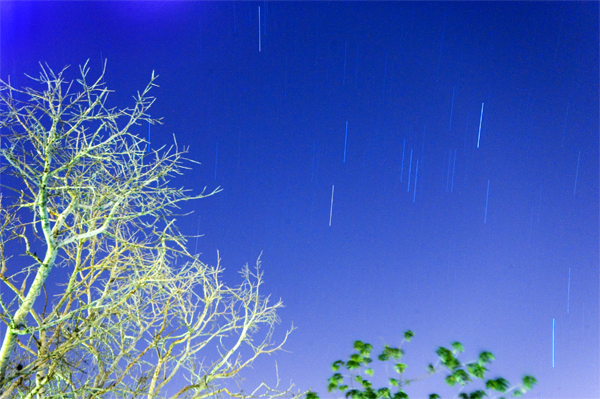 Orion travels over Bangalore's nighttime sky. The amount of light in the sky over the city is much higher than that over Hampi and the sky shows up as a hazy dirty orange rather than black. You can see the haze at the bottom of the window that's more haze from IISc street lamps, building lights and such like. If you set the WB on your image to tungsten light it sets back to this nice blue, so I'm guessing most of the stray light has this temperature.
I took this at f10 (and the light still shows up!) for about 20 minutes at 200 ISO. Pointed it high up in the sky to avoid as much background light as possible. I also sat so my shadow fell on the camera cutting off some ambient light as well. I also shut off the long exposure noise reduction option on my camera which meant the camera didn't lock up for a long time after a shot. There is some noise, you can deal with most of it using some noise reduction software.
Only thing being I wish I would think to do these things in summer. It was freezing up on the roof. Not too many people really go up on the hostel roof and a girl saw me climbing up and apparently called and asked who I was. I predictably didn't hear her and carried on. A while later there were two girls standing on a ledge facing the roof looking up. I thought they were out looking at stars or something so I carried on setting up my shots. After a bit there were 3 and I figured they were looking at me and wondering what the f*** I was upto and who I was. I must've looked nice and suspicious in my black turtle neck! I asked them if something was the matter and I think they either figured out who I was or at least realized I was also a girl, because the relief was obvious in their laughter!
Wednesday, November 22, 2006
Mistletoe
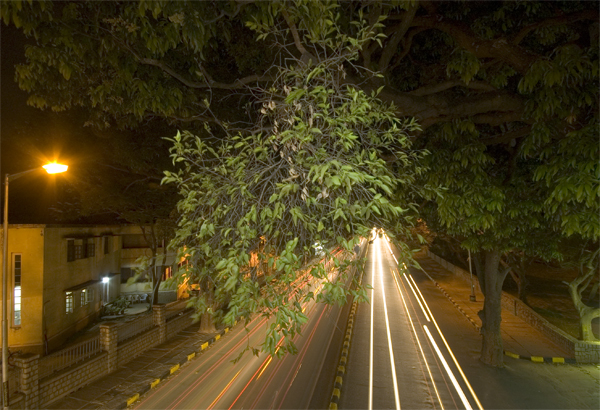 The plant you kiss under at Christmas, hangs from the mango tree near the gymkhana bridge. Don't really try it under this plant, in the middle of the highway. You've seen the flowers before.
 The seeds are usually deposited by birds and the seed splits through the bark of the tree and sets root. This parasitic plant then sucks up water from the tree and perhaps even nutrition. They have leaves though so they can photosynthesize for themselves. In IISc this species seems to be attack mostly mango trees. I wonder if these parasites are host specific...
Saturday, November 11, 2006


Wednesday, November 08, 2006
Wow
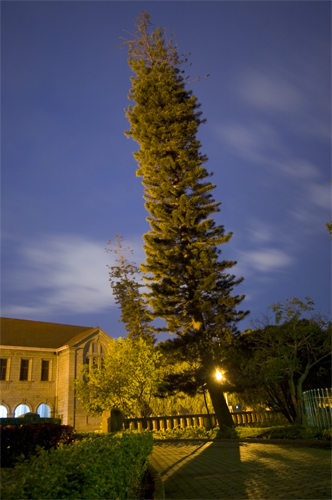
A lot of folks seem to have stopped by here after Prof. Abinandanan posted about the blog on desipundit.
Hi, hope you enjoy the pics, if you want to look at some more they're here. Hope at least some of you will check back again later :)
Tuesday, November 07, 2006
Flashing bulbs
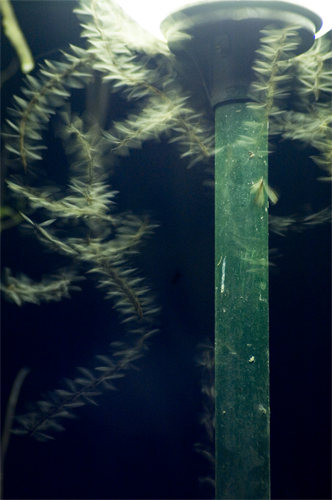
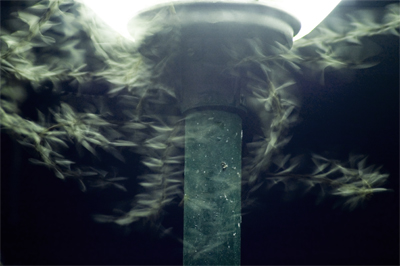
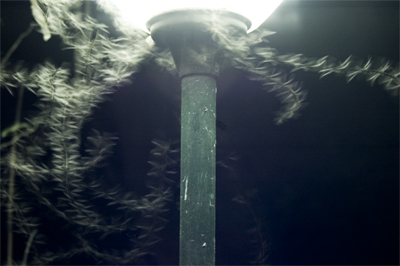
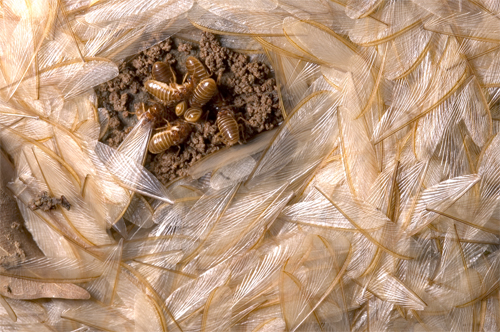
Its the time of year again when things get wet and all the creepy crawlies come out of the woodworks. The annual termite orgy has officially begun in IISc.
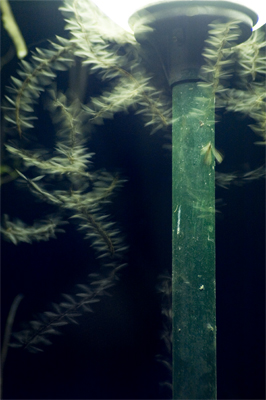
A few hundred winged insects came out the earth lost their wings and went in search of someone to loose their virginity to. The street lamps are abuzz , acting as lightning rods for sex-hungry insects eager to leave their genetic legacy behind. They fall to the ground loose their wings, follow each other doggedly, only to loose themselves in writhing masses of mating insects.

Fluorescent lamps flicker at a 100Hz in India. I was wondering whether that was why the termites flying around the lamp are stroboscopically stopped illuminated several times in their flight path in the first picture.


Subscribe to:
Posts (Atom)