Sion Touhig takes a well placed swing at the copy left movement saying that they not only don't achieve their avowed goals but also deprive photographers of their living.
He discusses it further at his blog here.
Need I remind you that everything on this blog is copyright?
Look/link back but do not touch!
Saturday, December 30, 2006


Wednesday, December 27, 2006


Wednesday, December 20, 2006
How do I look?
 My concerns and grapplings with this issue began with Naomi Wolf's book, 'The Beauty Myth', where I imagine many women have begun. I come to this issue primarily as a woman, not so much as a photographer, since I don't really shoot people almost at all. But it does reach into many peoples and my concerns with the issue of veracity in images.
So what would the issue be after that long preamble? Well, essentially this, how models are portrayed in ads and popular culture and how that affects our own perception of ourselves.
While this does affect men, what with the coming of the metro-sexual, this is still I think largely about women.
Recently I came across this entry in the blog BAGnewsNotes. It shows an ad that Dove made as part of their 'Campaign for Real Beauty'. The ad largely shows you how much and how images are made and manipulated before they reach the consumption stage. It suggests, off course, that our perceptions of beauty are quite skewed by our perception only of the end product, a highly synthesized and manipulated, unreal end-product. A far more telling look for me was at Glen Ferron's portfolio, basically celebrity and model pictures before and after retouching. It's profoundly frightening to see these changes. All skin is uniformly firm, toned and clear, bodies toned, waists thinner, etc, etc. The signs of being human are regularly removed. Industry pundits tell you that no image is unmanipulated, its merely a difference in degree.
This is really nothing new at all, we all know this. The extent to which this knowledge permeates our consciousness of course, varies. There is probably the whole spectrum from falling hook-line-sinker to utter cynicism. And in my mind, there is very little doubt that a lot of people, particularly young girls are buying into these images as real and aspiring to reach them, much to their detriment. One need only take a look around to observe this, or maybe look at your daughter or niece, we've all encountered it. (Lauren Greenfield's photo-documentary takes on the particulars of this sub-culture are definitely worth a LONG look.)
What might be interesting about all of this is that we are somehow hardwired, psychologically, to inherently view others are better looking than ourselves. Its interesting because that might mean that it is much harder to combat our poor conceptions of ourselves in relation to these astronomically, albeit assistedly, better looking models than we think.
Here are two things that prompted this thought. First, theres been some research done by Sarah Hill that does suggest this. That we think that the opposite sex finds people far more attractive than they really do. In short, we overestimate our competition in terms of attractiveness.
I was thinking that heres how it might work. Its been said by fashion photographers that the rationale behind some of the manipulation is that this is indeed how we see other people. A little thought suggests that it might be true if we're talking about relatively quick looks at people we see incidentally. We usually tend to sort of visually 'average' out things, rarely do we notice flaws in appearance, unless they are rather large. Try it for yourself, look at someone 'normally', cursorily, and then closely for long, with the intention of finding flaws you'll see what I mean. Whereas, when it comes to ourselves, we're usually gazing in a mirror in close-up and for long, noticing flaws. Our own perception of ourselves is a sense 'honester'. You can see how this would lead to a overestimation of the competition.
What do you make of a photograph, however? Because there are close-ups and you can look as long as you want at them. Are we now conning ourselves doubly? By 'seeing' a lack of flaws even at this close-range in models, are we convincing ourselves that our own flaws are that much worse? And reinforcing an idea we already had from daily lives?
What do you think?
Maybe I should be clearer?
PS. Look in the comments, some of which I had pulled into the main body and now have pulled out.
The abstract to the original article is here.
Monday, December 18, 2006
Friday, December 15, 2006
Motion camouflage
 These very cool flies, who can hover in a single spot and seem to defend aerial territories can do many other cool things. They remember their aerial spots using landmark cues and can return to almost exactly the same spot with accuracies in the mm range.
But by far the coolest thing (if they can do it, it has been proved yet) is motion camouflage. Male hoverflies apparently seem to sneak up on females during mating flights using this trick. The trick is to appear like a stationary object on the retina of the pursued while actually moving closer to it. The eyes of many insects are not quite resolved well enough and an object has to get very close to them before the size is perceivably larger and by the this time the pursuing insect is close enough to 'attack'. Now if the pursued animal was stationary this is straightforward. You just keep moving in a straight line towards it, not making any lateral movements with respect to it.

However if it is moving, you need to calculate where you ought to be in its field of vision and be there. The diagram above shows what this task would be like. (taken from Andersen and McOwan, (2003), they have a neat computational model of this behaviour) So you need to be able some kind of prediction about what its doing, apart from having the motor skills needed to compensate by moving as well. Hoverflies like this one appear to have all the requirements and apparently so do the coolest insect predators, the dragonflies.

Monday, December 11, 2006
Friday, December 08, 2006
Parental care
 The phrase parental care often brings up images of some mammal cuddling its furry large eyed child to its bosom. It seems the epitome of bonding between parent and child and visual images abound, like Raghu Rai's the small hand within the large hand.
Yet some of the most amazing stories of parental care actually occur within the so called 'lower' organisms. I'll tell you about the most amazing one. The now extinct gastric brooding frog female swallows her externally fertilized eggs and they remain in her stomach for weeks before they are old enough to brave the world on their own. The frog does not eat the whole time!
Still, invertebrates? Really? Can somethings that 'low' actually show such 'evolved' behaviour. I think people underestimate insects. Even those that don't would perhaps find it hard to like cockroaches. Yet here is a description of cockroach brood care from an abstract of a technical paper.
" Cockroaches show the entire range of reproductive modes: oviparous, ovoviviparous, viviparous, and intermediate stages. Postparturition parental care is likewise diverse, ranging from species in which females remain with neonates for a few hours, to biparental care that lasts several years and includes feeding the offspring on bodily fluids in a nest. "
In fact these insects are called sub-social and these behaviours are believed to be precursors to the more admired eusociality observed in some other insects. Termites the well known superorganisms, of the social insect world are phylogenetically quite close to roaches. So look closer before turning away in disgust the next time!
(For people who wanted to know more tech stuff about the image, it was shot in the daytime in IISc, in Sept 2005. f32, 1/60 with a cheapie manual ring flash the vivitar 5000, Nikon D70 and MicroNikkor 105mm.)
Thursday, December 07, 2006
And its out!
 My dad called up to say that the pictures were in the papers in Bombay. And I also received a 'formal' letter today. Since the news is out, I can announce it here as well!
This image of cockroach mum carrying her young nymphs on her back won the joint third position in the Sanctuary ABN AMRO Wildlife photographer of the year, 2006! (That's a mouthful!) The second picture of a sunbird hovering over flowers won a commendation in the same contest.

This is pretty cool, there are many very good wildlife photographers in India and well the competition is pretty stiff. So it's cool to win!
Also one of the nicest things about receiving this award was the very thoughtful letter I received announcing it. This isn't merely a you won note, theres a thoughtful analysis of why I won, which is unusual. None of the award letters/emails I've recieved before quite matched up. Off course, I didn't manage to go for the Living light awards in (which was a national competition organised by GNAPE and Ecotone, where I won first place in the seniors category) where apparently very nice things were said about the picture. (PS yes I AM bragging :) )
For those that don't already know, both these images and many other pictures are on my website (which I promise to spruce up at some point, bear with the poor graduate student). And if you want to use any image for any purposes, please talk to my stock agency, Visage images.
If you're from IISc and just want some prints drop me a line and we'll work something out.
Theres another post for those who want to know a bit more about this image and the biology.
Tuesday, December 05, 2006
Winter is here

And so are the winter migrants, my list so far: verditer flycatcher, bay backed shrike, booted eagle, forest wagtail, blue headed rock thrush.
A longer post sometime soon....or maybe just a rant, let see....
Wednesday, November 29, 2006

Friday, November 24, 2006
More star streaks
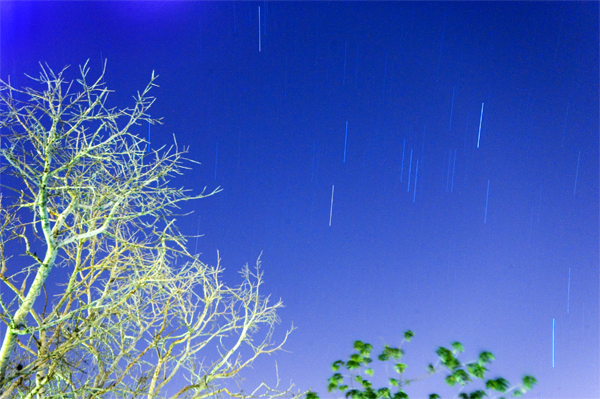 Orion travels over Bangalore's nighttime sky. The amount of light in the sky over the city is much higher than that over Hampi and the sky shows up as a hazy dirty orange rather than black. You can see the haze at the bottom of the window that's more haze from IISc street lamps, building lights and such like. If you set the WB on your image to tungsten light it sets back to this nice blue, so I'm guessing most of the stray light has this temperature.
I took this at f10 (and the light still shows up!) for about 20 minutes at 200 ISO. Pointed it high up in the sky to avoid as much background light as possible. I also sat so my shadow fell on the camera cutting off some ambient light as well. I also shut off the long exposure noise reduction option on my camera which meant the camera didn't lock up for a long time after a shot. There is some noise, you can deal with most of it using some noise reduction software.
Only thing being I wish I would think to do these things in summer. It was freezing up on the roof. Not too many people really go up on the hostel roof and a girl saw me climbing up and apparently called and asked who I was. I predictably didn't hear her and carried on. A while later there were two girls standing on a ledge facing the roof looking up. I thought they were out looking at stars or something so I carried on setting up my shots. After a bit there were 3 and I figured they were looking at me and wondering what the f*** I was upto and who I was. I must've looked nice and suspicious in my black turtle neck! I asked them if something was the matter and I think they either figured out who I was or at least realized I was also a girl, because the relief was obvious in their laughter!
Wednesday, November 22, 2006
Mistletoe
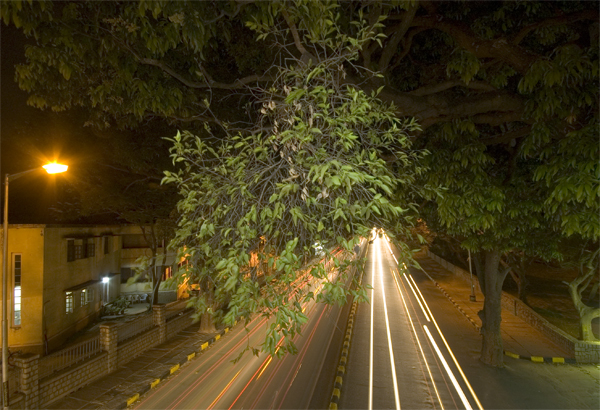 The plant you kiss under at Christmas, hangs from the mango tree near the gymkhana bridge. Don't really try it under this plant, in the middle of the highway. You've seen the flowers before.
 The seeds are usually deposited by birds and the seed splits through the bark of the tree and sets root. This parasitic plant then sucks up water from the tree and perhaps even nutrition. They have leaves though so they can photosynthesize for themselves. In IISc this species seems to be attack mostly mango trees. I wonder if these parasites are host specific...
Saturday, November 11, 2006


Wednesday, November 08, 2006
Wow
A lot of folks seem to have stopped by here after Prof. Abinandanan posted about the blog on desipundit.
Hi, hope you enjoy the pics, if you want to look at some more they're here. Hope at least some of you will check back again later :)
Tuesday, November 07, 2006
Flashing bulbs
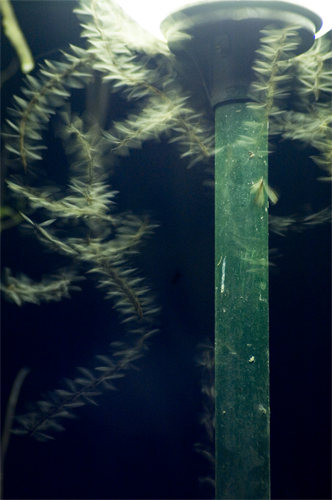
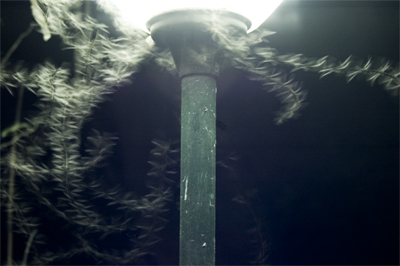
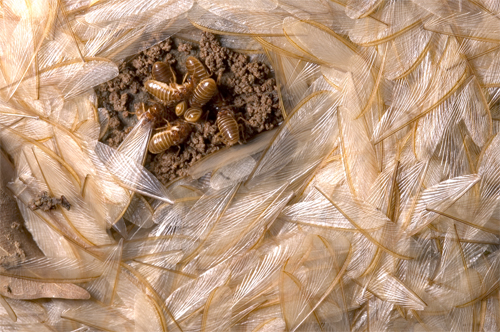
Its the time of year again when things get wet and all the creepy crawlies come out of the woodworks. The annual termite orgy has officially begun in IISc.
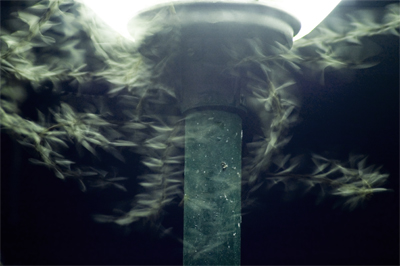
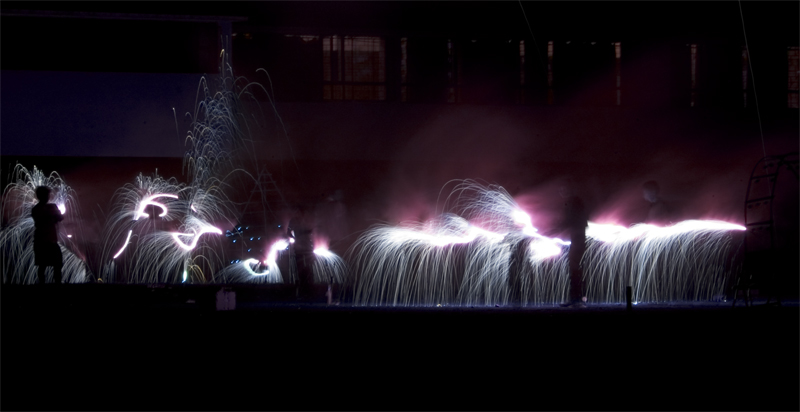
A few hundred winged insects came out the earth lost their wings and went in search of someone to loose their virginity to. The street lamps are abuzz , acting as lightning rods for sex-hungry insects eager to leave their genetic legacy behind. They fall to the ground loose their wings, follow each other doggedly, only to loose themselves in writhing masses of mating insects.

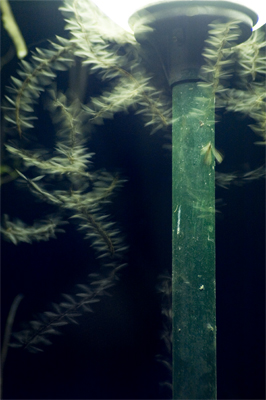
Fluorescent lamps flicker at a 100Hz in India. I was wondering whether that was why the termites flying around the lamp are stroboscopically stopped illuminated several times in their flight path in the first picture.

Tuesday, October 31, 2006
Rosamund Purcell
 I first came across her work which was used in Nat Geo feature written by Carl Zimmer.
She's been called the doyen of decay. I can see why. She is among other things, a museum photographer, so a lot of the stuff she shoots is dead. When she shot some marine creatures at Woods Hole she actually said that she doesn't see too many alive specimens!
It must be a strange thing to see animals, so inanimate and yet create images that inform their biology. As it were a photographs compress so much. They're a single snapshot, static & they're two dimensional. But I think she does justice to her subjects. She actually manages to add certain degree of dynamism and mystery to her images.
A Wildlife photographer? Maybe, but shes a much more expansive artist than that. She's done many books, exhibitions and collections on things that range from images of extinct animals to dice(!). In another book Owl's head she goes through the keepings of junk dealer in a more modern version of archaelogy to understand us and our recent history through our discardings.
(Just as an aside, here's a sort of related project, a recreation/imagination of what dodo behaviour, ecology might seemed like when they were alive.)
The photograph is copyright Rosamund Purcell, from here.
Thursday, October 26, 2006
Hampi
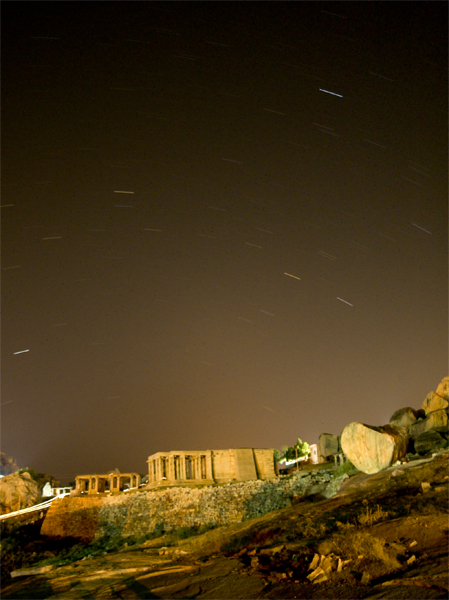
I took a break this weekend and went to Hampi. I shot things that weren't alive! The first is the Kadlekalu Ganesha temple on Hemakuta hill by night. The other the pretty stepped tank. The third shot is the Virupaksha tower at dusk.
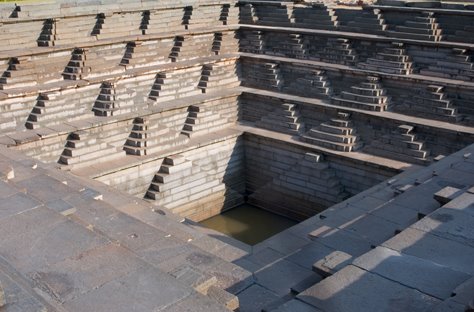
 I even shot pictures of human beings.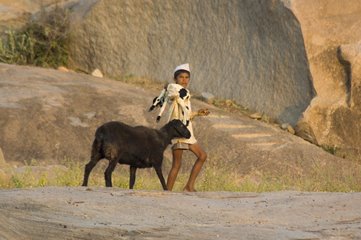
 And I even managed to wake up early in the morning!
OK, just for those people who want to go at some point. We got a lot of help from the internets, so heres some in return. We took a train, the Hampi Express to Hospet from Bangalore and were there at 6:10ish in the morning. Walked to Hospet bus stand which is about a 10 mins walk away and got a bus to Hampi almost instantly. When we got to Hampi, we were instantly accosted by folks pushing their lodges. We'd heard of Padmas lodge which is just a minute away, she had a decent room and roof which overlooks Hemakuta hill, so we took it. Theres water all day long, but no hot water. If you want that you have to ask for it. But even in October its hot so you don't really need it. Got a Kinetic for about Rs. 150, took 1.5l of fuel which was too much, about 1l should be enough, unless you're going to drive to the Vithalla temple which is a 12 km drive or a 2 km walk, guess which one we did? If you have the time, consider a cycle, it might be more fun.
Spend a couple of days if possible, the ruins are quite spread out and anything less than 3 days is a rush. We had to. I won't tell you too much about this, there are websites you can look stuff up on and decide what you want to see. Try and catch the sunrise from Matanga hill especially if you love rocky terrain. Its very beautiful and you will feel very virtuous for having gotten up early, at least I did. The climbs interesting and you'll meet the monkeys along the way, who seemed quite harmless to us, so don't worry about them.
Try and eat at least once at the Mango tree restaurant which is by the river. The foods faux European for the firangs and slow-train-coming & for-the-firangs Indian but the locations lovely. Be warned, food in general was slow in coming, its a good practice to ask what'll be quick if you're in a hurry. And when they say 10 mins, it might mean 10 mins to 30 mins!
On the way back we caught a bus out of Hampi at 18:00 and were in Hospet by 18:30, the last one out is at 7:00. Theres a Yatri Niwas on the way to the station which looked decent in which you could eat. We took the Garib Nawaj train at 20:20, which unfortunately runs only on Tuesdays. Unfortunate because it gets to B'lore at a very timely 6:00. The returning Hampi gets here at some ungodly 4 or 5!
C'est tout.
PS: the boy says my timings are way off, and add anywhere from 15 mins to 30 mins to all my durations!
 The last picture is of the town, yup, thats all of it!
Friday, October 20, 2006
Shell wildlife photographer of the year announced.
Mosey on over and have a look at the award winners. You can leave a comments as well. I would love to see them at the nhm, tiny images on the website dont really do that much justice to some of the images.
Monday, October 16, 2006
Apocalypse now
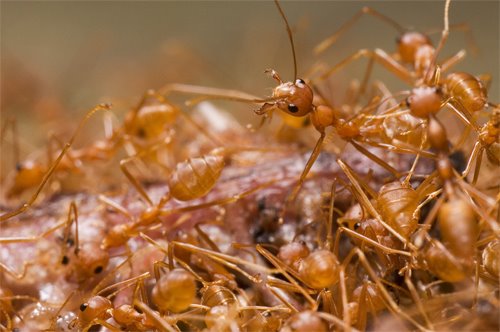 Wonder why this reminds me so much of that sometimes edited out scene. Oecophylla, the pirhanas of the insect kingdom.
Sunday, October 15, 2006
Placing internationally is GOOD for the ego
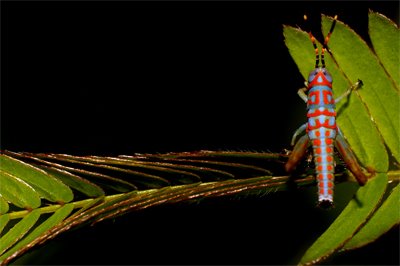
Update:
I'm skipping one post and going on to this one which provides info that made me *very* happy! The added bonus is that you get to know which picture made the finals...
It has shown up here. Check out the 2005 finalists, I'm week 1 in October
>>>>>>>>>>>>>>>>>>>>>>>>
I just got an email telling me I'm a finalist in the National Wildlife Federations 2005 photography competition!!!!!! Yea!!!! I think I'm a bit giddy!
Originally posted: Nov 15 2005
Tuesday, October 10, 2006
Talking some more
When he still wrote a free and regular column called the Sunday morning photographer, Mike Johnston was one of my favourite reads. One of my utterly favourite column was called "Scenic fatigue". I think I'm going through that sort of fatigue with shooting in general, I get exhausted just looking at my pictures.
Oh, I don't think I'm doing unfocused photography, there is a story to tell (more about the story itself when I feel like telling). Just sometimes I think that theres a huge danger in nature photography that you'll have everything just so and empty it of photography and leave it all biology or worse, prettiness. The interesting subject, rule of thirds, perfect light, colours, sharpness, low grain, selective focus, the little catchlight in the eye, the action/dynamism shot....you know. There are too many conventions/rules in this business. And too many times keeper shots are keepers because the meet an appropriate convention.
How do you break this little problem, cause all of those conventions do have a reason you know? They make things look...good. In a certain way. So I think I'm getting on a mission now, to find images (not necessarily mine), nature photography images that look good while breaking at least one convention... and then see whether I can work through, why the image works....lets see how it goes...
(I'm using this image for criticism, which I believe is ok under the fair use clause of the US copyright act. I've linked the originals and credited the author.)
 We'll start with the obvious guy, Mike 'Nick' Nichols. He's a out there 'I dont want to make pretty pictures' nature photographer. This compelling shot was taken as part of his project called 'Brutal kinship' on the nature of the relationships between humans and chimpanzees.
It's not a pretty picture, and some would argue its not even a nature picture. Does it break conventions? Some, you dont see the eyes of the animal, the face is hacked at the chin. (This is probably so its possible to look at the picture without turning away in disgust.) Its a portrait of an animal with no identity, which defies the genre portrait itself.
There's blood in the image and theres no denying the agony in those hands being restrained. The animal frames his own blood as in an act of display; "here, here's my death". There's no attempt however to prettify it, neither to judge the death as needless. The syringes, the tubing both suggest medical intervention in some form. Either an attempt to save the animal or maybe what caused the death in the first place.
The caption tells us its a chimp that died of systemic failure after a vaccine against HIV almost worked on it. It almost saved so many lives but died. Its a matyr's image. Its not an image of an animal, its an image of what happened. Its littered with clues to what might have happened and leaves us to figure it out before the caption reveals it. I think the tension already exists in the image, the justification of the death is ambiguous, and yet this is not an obvious 'animal rights' image. It becomes more so with the caption. But it does not lean so far as to condone the whole extreme animal rights stand of never using animals for research. Its a marvellous walking of the thin line, and in my opinion its why it works.
Oh, I don't think I'm doing unfocused photography, there is a story to tell (more about the story itself when I feel like telling). Just sometimes I think that theres a huge danger in nature photography that you'll have everything just so and empty it of photography and leave it all biology or worse, prettiness. The interesting subject, rule of thirds, perfect light, colours, sharpness, low grain, selective focus, the little catchlight in the eye, the action/dynamism shot....you know. There are too many conventions/rules in this business. And too many times keeper shots are keepers because the meet an appropriate convention.
How do you break this little problem, cause all of those conventions do have a reason you know? They make things look...good. In a certain way. So I think I'm getting on a mission now, to find images (not necessarily mine), nature photography images that look good while breaking at least one convention... and then see whether I can work through, why the image works....lets see how it goes...
(I'm using this image for criticism, which I believe is ok under the fair use clause of the US copyright act. I've linked the originals and credited the author.)
 We'll start with the obvious guy, Mike 'Nick' Nichols. He's a out there 'I dont want to make pretty pictures' nature photographer. This compelling shot was taken as part of his project called 'Brutal kinship' on the nature of the relationships between humans and chimpanzees.
It's not a pretty picture, and some would argue its not even a nature picture. Does it break conventions? Some, you dont see the eyes of the animal, the face is hacked at the chin. (This is probably so its possible to look at the picture without turning away in disgust.) Its a portrait of an animal with no identity, which defies the genre portrait itself.
There's blood in the image and theres no denying the agony in those hands being restrained. The animal frames his own blood as in an act of display; "here, here's my death". There's no attempt however to prettify it, neither to judge the death as needless. The syringes, the tubing both suggest medical intervention in some form. Either an attempt to save the animal or maybe what caused the death in the first place.
The caption tells us its a chimp that died of systemic failure after a vaccine against HIV almost worked on it. It almost saved so many lives but died. Its a matyr's image. Its not an image of an animal, its an image of what happened. Its littered with clues to what might have happened and leaves us to figure it out before the caption reveals it. I think the tension already exists in the image, the justification of the death is ambiguous, and yet this is not an obvious 'animal rights' image. It becomes more so with the caption. But it does not lean so far as to condone the whole extreme animal rights stand of never using animals for research. Its a marvellous walking of the thin line, and in my opinion its why it works.
Friday, October 06, 2006
In a hurry, gotta go
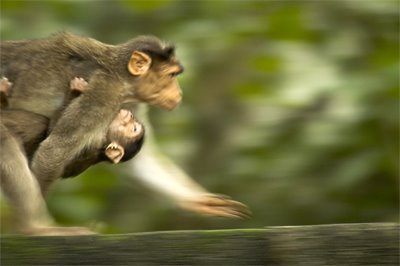 Those of you who've been wondering what I've been upto, sorry. I've to pay attention to a few other things right now, which means I cant really do this. So instead I thought I'd link you to a few other (amateur, whatever that means!) Indian wildlife photographers that I like.
Theres Kalyan Varma whos also a Bangalorean, and he has a few other interesting projects going, which unfortunately dont seem to have taken off that much. The PlanetWildIndia in particular has quite a bit of potential. Imagine being able to use it as a travelogue to find new and interesting places, particularly those that are within reach to shoot in! I suppose there are already lists with that sort of information on them that one could use. It would be nice to get that kind of information/resource list together.
Kalyan's got a couple of friends , who I don't personally know, who're pretty good photographers themselves, I was pretty impressed by Sudhir Shivram. There are others, but what I think distinguishes these guys is their dedication to this stuff despite other day-jobs. There are others, leave a link if you know of any that you think should not be missed.
Tuesday, October 03, 2006


Monday, September 25, 2006
New species
There's been a lot of buzz about new species of late. The most recent surprise was the ant that was found in IISc. Our campus is home to over 90 ants, whats a new one right? Well no, ants have been worked on for ages, they're probably among the better documented insect species.
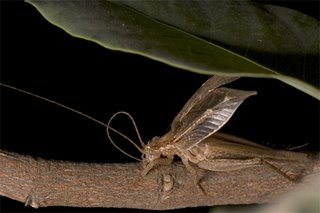
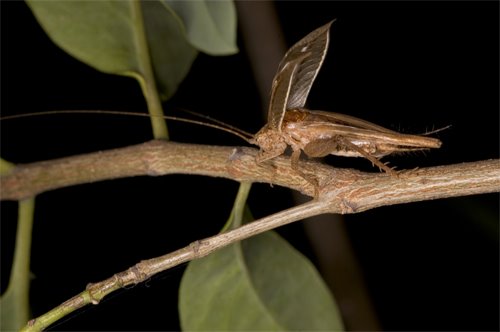
Crickets on the other hand have definitely received less attention. The male you see singing in the photographs belongs to the species Prozvenella bangalorensis. It was also discovered on the IISc campus. You can see another picture here and also hear the call which is actually pretty nice, unlike many other stereotyped repetitive calls.
So how many campuses do you think can live up to that challenge? Two species discovered and described from it? My guess would be not too many, but other folks in India and in the tropics were looking in their backyards, particularly at neglected insects, my suspicion would be quite a few.
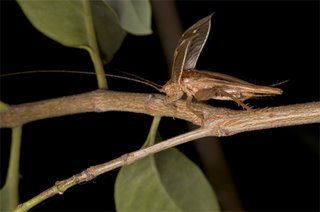

Crickets on the other hand have definitely received less attention. The male you see singing in the photographs belongs to the species Prozvenella bangalorensis. It was also discovered on the IISc campus. You can see another picture here and also hear the call which is actually pretty nice, unlike many other stereotyped repetitive calls.
So how many campuses do you think can live up to that challenge? Two species discovered and described from it? My guess would be not too many, but other folks in India and in the tropics were looking in their backyards, particularly at neglected insects, my suspicion would be quite a few.
Subscribe to:
Posts (Atom)