Wednesday, January 30, 2008

Solastalgia: olacium (comfort) and algia (pain)

IISc lost the hovering diving pied kingfisher because water bodies disappeared a while back, one among many others
I don't usually link articles but this one written by Clive Thompson on Glenn Albrecht's work is irresistable. An excerpt:

"... scores of Australians described their deep, wrenching sense of loss as they watch the landscape around them change. Familiar plants don't grow any more. Gardens won't take. Birds are gone. "They no longer feel like they know the place they've lived for decades," he says.
...
They're suffering symptoms eerily similar to those of indigenous populations that are forcibly removed from their traditional homelands. But nobody is being relocated; they haven't moved anywhere. It's just that the familiar markers of their area, the physical and sensory signals that define home, are vanishing. Their environment is moving away from them, and they miss it terribly."

Monday, January 28, 2008

Seperating the men from the boys: variance

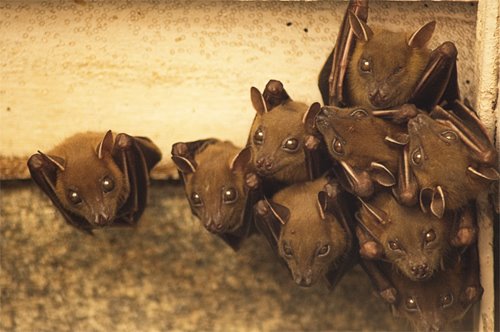
Short nosed fruit bats in a mating group

Get ready for a lot of speculation. I've blogged about the harems of these bat's before. This post is just to give you a feel for what variance is like (and to show you the pictures) . I looked under the eaves of the Physics and IPC departments. I found a total of three harems, the top male, in the photograph above monopolised 10 females. (Based on a bat guy's know-how I'm guessing the bat on the outside is a male, the ones in the group are all females. You do see a few hints of dimorphism between the two.) The second largest harem had 7 females, and the smallest, in the next photograph had 3. There were three pairs and four loners.


The smallest harem

If my conjecture is right, (and seeing how it skews the sex ratio quite strongly towards females it may not be), then three males between them managed to have primary sexual access to about 90 percent of the female population (20 of 23)!

Biologists like to call this reproductive skew, the notion that reproductive success is spread across a population in a skewed manner, allowing a few individuals to produce the most offspring. On average each male should have 2.3 females, paired up with him here (23 females, 10 males). But some males have nearly 5 times that number and others have none!

A pair (Can you see the differences between them? My guess, right side one's a male)

There are much wilder skews in reproduction in other animals, think about social insects. Honeybees, for instance, in which the queen bee is the sole reproducing female among thousands and thousands of sterile female bees. Biologists have used kin selection theory to explain such behaviour, where some animals willing give up mating rights to help kin, because they receive sufficient indirect genetic benefits through them to make up their losses.

A solo roosting bat

In many other systems, however, such as this and other polygamy systems, this won't work. The relatedness between these females is likely to be low. So what's going on? Reproductive skew theory is a system of models that attempt to add ecological and social factors to kin selection kind of ideas within some kind of formal quantitative frame-work. In this system, among the bats, the key driver appears to be access to a resource that makes all the difference, a roost. The difference between boom and bust.

Anecdotally, two things. The largest harems in IISc have always been in the same roost. So there seems to be something to that idea, good roost, high attractiveness . Also, as you would have noticed I shot these images using flashes. Now the bright lights in the roost were not appreciated and were probably stressful and disturbing. Now these bats can fly in the day, they just don't from fear of predation. There I was however, simulating it to an extent.

But none of the animals in the harem situation moved, neither did the pairs. The only bat that instantly took off and moved to another roost was the solo bat. The picture above is him taking off. I suppose one could read something interesting into it, the roost may not have been so good and so the male lost little in moving on. The other males, with the harems, however, stood to loose both females and the roost and well the hung on for all their fear and tribulations. For which I'm grateful, off course!

Bat huddle or exchanging parasites

PS: I did warn you this was going to be speculative.

Thursday, January 24, 2008

Aphids: speedsters

Ants tending their aphids
Aphids are perhaps most famous for being the poster children of mutualism. To be able to cooperate with another species is quite an achievement. Particularly in the eyes of humans, a species whose own history of cooperation is extremely checkered. Then to stably maintain that cooperation over evolutionary time-scales where we fail often, even over the shorter course of human history. But then the clock ticks over slowly at the level of genetic evolution. Meme time is a faster beast.

Another ant, probably not another aphid
Apart from being cattle to their social arthropod herders, aphids are interesting in other ways. Ways that relate again to time, ecological time. Ways that relate to the rhythms of days, months and years. Aphids feed on plant sap. They used specialized mouth parts to dig into the living phloem of plants to extract sugar and other nutrients from the plant. They are, in a way, plant parasites. Gardeners will differ with my dilly-dallying and pull out the aggressive pesticides.

Aphids feeding on bamboo (click on image to enlarge)
Many species are monophagous, they can eat only a single species. In the dispersal stage they find the plants they eat using chemical cues. They can probably infest a plant only at certain stages in it's life cycle and must find plants that are appropriate to them. Such resources are often rare, ephemeral and short-lived. To make the most of the possibly short-lived windfall, these insects must expand rapidly in number.

Aphids speed up reproduction time in a truly spectacular way. They reproduce parthenogenetically. No mating. They can mate and do under certain circumstances, but they can switch to just making perfect copies of themselves. You might ask ok, but just how much time does an aphid shave off by skipping the finding-a-mate stage? Admittedly only a little.

The truly large time saving comes from a crazy trick called the telescoping of generations. Female aphids give birth to parthenogenetically produced female aphids who are already pregnant with the next generation. That amounts to a larger reduction of reproduction time. And it's what allows them to infest a plant in your garden in the short span of a few days. It's also what might allow them to develop quick resistance to the pesticides gardeners and farmers use. A granddaughter and daughter is exposed to everything a female aphid is exposed to and selective pressures needn't work independently on each generation, which I think should speed up the process of developing resistance.

A ladybird feeds on bamboo aphids

Off course, such abundance does not go unnoticed in the competitive world out there. Aphids have their predators, ladybirds most notable of all, lacewing larvae, hoverfly, wasps and many other tiny carnivores. Many of these predators are believed to be attracted by plants, who produce volatile chemical cues in response to aphid attack. All these wonderful weapons deployed in a war for survival in a system in which the upper hand probably changes often and in innovative ways.

Wednesday, January 23, 2008

Flame of the forest

Repost
I'm terribly sorry I haven't really been posting much, there's been a lot to do. With some luck we should be back on schedule shortly.
These trees are blooming all over right now, so I thought it was a good time to resurrect the post.

Flame of the forest

This tree deserves it's name in more ways than one. The flowers look like flames individually. A tree in flower does really look like it's on fire. And every bird within a mile's radius is in love with it. And off course squirrels and insects.

Two days of waiting paid off! Ta dah here they go. The last one, a Spangled drongo, is a western ghats species. If you look at its distribution in the GI and I its painted along the western ghats. Well, it's here and it picked this tree to feast upon.

Flame of the forest
You know sometimes I feel like one of those sad homeless people you see on the streets, clutching at their treasures. Things no one else would find even remotely interesting. I'll be raving about some bird no ones even ever heard of before. Well, fortunately there are a few people who are a bit like that in CES and I'm not considered stark raving, but only moderately mad. Well, the slightly deranged vocabulary that apparently accompanies this enterprise does make up!

Wednesday, January 09, 2008

Don't fear the shadows

Wildlife photographers, particularly macro photographers, do not like shadows. They'd prefer it if their images didn't have any. Much of their obsession over lighting is about removing shadows or at least about softening them considerably. Diffuse light which does this is everyones manna from heaven.

Painted stork in shadow on a roof in Kokkre Bellur

There's a simple reason for this dislike. Shadows typically obscure details and features. Parts of an image in shadow usually do not show great detail. You'll hear talk now and then of good shadow detail but that's a relative thing. In comparison to the middle tones in an image, you're not going to see much in the darker (in shadow) regions. (Take a look at the two painted stork images, take one after the other.) And somehow, somewhere along the line, detail has become the be-all and end-all of wildlife photographers. Or at least the majority of them. This universe is slowly changing now. But this change is not the only reason one ought to embrace shadows.

The stork steps out of the shadow


Wasp nest surface front diffuse lit
Shadows are important to limning form. They are darn important. Take a look at the preceding and following photograph. They are of the exact same object, same view and position, no change except the direction and hardness of the light. In the second image, the light comes in from the right hand, causing the bumps on the surface to throw shadows onto the ares under them. The valleys elongate and change the shapes of the shadows giving you a sense of their shape and the curves of that surface. You suddenly have a sense of the shapes of each of those bumps and valleys.

Wasp nest surface side hard lit

The visual areas of our brains have wired into them algorithms that allow us to infer shape from what is essentially a 2D representation of the world, that the retinas pass onto them. There are two pieces of information that the brain uses to reconstruct shape in the brain. One piece of info comes from the stereoscopic nature of our eyes, two 2D representations from two eyes set at a fixed angle can be used to reconstruct shape. This is missing in a photograph which is truly 2D. Viewing a photograph is like viewing the world with a single eye.

The other info that can be used are shadows (and hence, off course, bright areas). Objects cast shadows depending on their shapes and on the surface which the shadow is cast. The shape can can often be inferred from the shadow. Whether we are hardwired to do this or learn I don't know, and am too lazy right now to find out, but we can. The shapes of uniformly lit and hence even toned objects like the wasp nest surface in the 1st wasp nest photograph cannot be apprehended at all. We take our cues from the smallest hints, we do it so effortlessly that it does not occur to us that we couldn't without shadows.

Giant african land snails with a smaller native (?) snail
Note the shadows at the far end of each whorl that shows the curve of the shell within the whorl


Note that the lack of shadows makes the shape of the snake in section hard to apprehend, makes it look flattened


Now think of shadows at a smaller scale. They create texture. Rather they limn texture. Something that is completely missing from the first wasp nest image and predominates in the second. For what is texture, but many shapes at micro scales.

Red weaver ant. The leaf texture shows up because of shadows


Off course none of these are good reasons not to use shadows on their own merit, as excellent design elements.


Leaf shadows
Katydid hide and seek

Wednesday, January 02, 2008

Kaadupapa: forest baby

Slender loris on branch
I find it a little hard to decide precisely which attribute earns the Slender loris it's Kannada name, Kaadupapa. Whether it's the childlike huge eyes, adapted for nocturnal vision. Or the tiny tiny hands, equipped with pads, for a grip that does not often fail. The fragile slender limbs, the slow deliberate response to everything. Or the whistle, a territorial call, which could be mistaken for a child's demands for food.

Slender loris on branch

All the furry, feathery creatures of the world find their way to our doorstep. CES is the orphan-house for animals. We have had beautiful bats hung on our doorway, with a note in a childish hand weighed down with stones on the doorstep left as explanation. People regularly bring us squirrel babies, naked, still blind to the world. The common denominator among these many is that they shiver, they are cold. Small animals (all that remains in this truncated land loose heat rapidly, they are more surface than substance and this is their undoing. The first Loris we ever caught was retrieved from the bicycle repair shop in a rain-storm. It had an arm missing, one hopes it was a predator, a non human one that took it. This one came to us late yesterday night, few details reached me through the many layers that were between the finders and the 'rescuers'.

Slender loris close up

Most of the time, when there are no apparent injuries, we surmise that these little ones are just cold. All they need is a little warmth and food and they are ready for the world again. We transferred this little guy to a spacier box, gave him a towel to keep warm with and a few crickets to feast on and wished him beddy bye for the night. The lab is warmer than the outside and that should help. The warmth, rest and food seemed to have done it well and it was reasonably active in the morning. A little checking showed no obvious injuries or broken bones (with gloves, these guys know how to bite real good). So we figured it's best to let it go.

Not everyone is so lucky. The last one we had was all skin and bones and breathed his last before my eyes. I slept not so much last night, hoping this guy would not go the same way. Or escape and wander around the lab like the first one did.

Lorises are well protected by law in India. But their nocturnal nature has spawned myths and rumors about them, the ghost like call does not help their PR one bit. And like everything else on this earth, they are threatened by habitat loss. The IUCN includes it in the Red list and terms it near threatened. It's probably the most exotic animal IISc hosts, also one that claims kinship to us, a primate. According to a Sindhu, a Loris researcher working at NIAS, we have a healthy population here which can, given a chance, last a while. Here's hoping IISc doesn't loose a Red-lister in it's quick and dirty march towards what (everyone hopes) is (at least) an (infrastructural) A-list.

Large eyes help in nocturnal hunting

Wishing you a great 2008!

My present for 2008, a slender loris

Monday, December 17, 2007

Macaques: expressive, intelligent and social? Or the other way around?

Repost
PS: I'm at home in Bombay. To call my internet access here bad is to compliment it. Posting will be a bit slow for a while.


Have you ever watched a Bonnet Macaque and felt that it was extremely expressive? It indeed is. Macaques use a huge range of facial gestures to communicate within and between their social groups. Each gesture has a subtle meaning that indicates different degrees of submissive to aggressive behaviour, to simple greeting and play behaviour. Simple things like lip-smacks (submission) and eye-flashes (greeting) lubricate everyday living. Presenting, a display of the bottom, unlike in humans, is almost a gesture of humility, at any rate, submission. And yet, even high ranked males will occasionally present to lower ranked monkeys, perhaps to keep their loyalty, to keep everyone happy. Adult males, females and younger members will groom others (allogrooming) to ingratiate themselves to the groomee. When members of another troop come too close, a strategic yawn will display the majestic canines of the alpha male, providing an oh-so-subtle indicator of discomfort.

Behaviours are also used to indicate heirarchy, each animal's knowledge of its position within that ladder and subtle shifts that occur. A young male will present often to an older, higher ranked male, until one day it begins an alliance with another and reaches upward on the social ladder. Females are born into their positions on this ladder in Bonnet macaque societies, and cannot climb or descend. Almost tailor made for these trapped females, Bonnets have a separate ranking system one that measures social attractiveness. Females may have a low social rank, but be quite comely in other ways. Socially attractive females in certain interactions actually precede higher ranked females.

If you think about it that's a lot to keep in mind. Social heirarchies and networks will jostle for brain-space with food and water maps, spatial maps, cultural memories, and off course all the other hard-wired stuff. The boundaries and details of these social interactions will shift continuously, new players may emerge, old ones disappear. The representations of this complex system in the brain must constantly be rewired. It must remain flexible and capable of learning through an entire macaque life.

Anindya Sinha from NIAS, among others, has argued that this may be the route through which we humans, primates as well, have reached our extravagantly complex and conscious brains. He argues in yet another paper, that many complex mental states such as deception, intentionality and attribution may be seen in even 'primitive' primates like the Bonnet. The idea I suppose is that somewhere along the primate lineage the two process ran away with each other, complex and intelligent brains fueled the growth of more elaborate social and communication structures and vice versa.

An elegant idea, and testable! The more social an animal is the more likely it is to be intelligent. Even now, if one thinks about all the animals that are attributed with intelligence whether merely through folklore or through actual research, many are indeed social. Dolphins, apes, elephants, corvids are the first to come to mind, each with complex sometimes unexplored social systems.

Tuesday, December 11, 2007

Lighting for macro

A paper wasp (Vespa sp) taking off from the nest
One of the things that I find annoying about macro work, mine mostly, work that has been done with flash is the bland, black, unlit backgrounds. These give you darn little feel for the environment the animal is in. They happen largely because all macro work is this fine compromise between magnification, depth of field (DOF), available light and flash light.

When you increase magnfication, DOF falls, it's the law. If you want high DOF, which you usually do, that means you've got to nuke the subject with light. When you're adding huge amounts of light using a flash and meter for the flash, it usually is over-powers ambient light. Its so much brighter than ambient light that ambient makes very little contribution to the final image. Hence the black backgrounds. (Strobist on balancing ambient light.)


A hornet leaves the nest to forage
There are off course many ways to deal with this. You can compromise on DOF, use selective focus instead of trying to keep everything in. That allows you to lower your aperture, pour in less light and be closer to the metering you would get from ambient light.

The second is simply to find areas of high ambient light. Not necessarily on your subject but on the background. On some distant object, for instance, which then becomes this nice bright source of buttery background bokeh as in the hornet images in the post. The bright patches in the background come from a tree which the evening light was hitting. It was at least 4 feet away from the nest, completely out of focus and created this lovely warm coloured bokeh. You can also use the sky in this manner, it's almost always a very bright source.

Inbound and outbound traffic

The third is to actually light the background yourself! I personally have gotten so stuck with the idea of lighting my subject that I never think of backgrounds at all. Off course, in my defense most of my earlier images used a single flash which could only be pointed in one direction. So, it was a bit hard to light two things at the same time, now with two I can do more if I want to.

The other good reason for lighting the background, is to be able to separate the subject from the background. When the main subject is lit directionally, it may have parts of it in shadow. This part will be the same near black shade as the background. It's a good idea not to have this so you can tell the shape and form of the subject itself, to separate it so to speak.

Two ways that immediately come to mind to do this, brighten the background as before or rim /back light the subject. The hornet pictures actually have both tricks in them. The back light is provided by a fully zoomed flash, you can even snoot it to prevent spill, the trick is to get the light behind the subject just lighting the edges.

A few more technical details on the hornets in my flickr photostream.

Saturday, December 08, 2007

Clean up 3: or the story of keep trying

Some of the folks at clean-up 3
You must remember the first two clean-ups (1, 2)? It didn't end with those. The green-gang had yet another clean up and this one unlike the previous one was attended predominantly by students and a fair number. I can't say exactly how many, people kept drifting in and out of the effort depending on their schedules, but lets say at least 15 in all. I was thrilled!

We picked an area around one of the messes, the C mess. The garbage here is largely the responsibility of mant of the very lazy students IISc breeds. Folks won't walk 2 meters to a garbage can, they'll leave things right where they are. It doesn't help that the place is surrounded by residential areas. Much the same thing happens and occasionally domestic waste also ends up in this place. Its a thorough-fare as well, so you can imagine the state. Anyway, we had a long session of picking up after the .... and then we had a discussion about what next.

Mahua recruiting for Green-gang
Many were understandably not happy about the idea of clean ups alone, and wanted to do more to ensure that places we cleaned would remain that way. We initiated a few things, one of these has so far generated a positive response. We decided to ask IISc admin for more dustbins, to begin with in this area. We got much more than that, we were told that the area was ear-marked for 'development' and they asked us to plan what we wanted there. After some back and forth, it was decided we didn't trees and bush hacked away, since the areas actually quite rich in bird life, and we presented a plan for a few extra dustbins, lights and cleared paths. And voila! Work seems to be already underway!

This is the most positive and immediate response I've seen IISc make about just about anything. Good to know it can be done!

The other clean-up efforts had also spawned several initiatives, many of them have gotten quite far in themselves. A post about them in a short while, or maybe Arati who has put in a great deal of effort into many of those endeavors, will pick on this and oblige us with a post on what's been going on?

PS: For those of you wondering why the blog silence for a while, I made the last push needed to finish and submit my thesis. It's done and we'll be back to regular schedule shortly.

Wednesday, December 05, 2007

Johnathon Jones in the Gaurdian

I couldn't agree more. And this is NOT a bad thing.

"Critics and museums lie when they claim serious art is accessible. It is obscure and demanding."
Johnathon Jones

Bat harems

Repost
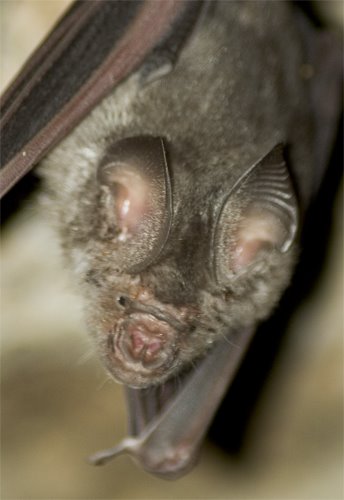
These are short nosed fruit bats (Cynopterus sphinx). I like this picture and a lot of folks do as well. One of the reasons is I guess the nice geometric formation. But the other almost certainly is our human preference for large-eyed infantile creatures. These are nocturnal bats and cant echolocate so they use their eyes to find food and hence must have large eyes. Unlike the eyes of the next guy who is an insectivorus bat, which echolocates and creates a world view using that sense instead. Thats most probably one of the leaf nosed bat species (probably Hipposideros ater), and was shot in Lepakshi, AP. (Not pipistrel like I'd said before).

The other interesting thing about this group is that its a group. Most bats actually live in some kind of group. But this one is special, because its a harem. A male bat creates a resource, in this case its a roost. Actually under more natural conditions these bats build what are called tents. However this group lives in the eaves of the physics dept. And the females basically live in his resource and he gets the first go at reproducing with them. The groups remain stable over quite some time apparently, with some dynamic fusion fission going on. So I guess a female could truly 'evaluate' a male over a period. According to one study, harem keeping males though sire abt 65% of the offspring of harem females, not all interestingly!

A bat guy who came to the lab recently speculated that the guy outside the group is the male, he says that the male is probably the bat on the outside cause they dont usually stay within the group and are the first to leave at disturbance. Which are both interesting actually. Cause if you look closely at the image (click for a larger version) you'll notice ticks on some of the animals. All animals in groups face some costs, here females are sole parental care providers so there is no 'division' of the males efforts. But they will almost definitely get parasites from their roost mates. Also a big group is also always more attractive to a predator! (If you look carefully one of the bats has an eye missing, put out by a predator?)

Its interesting that males show behaviours that suggest avoidance of both these costs but the females don't! I wonder if and why the costs are assymetric between the sexes?

Sunday, December 02, 2007

Vultures in the main building

Repost
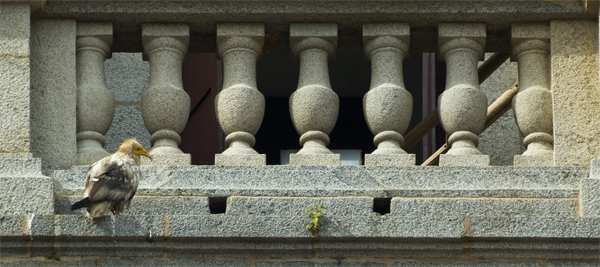
This image to me is iconic IISc. The Faculty building has been the face of IISc for donkeys years, its on every brochure, every handbook, every calender. No one notices the details.

Like the two Scavenger vultures that have been on its ledges for the many years (don't ask a lady her age, and a PhD student how long they've been) that I have been here. I'm told they've been there well over thirty years. They're reputed to mate for life and I think larger birds are relatively long lived (but 30 years? maybe they've turned over...) I wonder if Tsundue had a word with them when he was up there?

Anyway, a few years ago Nature news had a feature to which the title was "Faeces brings colour to birds' faces: endangered vulture eats shit to impress females". Now see thats just a brilliant feature to read with your breakfast chai. Its also the sort of thing that adds to the perception that theres not much 'substance' to biology just these silly 'observations', particularly the more classical branches like mine.

But lets put this whole observation in perspective. These birds eat feces in order to accumulate carotenoids which give their heads that characteristic yellow colour. This colour is a signal they can't fake as far as we know, they must eat shit to be yellow, hence its an 'honest signal'. The birds when they eat the shit are obviously taking a risk with endoparasites, enteric infection and so on. And a female could judge from the colour just how much of a risk a particular male took. She could also asses his present condition and tell whether he got away with the risk. Now then, the male bird is in essence signaling to her saying in a sense 'I can do well despite my handicap, hence I must have good genes!'.

Amotz Zahavi sometime ago came up with a brilliant theory called the handicap principle which he says explains many many examples of exuberant sexual display in organisms, which are hard to explain in terms of plain old natural selection. And this behavioral observation seems to fit quite well with his theory. And off course there is an opposing theory, which is Fisher's runaway selection hypothesis.

Here's the paper for the work I referred to. Here's the theoretical work that proved that the handicap principle can work as model. The history of the theory itself is full of some nice internecine evolutionary biology warfare, but I'll leave that to you to find out.