Wednesday, May 31, 2006

Shooting again

The weekend was good. Like all weekends that are actually spent shooting. Its good to be out again.

But today was a bad day. I'm easily disturbed but well... See someone wanted to use my pictures for nothing gratis and I said no. The person got pissed off and thought I had no loyalty and so on, and believed for various reasons that I should do this, allow the use of the images free.

What I'm wondering is should anyone? I know for one that my images take work and a LOT of dedication. It takes a certain amount of knowledge, a certain amount of research into my subjects. None of these is a one session shot, each session often takes 4-5 maybe even more hours at a strech, in the 'elements'. Often immobile in uncomfortable positions, or moving continously and cautiously for ages or being some weird kind of contortionist. I love it, but its work. Much more relevantly, the images are worth money, they are actually reasonably valuable or at least my agency thinks so. Why should anyone give away anything unless they feel compelled to? Why should anyone expect this kind of compulsion?

This kind of 'grabbing' is even true of a lot of contests. Even participating in these contests not just winning allows the company sweeping rights over the images. It cant be a good thing for photographers, can it? By many estimates the number of images made in the last few years is orders of magnitude greater than that in say the 90s. There's a flood of images out there, on flickr, blogs, online (penny) stock agencies, theres people giving them away for the asking.
This glut of images makes people believe that images are easy to make and well a dime a dozen But good images are not. It makes it harder for people like me, who are on the fringes of being pros to convince people that 'no, not for free'. I'm sure its made the renumeration for pros come down somewhat.
Its even shittier when you're up against people who dont know good images from bad, who wouldnt see quality and craftsmanship if it bit them in the *&%^#$. And then if you're in India and you're a young student, why you're just ripe for exploitation aren't you? Maybe this isn't true, but tell me really if any of you are reading this out there, how much unpaid work have you done lately? Work that doesnt fall within your real responsibilities that you're expected to do anyway, for NOTHING. My guess is if you're a student, a lot....

Think about it a bit, and next time just say 'NO'

Saturday, May 27, 2006

In knots

Yea!! I finally updated my site, with a few hundred new pictures. So folks who'd got bored seeing old stuff could go look for new stuff....except most people who knew the old place dont know this place. so new people go see new site....


i love the internet and my propensity for tying myself up in knots in it.

Thursday, May 25, 2006

Holometabolous insects

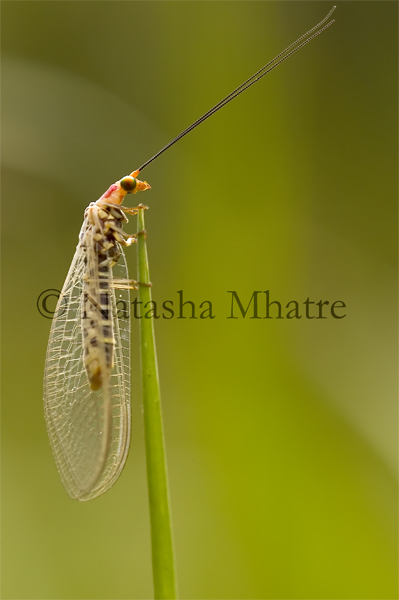
Hmm, I had found me some unhatched lacewing eggs, upon which I kept a very close eye. This ere eye hoped to catch the hatching and to not miss the young ones as I had with the the last series of eggs. (check prev posts). Here's what an adult looks like.

Pretty faerielike huh? Well they're a little like dragonflies but to the good biologist me what sets them apart is the fact that some of them have ears....on their wings!

Well, so for some reason I was expecting little baby lacewings to pop out of these eggs... small versions of big momma/daddy you know? Quite a surprise when I got these hairy creatures instead!

Well, vive holometabolous insects....these lacewing larvae as I had conveniently forgotten are well known for their voracious appetites for many small creatures, mosquitoes, their larvae, aphids, etc. They are often used in biological pest control programmes for this reason, lacewing eggs are actually sold to you so you can 'spread them throughout your fields or gardens' to acheive maximum pest control.

The larvae eventually pupate and voila you have an adult...and no I havent found a lacewing pupa just yet !

Light and line

All photos in this post except the first are not mine and are preceded by links to the original
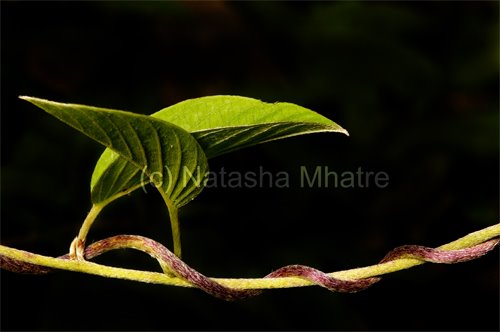
There are rewards when you wake up early in the morning. The vines are lianas (woody creepers) brought here to ces from the western ghats, planted years ago. They mesmerise everyone who sees them the first time. Its like a breath from a rainforest somewhere hit the city of bangalore. The building at the back is my department.


The reason I picked this image is that its about lines, it verges on a graphic version of a line photograph. And yet its not.

Here are a few examples of graphic line images. This one uses the classic quality of repitition.
repitition

heres repitition and symmetry breaking
rupture

Heres another, uses form, depth and curves. (And, off course, some beauiful tonality)
curves

You'll notice that these images have very simple geometries, something that makes many line images intuitive and quick to 'grasp'. You see the image, finding the form, are led around the image exactly as the photographers eye saw it.

Occasionally the repititive line is used to dilineate form, to explore smooth curvy geometries
form

Some photographs explore the line as a twisty concept...
twisted


Few explore, straight and twisty lines in a confused ungeometric pattern. Which is why i like that picture....

Sunday, May 14, 2006

Open wide

I need a go ahead for a project and until that happens I'm slacking a little on shooting. Well that and its hot, and I am killing myself learning how to swim well....Summers lovely.

Quick post about why a good wide is a MUST for a wildlife photographer

Animals live in some kind of environment and sometimes you want to depict that relationship in an image. Often however the problem is that the elements of the that environment, in which the animals is situated are much larger than the animal itself.

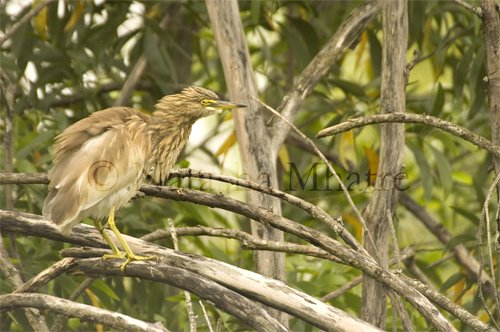
And any image that has both in the same shot if its made with a conventional mid-range to long tele is going the compress the tiny animal against a grand huge background. this your standard too tiny in the frame animal. mind you, that you can choose to show only some part of that environment and let the rest suggest itself as 'more of the same'. Here's an example.

Fairly informative. Pond herons roost on dead trees. But it will by its very nature leave out something. for instance that this particular dead tree is next to a pond. If you try and include the pond in the pict by zooming out. well the heron become smaller....and the pond becomes the picture....

So if you want a landscape feel to your image, want to give a feel of the WHOLE area, and yet want to have your animals at a size thats noticable, try a wide.

Whats a wide allows you to do, is create a perspective that the human eye does not normally have. It makes objects closer to it much larger than those further away.

(link to get you to understand this.)

so now if you can manage to get close to your animal and have all your landscape elements neatly organised behind the animal, voila animal elements all similar sizes managing equal amounts of attention.....

easier said than done, lets see you get a couple of inches from this mongooses nose!

Tuesday, May 02, 2006

Keystone species and co-evolution

When you build an arch, there’s a stone in the middle. If you take this central stone out the whole arch collapses. And it’s called the keystone. Ecologists have borrowed the term to describe a species that is ‘key’ to an ecosystem, if you take it out the whole system collapses.


There’s a lot of ways you could be a keystone species, produce a lot of food for instance, or produce food in a season where everything else doesn’t. Maybe all the energy in the system goes through this species at some point, and if you remove it there are two separate entities with no flow between them...producers one end, eaters the other. This is called a wasp waist system; the keystone species would be the one at the waist.

Fig trees are thought of as a keystone species. And sometime you can see why. They produce a LOT of food and often different trees will bloom and fruit at asynchronously, keeping food available to a system. There are usually a huge number of animals that will come to the smells of ripening fig fruits. Some of them will be young boys and girls on their way from school, off course!

We rarely notice figs when they’re not ripe however, which is kind of funny because a lot of other creatures do and they are attracted to them. Figs have another story going, one of co-evolution. The fig is actually a structure called a syconium and its flowers are enclosed inside it. For these flowers to be pollinated, a pollinator must get inside the fig. Here’s where the fig wasps come into the story. A female wasp finds a receptive fig digs into it, she then pollinates some flowers (in some species seemingly intentionally, in others not), after or along with this she lays her eggs in some of the flowers. And then dies. Several wasps may lay in a single fig. Once the next generation of wasps is born, the females mate with the males, the males dig an exit and the females fly off looking for the next fig.


(Dont have a pic of the pollinator yet, coming soon)

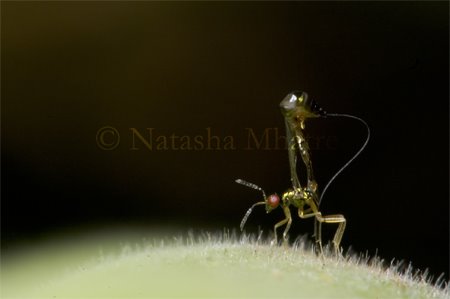
But that isnt it, there are others in the system, other wasps the gallers. These guys are in some ways the cheats of the system. They lay their eggs from the outside inducing galls for their larvae to eat. The larvae of some even eat the larvae of those that came before. Thats a galler laying eggs.

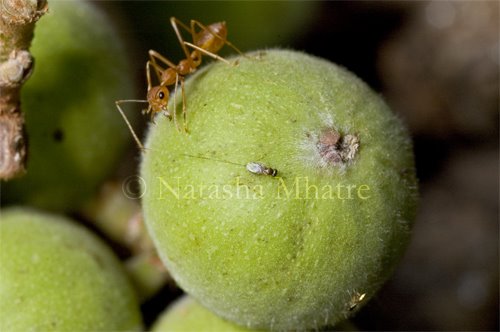
Off course the gallers arent all shiny happy people, because right behind that lovely fig ripe for the laying lurks the big bad.........ANT. Red weaver ants, those big bad evil creatures that will shy from attacking nothing, wait for these wasps (pollinators and gallers) to eat them.

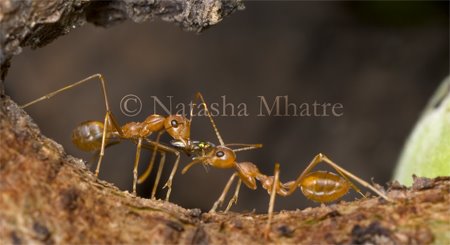
They get them too sometime, these little flitty things. Heres two ants fighting over who gets to keep the wasp.

So thats the fig wasp story, gleaned from the comprehensive presentation of Mahua and Yuvraj at CES, IISc.

Thursday, April 20, 2006

Food

Can you imagine a world where you stumble onto a pile of your favourite food, and its BIGGER than you?

Wednesday, April 19, 2006

Speed

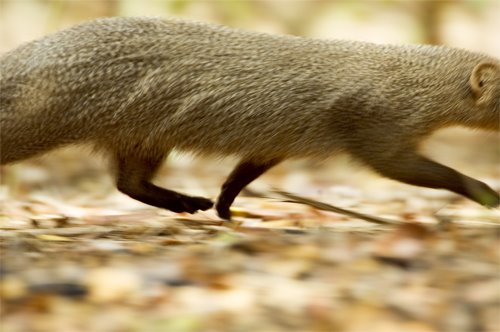
One thing about a lot of wildlife, its come and gone before you know it. A split second of something, is often all you'll ever get. If you're not fast, you wont have pictures. Think about it, I waited a few hours for this 100th of a second.

The other thing is get level. What I like most abt this image apart from the motion is that you can see the space between the ground and the belly. It's an animal that spends its life close to the ground, in the undergrowth. Its a long animal, its a hairy animal and a quick one. The image manages to convey all of that in an abstraction.

A head would distract from this message, it would give the animal an idividual personality, perhaps an expression. And we would be diverted there...maybe not such a bad thing, but it wouldnt be this picture...

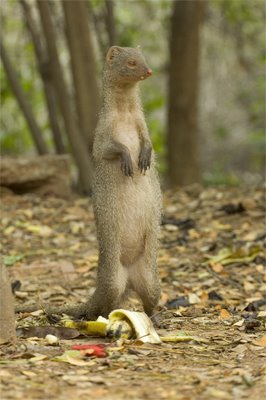
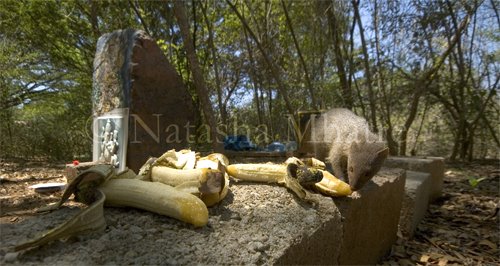
This picture for example, it suggests, tall, or actually long since the animals arent usually standing. but it adds other elements, vigiliance, and for me certainly humor in that bow-legged very awkward looking hind leg stand. theres the other elements for instance, where did this neatly peeled banana come from? and mongooses eat bananas?

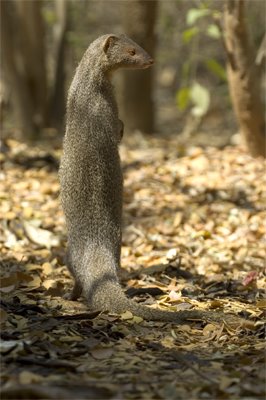
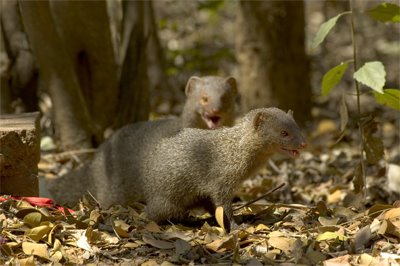
This other image of the mongoose standing taken from the back, on the other hand ,has tall / long and vigiliant. none of the other elements. its not funny, either which could be good or bad....

The subtext to all this is that photography often is about deciding how much to leave in or out. not only in elements but even in subjective experience of a picture.

Some pictures base themselves on a narrative in the elements that are in the picture. the one below for instance, theres a temple, theres offerings, theres a mongoose eating them, theres a larger looking mongoose (most likely mum) hanging around waiting in the background. you can construct a fairly complete and complex narrative around that. And these are apparently all the rage now, the complete story in a frame.

but there are complete, if not complex stories, in shots like the first one. removing elements from an image does not necessarily compact the scope of an image. but it does place greater demands on a viewer. It is therefore harder to pull off successfully.

Usually its got to trigger some instantaneous gut feeling. then give you just a couple of details and leave you with that.

the first picture, hey whats that moving so quickly. hmm legs, fur = animal, probably some long thing, didnt fit in the picture. wheres it going to in such a hurry? maybe its escaping from something. maybe not, thats always how you see critters, scurrying off to their next unknowable task...furtive, hiding under stuff, bellys scraping the ground. no wonder we hardly ever see em. just some blur off the corner of the eye. .....no wonder the weasel (this looks like one) has been associated with sneakiness...and so on

if that tenuous something can be triggered i think a photo works. off course i dont know if it does for you, you could tell me. but thats (sometimes) what i try and guess at when i pick something and discard some pics...

Friday, April 07, 2006

Sometimes its just about being awake

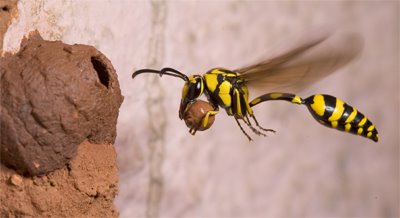
And then off course once you've seen the opportunity, about taking it. I'm sure you've seen these pots in you're home. well i realised there was a just begun one in mine and i figured that well the wasp will come back and finish it. so i waited for it. the first set of pictures were ok...not close enough, light wasnt right. but because i knew what the wasp would do i could set it up so things would be right...

Then i waited over several days, hoping to catch a trip when she was bringing some mud in...and now i'll wait for until she brings over some caterpillars.
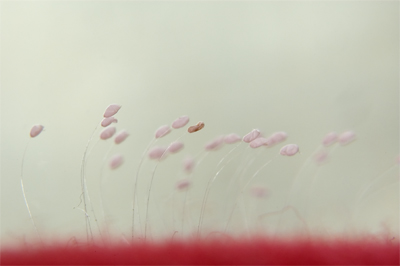
Other times its even easier than that. these are lacewing eggs, they've hatched unfortunately. next time i hope to catch them before that happens. These were on my balcony curtains, the red lights them up nicely, doesnt it?

oh the other story in this one? make sure you've backed up before you delete!!!! i deleted all the RAWs for this session and theres no back up, oh well, they're still there i'll try and redo it .

The addendum to this story is that I was never really able to 'redo' it to my satisfaction. The positions of the eggs had been altered due to many things...and I couldnt replicate what I wanted to. Moral of the story, do not loose your RAW files.

Thursday, February 09, 2006

What's luck got to do with it?

Something, a little bit ...I waited nearly 3 hours for these pictures. I've waited 2 years to wait those 3 hrs!

I walked down a mud path on campus a few days back, looking for owls. I didnt find any. The lucky bit was that a family of three mongooses were there instead. They probably visit this bounty of bananas left behind by a devotee next to a small roadside shrine once in a day. I happened to walk by at the time that they made their daily visit and saw them before they disappeared into the brush. That was lucky....I know now they are there maybe, 20-30 mins cumulative in a day.

I didnt get any shots on that first day. I've gone back to that place 4-5 times now. This thursday, I had a day off and spent nearly three hours waiting for them to turn up. And they did.

Originally posted: Feb 09 2006

Tuesday, January 17, 2006

STreeeeeeeeeeTCH

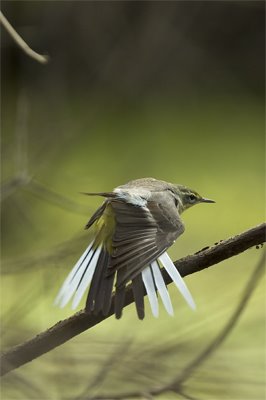
A gray wagtail down at the water level in the pond in Jubliee. It was a long wait before this fella got accustomed to me. The white breasted water hen at the other end didnt want any truck with me, ever. And although she got chased around for invading another wb waterhens turf several times she didnt come any closer to me.

Its an amazing place down there, last week i spent the good part of a day there...theres about 6 different odonates. and they seem to a certain extent to seperate their display times out through the day. the surface of the pond is covered with flies that walk on the duck weed and scum. the lovely green in the picture is actually the duckweed on the surface of the pond. Theres a checkie who hunts among it. and a whole host of birds that feed all day and then spend the night in the brush by the edges.

interestingly there arent as many mosquitoes as you would imagine. perhaps because the dragonflies eat them....

Originally posted: Jan 17 2006

Friday, December 30, 2005

Wall climber


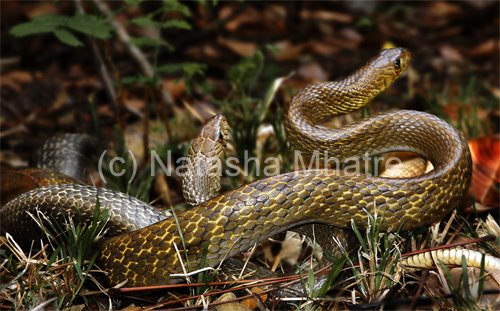
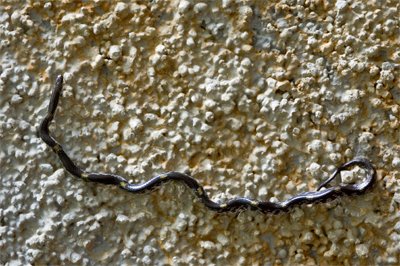
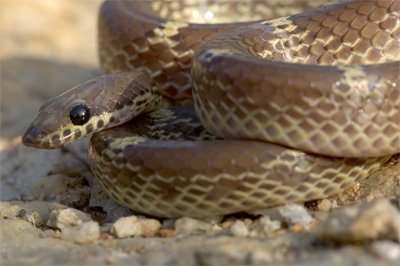
Meet my christmas present! Wolf snake (Lycodon aulicus). Often mistaken for the venomous common krait, these are non-poisonous. And great wall climbers. We caught him/her from PD block and took some photographs and let him go....heres another one.

Friday, November 25, 2005

Change and stasis

Few of my images betray that I shoot in a place that where humans are close by. Few pictures betray that almost all environments in my pictures are modified, however subtly, by human hands. Which is a significant omission, IISc is an urban campus. There are many people here, many buildings and much activity.

Many habitats are closely watched and controlled, grasses cut to prevent fire, paths cleared, bush cleared to protect power lines, telephone lines, buildings, etc from damage. Occasionally unnecessary things get done too, because someone making a decision thinks its an improvement. Exotics are planted, human garbage encourages some species, discourages others...and so on. People sometimes mean well, other times not. The bottom line is they alter...they change. And the animals I shoot respond to these changes.

* a little digression* i owe a guy called Sohrab Hura a bit of a debt here...many of these issues he started me thinking on.

How do you apply something thats essentially a static medium, ie photography, to document this change? (Open to ideas here)

What is the nature of change? Theres the cyclical changes of the day, the seasonal year, the cycles of rain that come and go. When do you know that a change is because of x and not because of y. Off course thats what huge areas in ecology deal in, theres tons of statistical tools like mds, pca, etc help you test these things. So in some ways thats a stupid question. And communities in relatively undisturbed forests are very dynamic and change all the time....

Its tempting to conclude that much of what I see is just that change that is part of the natural process. Yet I'm not always so sure. It's the pace in some instances that is alarming. In others that you see habitat shrink, sometimes disappear. I see the numbers of dogs go up, I see ground nesters disappear...you seem to see cause and effect in operation...its tempting and very hard to ignore. and yet theres a little guy back there that keeps screaming 'alarmist'!!!

well anyway thats a digression...human intervention is possible to depict, the hand of man has many classical and accepted visual idioms. barbed wire in one case; garbage as in the UNEP winners pictures, road kill, etc.... change however is harder to come by...

I suppose the classic ghost in the frame effect... sometimes done with multiple exposures...other times with very low light and loooong exposure. Nichols again does a lot of this...but then he revels in low light conditions. yet that sort of change is within the now, within the frame... how do you encapsulate hours, days weeks, months, years in images?

Monet did his famous haystacks in the different seasons to show the passage of time. Ansel adams drew on that tradition when he made his famous tide images. A series, usually a triptych...*the trinity is such a christian thing, well actually, no, even we have our three guys, yeah? brahma, vishnu & maheshwara?* the success of adams approach is in that he maintains the same angle and of view and the eye immediately starts picking over the scene to spot the differences. its like frames in a video shot.

Monet of course, uses many views and angles, i find myself reconstructing the place around the haystack, theres a sense of physical space that grows out of it. good impressionist that he is he also creates an atmosphere of winter/summer...the mist and fog of winter and the harsh hazy light of summer...theres also the sense of change from the fact that many are painted at sunsrise/sunset. then theres the idea of painting haystacks, essentially things that will get used eventually, will diminish eventually as landscape. painting the mutable in the style conventionally used for something immutable, mountains, rocks...stone.

There are, of course, those that believe that transience is the one thread, one commonality that hold all photography together. The decisive moment is this isnt it...this moment caught in midflight...hold still matrix style look around, it will never happen again, never like this...(i havent read the book i confess, this entirely second hand, i dont know if this is what bresson meant at all).

Thursday, November 03, 2005

Whats is better? Everythings dying.

You know theres this nice little argument going on about wildlife pics at photo.net (nice place if you havent ever visited it...) . Anyway the one line question is a technically flawed image of an interesting/uncommon behaviour "BETTER" than one that is technically perfect but not as interesting/uncommon?

the better off course is laden, better for who? most of the argument there was about better commercially...well even in the world of commerce, there's types and types arent there?

anyway, i wont take this thought any further and you can get in on the fray in pnet if you want to. this is a depends question and even then its a judgement call...

I was thinking about something else, there's this new site called wildindia....and a story and picture on it of a tusker who got shot shortly after being photographed. then i read an article in the newsletter for birdwatchers by shyamal. it talks about avifaunal changes in IISc...that was 1998 i think. I havent seen a lot of the birds he says were there even then ... (i confess now to not being a very good or even assiduous birder. and to the fact that i've seen as vagrants one or two he doesnt talk about...).

I think the point still remains, that all of us morons pointing our lenses at these crits are watching them vanish before the shutter trips. that whether we want it or not we are documenting the disappearing...

at any rate my way of looking at things have changed a lot, suddenly the crits i shoot are very firmly embedded in a human and ephemeral landscape.

Thursday, October 27, 2005

Hi grab a coffee....

This blog was elsewhere to begin with, but I think I'd like to move it to blogger.com. It just seems like a nicer place to be. I'm going to try to repost everything i'd posted earlier...

>>>>>>>>>>>>>>>>>>>>>>>>>>>>>>>>>>>>>>>>>>>>>>>>>

Ok then, here we go.

I'm not sure I like the idea of a blog and this page may disappear by the end of the day...the week, whenever. I'm going to try and keep it crib free, but given I'm a garduate student that's a bit quixotic?

Also I'm going to try and keep it centred on photography... lets see how that goes. A cursory look at my site indicates that I'm a wildlife photographer...whatever that quantity is, I shoot critters, and vegetation. I find people interesting, but harder.

But now I'm beginning to find the whole business of shooting wildlife complicated too. Theres so many categories...

Wildlife to most means wilderbeest in africa, wilddogs at a hunt somewhere...you know 'large charismatic animals' or birds...or if you're nick nichols, habitats and crits that are rare and threatened, on the edge. the journalistic /conservation angle thats a newer angle to the business. Or the folks who look at little creatures, Moffet, etc the macro guys...then theres dalton who does the extreme action stuff even if its on little things like butterflies....

the point being that everyones got what is usually a fixed style, and even when they try something its more like an excursion, less a change of direction...and well i begin to find that boring...i think i've narrowed my obsessions sufficiently when i've said wildlife photography. its harder to go further down that path...

the other things that somewhere along the line I'm still a biologist/ecologist. I dont see alive things in any way other than fitting together in some way. and yet a lot of people i've mentioned have pushed the envelope based on the very narrowness of their obsession...

sometimes this whole business makes it hard to edit, to ask if a picture i've taken is any good. good for whom? for me? and then why? where does it fit? whats it worth in the larger body of work it's part of? there a few hundred photographers in bangalore alone...some (a good number) make technically sound pictures, some, interesting pictures...why should i be adding to this corpus at all?